Why Do a Triangle's Angles Always Add to 180°?
Root Concept
Draw a line through one corner parallel to the opposite side, and the triangle's three angles reappear along that straight line — so their total is the angle of a straight line, 180 degrees.
CodePLU Goal
Upgrading Human Mental Models
Learn how to think in Workflows

Concept Development By codeplu.com
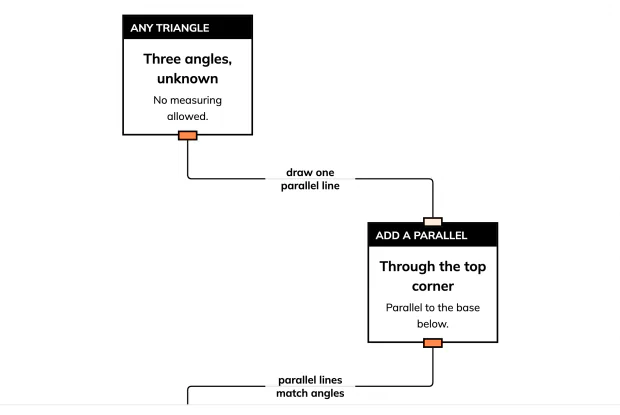
The classic proof in five steps, each connection carrying its justification
How Would You Know It Is True for Every Triangle?
Most people meet this fact through measurement. Draw a triangle, measure the three angles with a protractor, add them, get something close to 180, and repeat with a differently shaped triangle. It is a reasonable classroom activity and it proves nothing, for two reasons. Measurements are approximate, so "close to 180" is compatible with the real answer being 179.4. And there are infinitely many triangles, so no amount of checking covers them all.
A proof is a different kind of object. It shows that the result could not have come out any other way, for any triangle, without measuring a single angle. The one for this fact is genuinely beautiful and it needs only one idea: draw an extra line. Through the top corner of your triangle, draw a line parallel to the base. Suddenly the two base angles have twins up at the top, because parallel lines cut by a crossing line produce equal angles in known places.
Once those twins are in place, the three angles of the triangle are sitting side by side along one straight line — the original top angle in the middle, with a copy of each base angle on either side. And the angle of a straight line is 180 degrees, by definition of a half turn. So the three must total 180. Not usually, not to within measurement error, but necessarily. That is what a proof buys you, and it is the reason this pattern of tutorial is called a derivation.
The Proof, Step by Step
Why is drawing an extra line allowed?
Because it does not change the triangle. This is the move beginners find suspicious, so it is worth being clear: you are not modifying the shape, you are adding a construction line to reveal relationships that were already there. Geometry does this constantly — you are permitted to draw any line the axioms allow, and the parallel line through a point is one of them. If the extra line altered the triangle the proof would be worthless; because it does not, everything you discover about the new figure is also true of the original.
What rule makes the angles reappear at the top?
The alternate angles rule. When a line crosses two parallel lines, the angles on opposite sides of the crossing line, one at each parallel, are equal. In the figure, each slanted side of the triangle is a line crossing both the base and the new parallel line, so each base angle has an equal partner up at the top corner, on the far side. This rule is the load-bearing step of the whole proof, and it is itself a consequence of what parallel means — lines that never converge, so the angle they make with a crossing line cannot drift.
Why do the three angles end up in a row?
Because the top corner is where all three now meet. The triangle's own top angle is already there. To its left sits the copy of one base angle, and to its right the copy of the other, both created by the alternate angles rule. Together the three fill the space along the new line on one side of it — they cover it exactly, with no gap and no overlap, because there is nothing else between them. That completeness is the part to check carefully when you build it, because a proof with a gap in the middle is not a proof.
Why is a straight line 180 degrees?
Because that is what the degree system defines: a full turn is 360 degrees, so a half turn is 180, and a straight line is precisely a half turn. This step feels like a technicality and is actually the foundation — the number 180 enters the proof here and nowhere else. It is also why the result is 180 rather than some more mysterious constant: it is inherited from the arbitrary decision to divide a full turn into 360 parts. In other angle systems the same proof gives the same fact with a different number attached.
Is it true on every surface?
No, and this is the most interesting caveat in elementary geometry. The proof leans entirely on the parallel line behaving as expected, and on a curved surface that fails. Draw a triangle on a sphere — say between the north pole and two points on the equator — and its angles add to more than 180. Draw one on a saddle-shaped surface and they add to less. So the fact is not a universal truth about triangles; it is a truth about flat space, and the amount by which the total departs from 180 turns out to be a measure of how curved the surface is.
Real World Example
A Triangle Whose Angles Add to 270
Take a globe. Start at the north pole, travel straight down to the equator, turn, travel along the equator a quarter of the way round, turn, and travel back up to the pole. Three straight paths, three corners — a triangle:
The two corners at the equator
90° each
Any line of longitude meets the equator at a right angle. Both of your turns there are 90 degrees, which already uses up the entire 180 allowance before the third corner is counted.
The corner at the pole
Another 90°
You travelled a quarter of the way round the equator, so the two lines of longitude leave the pole a quarter turn apart. That is a third right angle.
The total
270°
Ninety degrees more than a flat triangle. Nothing has gone wrong with the arithmetic — the proof simply does not apply, because on a sphere you cannot draw the parallel line it depends on.
What this tells you
The 180 rule describes flat space
The excess over 180 is a measurement of curvature, which is how surveyors detect the Earth's shape from large triangles and how curvature is defined in general relativity. The exception is more informative than the rule.
FAQs
Final Words
Five steps, one extra line, and a fact that stops being something to trust. Take any triangle, draw a line through the top corner parallel to the base, and the alternate angles rule copies both base angles up to that corner. All three angles now lie along a straight line, and a straight line is a half turn — 180 degrees. No measurement, no exceptions, no need to check another triangle.
Also worth carrying away: the proof shows you exactly what it depends on. Everything rests on the parallel line, which is why the rule holds on a flat page and fails on a globe, where a triangle can have three right angles. Knowing what a proof leans on tells you where it stops applying — which is often more useful than the result itself.
Continue This Track
This concept is part 3 of Shapes and Their Families.
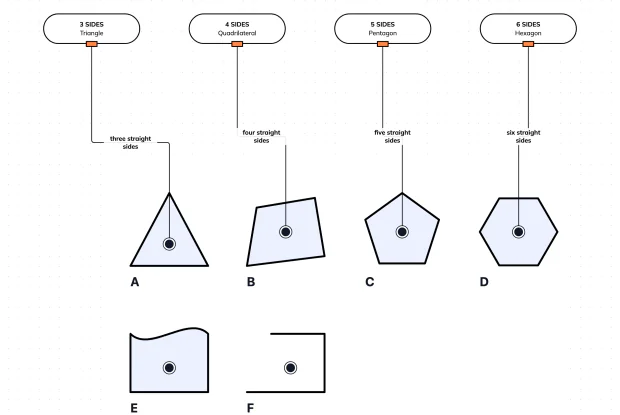
What Makes a Shape a Polygon?
A polygon has to pass two tests: every side straight, and the outline joined up. Pass both and the shape earns a name, and the name is nothing more than how many sides it has. Sort real shapes from near-misses in an interactive playground.
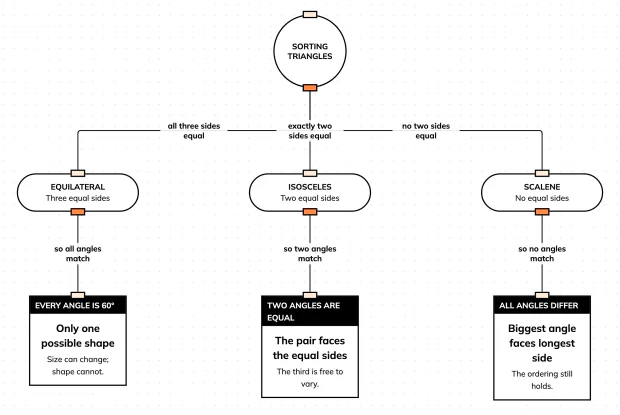
What Kinds of Triangle Are There?
Triangle types are usually memorised as a list of names. They are better understood as one decision — how many sides are equal — from which the angles follow with no extra information. Match each type to what its angles must do in an interactive playground.
Why Do a Triangle's Angles Always Add to 180°?
Everyone is told that a triangle's angles total 180 degrees. Almost nobody is shown why, so it gets filed as a fact to trust. Follow the five-step proof from one parallel line to the conclusion and assemble the argument yourself in an interactive playground.
What Are the Types of Quadrilaterals?
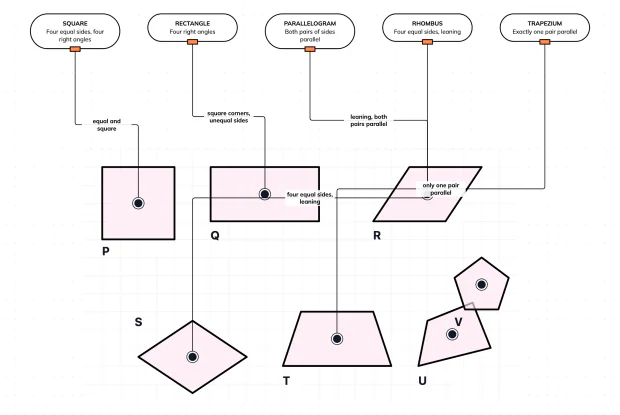
Square, rectangle, rhombus, parallelogram and trapezium are not five separate boxes to sort shapes into — they are conditions, and a shape can satisfy several at once. That is why every square is also a rectangle. Match each name to the shape that earns it on a grid.
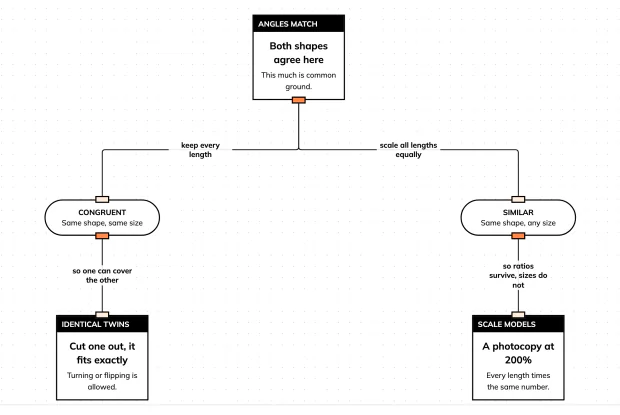
When Are Two Shapes Really the Same?
"The same" is ambiguous in geometry, and the ambiguity causes real errors. Learn the two precise versions — congruent and similar — and where they part, then build both branches in an interactive playground.