What Makes a Shape a Polygon?
Root Concept
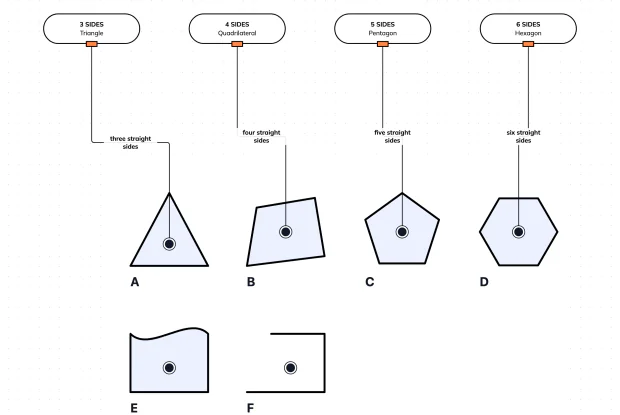
A polygon is a flat shape made only of straight sides that join up into a closed outline, and its name comes from the number of those sides — three is a triangle, four a quadrilateral, five a pentagon, six a hexagon.
CodePLU Goal
Upgrading Human Mental Models
Learn how to think in Workflows

Concept Development By codeplu.com
Why Do Some Shapes Get a Name and Others Do Not?
Geometry hands out names generously to some shapes and not at all to others, and the rule behind it is simpler than it looks. To be a polygon — and so to get a name — a flat shape has to pass exactly two tests, and failing either one is enough to disqualify it.
The first test is that every side must be straight. A shape with even one curved edge is out, however neat it is. The second is that the outline must join back up: you should be able to start at any corner, travel all the way round the edge, and arrive back where you began without lifting your finger or hitting a dead end.
Pass both and the shape is a polygon, and then naming it is pure counting. Three sides is a triangle, four is a quadrilateral, five a pentagon, six a hexagon. That is the entire system, and it keeps going — the names for ten or twelve sides exist too, and are used about as often as you would expect.
Straight, Closed, and Then Counted
Why must every side be straight?
Because a polygon is built out of line segments, and a segment is straight by definition. This is the condition that rules out circles, ovals and the sort of rounded blob a young child draws for a cloud — all perfectly good shapes, none of them polygons. It also rules out shapes that are almost polygons, like a rectangle with one corner rounded off, which is the case worth watching for because it passes at a glance. The reason the rule is drawn so strictly is that almost everything useful about polygons depends on it. You can count sides only if there are distinct sides to count. Angles only exist at corners, and corners only exist where two straight sides meet. A curve has no corners anywhere along it, so a shape with a curved edge cannot have its angles counted, cannot be classified by them, and cannot join the family.
What does closed mean, and why does it matter?
Closed means the outline joins back up into a complete loop with no gaps and no loose ends. Put your finger at any corner and travel along the edge, and you should return to your starting point having covered every side exactly once. An outline with a gap in it, however small, fails — and the shape in the practice below with a short gap is there precisely because a nearly closed shape is what people wave through without checking. The reason this matters is that closed is what creates an inside. A complete loop divides the flat page into two regions, the part within and the part without, and every question you might ask about a shape's area, or whether a point is inside it, depends on that division existing. Leave a gap and there is no inside any more — the two regions leak into each other through it.
How does a polygon get its name?
By counting its sides, and that is genuinely all there is to it. Three gives triangle, four gives quadrilateral, five pentagon, six hexagon, seven heptagon, eight octagon. The names come from Greek number words with the ending -gon, which itself means angle — so hexagon literally reads as six-angled. That is a fair description, because a polygon always has exactly as many corners as it has sides. It cannot do otherwise: every side ends at a corner, every corner is where two sides meet, so the two counts are locked together. This is why you may see a shape described by its corners in one book and its sides in another with no contradiction between them. Two of the names sit slightly outside the Greek pattern, as it happens — quadrilateral comes from Latin rather than Greek, and triangle from Latin too, because both were in common use long before the system was tidied up.
What makes a polygon regular?
A regular polygon has all its sides the same length and all its angles the same size, and both conditions are needed. This is where a lot of loose talk creeps in, because people say hexagon and picture the neat honeycomb shape with six matching sides — but that is a regular hexagon, and plenty of six-sided shapes are lopsided, long on one side and short on another, and are hexagons just as much. The same applies right down the family: a square is a regular quadrilateral, and an equilateral triangle is a regular triangle. So regular is a further claim laid on top of the side count, not part of it. It is worth being fussy about because regular polygons have properties that irregular ones simply do not, including the ability to tile a surface without gaps, which is why floor tiles and honeycomb cells are the shapes they are.
Real World Example
Three Shapes Chosen for Their Sides
Polygons get picked for practical reasons, and the count is usually the reason:
A stop sign
8 sides — octagon
Road signs use shape as information, so a driver can recognise one before the writing is readable or in conditions where it is not readable at all. The octagon is reserved for stop in most of the world for exactly that reason, and it works because eight sides is unmistakable at a distance and shared with nothing else on the road. It is also a regular polygon, with all eight sides and angles matching, which keeps it recognisable whichever way round it is mounted — a shape that looked different when rotated would be a poor choice for something bolted to a pole.
A honeycomb cell
6 sides — regular hexagon
Bees build in regular hexagons, and the reason is efficiency rather than aesthetics. Hexagons tile a flat surface with no gaps at all, so no space is wasted between cells, and of the shapes that tile perfectly the hexagon needs the least wax for the area it encloses. Only three regular polygons can tile a plane without gaps — the triangle, the square and the hexagon — and the bees have converged on the most economical of the three. It is a good demonstration that regular is a genuinely different claim from six-sided, since an irregular hexagon would leave gaps.
A football's panels
pentagons and hexagons
The traditional football is made of twelve regular pentagons and twenty regular hexagons stitched together, and the mixture is not a design choice. Hexagons alone tile flat, which is precisely the problem — a ball needs to curve, and introducing pentagons forces the surface to bend. Every pentagon is a deliberate pucker. It is the clearest everyday case of side count doing structural work: swap the pentagons for hexagons and you get a flat sheet, swap them the other way and the shape closes up too tightly.
FAQs
Final Words
Two tests decide it. Every side straight, and the outline closed with no gaps — and closed is the one that matters most, because a complete loop is what creates an inside for the shape to have.
Pass both and the naming is pure counting: three is a triangle, four a quadrilateral, five a pentagon, six a hexagon. A polygon always has as many corners as sides, so it makes no difference which you count.
Regular is a separate claim laid on top — all sides equal and all angles equal. A lopsided hexagon is still a hexagon, and the difference is why honeycomb cells tile perfectly while a lopsided one would leave gaps.
Continue This Track
This concept is part 1 of Shapes and Their Families.
What Makes a Shape a Polygon?
A polygon has to pass two tests: every side straight, and the outline joined up. Pass both and the shape earns a name, and the name is nothing more than how many sides it has. Sort real shapes from near-misses in an interactive playground.
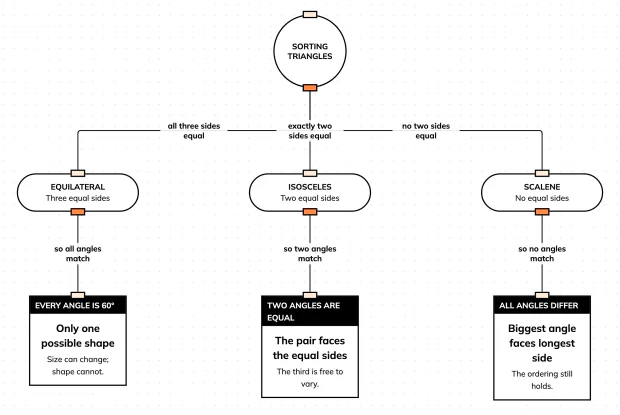
What Kinds of Triangle Are There?
Triangle types are usually memorised as a list of names. They are better understood as one decision — how many sides are equal — from which the angles follow with no extra information. Match each type to what its angles must do in an interactive playground.
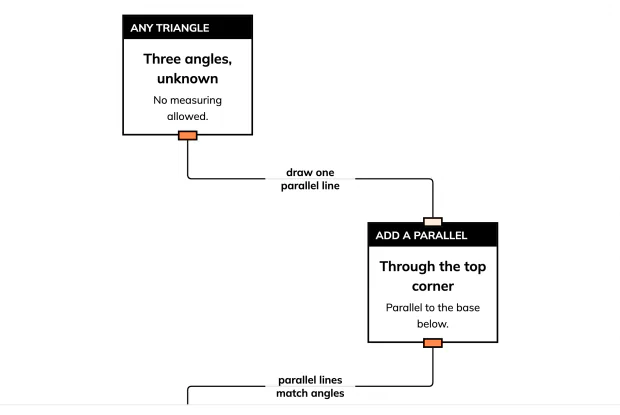
Why Do a Triangle's Angles Always Add to 180°?
Everyone is told that a triangle's angles total 180 degrees. Almost nobody is shown why, so it gets filed as a fact to trust. Follow the five-step proof from one parallel line to the conclusion and assemble the argument yourself in an interactive playground.
What Are the Types of Quadrilaterals?
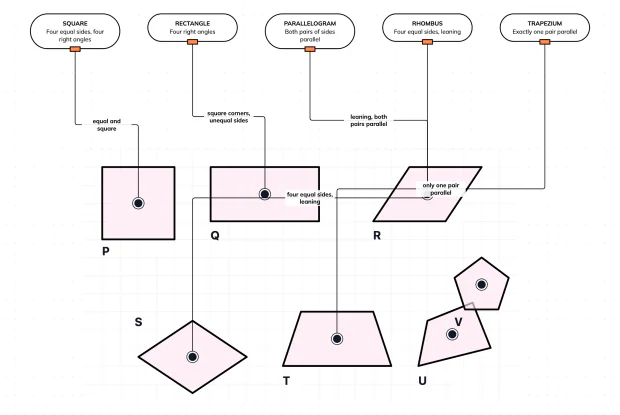
Square, rectangle, rhombus, parallelogram and trapezium are not five separate boxes to sort shapes into — they are conditions, and a shape can satisfy several at once. That is why every square is also a rectangle. Match each name to the shape that earns it on a grid.
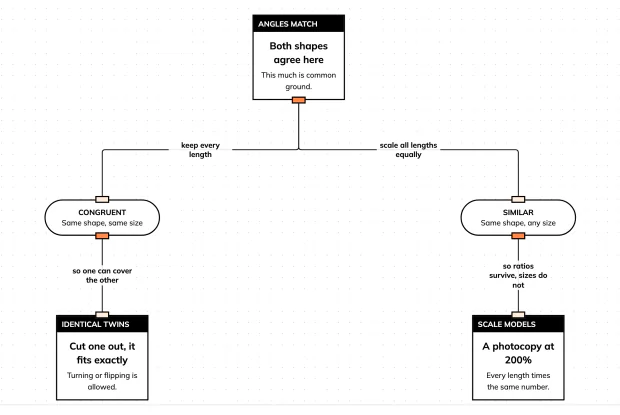
When Are Two Shapes Really the Same?
"The same" is ambiguous in geometry, and the ambiguity causes real errors. Learn the two precise versions — congruent and similar — and where they part, then build both branches in an interactive playground.