When Are Two Shapes Really the Same?
Root Concept
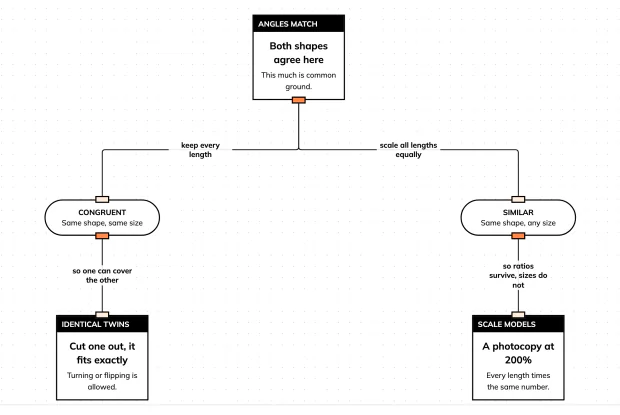
Both congruent and similar shapes have identical angles; they part on length — congruent keeps every length, similar multiplies them all by the same factor.
CodePLU Goal
Upgrading Human Mental Models
Learn how to think in Workflows

Concept Development By codeplu.com
Congruent and similar as two branches from identical angles, forking on what happens to lengths
What Does "The Same Shape" Actually Claim?
Point at a small photograph and its enlargement and ask whether they are the same. Most people say yes. Point at two identical coins and ask the same question, and they also say yes. Both answers are reasonable in ordinary speech and they mean different things, which is exactly the kind of ambiguity that causes mistakes once you start calculating. Geometry therefore splits "the same" into two words with precise meanings.
Congruent means same shape and same size. Cut one out and lay it on the other and it covers it exactly — you may turn it round or flip it over, but you may not resize it. Two coins of the same denomination are congruent. Similar means same shape, any size: all the angles match and every length has been multiplied by the same number. A photograph and its enlargement are similar, as are a scale model and the building it represents.
The shared ground is angles, and that is the part worth noticing. Both relations require the angles to be identical, which is what makes both feel like sameness. They part on lengths, and only on lengths. Congruent keeps them; similar multiplies them all by one common factor. Get that fork right and a large amount of geometry — maps, models, shadows, trigonometry — turns out to be the same idea applied over and over.
Where the Two Meanings Part
Why is matching angles not enough to be congruent?
Because angles say nothing about size. Take any triangle and enlarge it: every angle is unchanged, since an angle measures how much two lines diverge and that does not depend on how far you follow them. So two shapes can have perfectly matching angles while one is a hundred times the other. This is why "same angles" is the definition of similar rather than of congruent, and it is the single most common error — treating matching angles as proof that two shapes are identical.
What exactly is allowed when checking congruence?
Moving, turning and flipping. If one shape can be picked up, rotated, possibly mirrored, and laid onto the other so they coincide, they are congruent. What is not allowed is stretching, shrinking, or squashing one direction more than another. The mirror case catches people out: a left hand and a right hand are congruent in this sense, because a flip is permitted, even though you cannot superimpose one on the other without lifting it out of the plane. Different textbooks emphasise this differently, so it is worth checking whether a given problem counts reflections.
Why must the scale factor be the same in every direction?
Because otherwise the shape changes. Multiply width by two and height by three and the angles shift — a square becomes a non-square rectangle, and a circle becomes an oval. That is a distortion, not a similarity. This is exactly the failure mode of dragging a photograph by its corner versus its edge on a computer: dragging the corner usually preserves the ratio and produces a similar image, while dragging an edge stretches one direction and produces something that looks wrong for reasons most people cannot immediately name.
What do similar shapes let you calculate?
Unknown lengths, from ratios. If two triangles are similar, corresponding sides are in a constant ratio, so knowing three lengths gives you the fourth. This is the machinery behind measuring a tree by its shadow: your height and your shadow form a triangle similar to the one formed by the tree and its shadow, because the sun's rays arrive at the same angle for both. It also underlies map scales, architectural models, and most of trigonometry, which is fundamentally a study of ratios in similar right-angled triangles.
What happens to area when lengths are scaled?
It grows by the square of the factor, and this catches almost everybody. Double every length and the area quadruples, because area depends on two dimensions at once. Triple the lengths and area rises ninefold. Volume behaves worse still, rising by the cube — eight times for a doubling. That is why a scale model is misleading about weight, why a large animal cannot have the proportions of a small one, and why doubling the size of a pizza more than doubles how much pizza you get. Similar shapes preserve ratios of length, not of area.
Real World Example
Measuring a Tree Without Climbing It
Stand next to a tree in sunshine and measure three things you can reach. You are about to get the fourth for free:
What you measure
Your height, your shadow, the tree's shadow
Say you are 1.7 m tall and cast a 2.0 m shadow, while the tree casts a 12 m shadow. The tree's height is the only unknown, and you never leave the ground.
Why the triangles are similar
The sun's rays arrive at the same angle
You and your shadow form a right-angled triangle; so do the tree and its shadow. Both have a right angle at the ground and the same sun angle, so all three angles match — which makes them similar.
The ratio does the work
1.7 / 2.0 = height / 12
Corresponding sides of similar triangles are in a constant ratio. Solving gives about 10.2 m. This is one of the oldest surveying techniques there is, and it needs only the similar-shapes idea.
Where the method fails
If the ground is not level
A sloping surface changes one shadow's length without changing the other's in proportion, so the triangles are no longer similar and the ratio no longer holds. Knowing what a method assumes tells you when to distrust it.
FAQs
Final Words
Geometry replaces one vague word with two precise ones, and they fork at a single point. Both congruent and similar require matching angles. Congruent then keeps every length, so one shape can be laid exactly over the other. Similar multiplies every length by one common factor, so proportions survive while size does not.
The similar branch is the one that does the most work in the world: map scales, architectural models, the shadow trick, and the whole of trigonometry are that one idea reused. And the trap worth remembering is area — doubling lengths quadruples area and multiplies volume eightfold, so "twice the size" almost never means twice as much of anything you care about.
Continue This Track
This concept is part 5 of Shapes and Their Families.
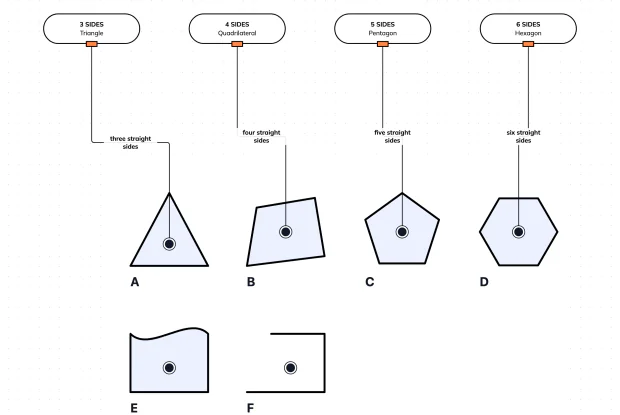
What Makes a Shape a Polygon?
A polygon has to pass two tests: every side straight, and the outline joined up. Pass both and the shape earns a name, and the name is nothing more than how many sides it has. Sort real shapes from near-misses in an interactive playground.
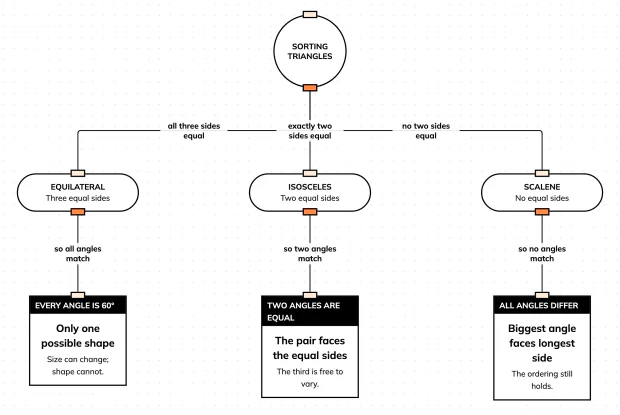
What Kinds of Triangle Are There?
Triangle types are usually memorised as a list of names. They are better understood as one decision — how many sides are equal — from which the angles follow with no extra information. Match each type to what its angles must do in an interactive playground.
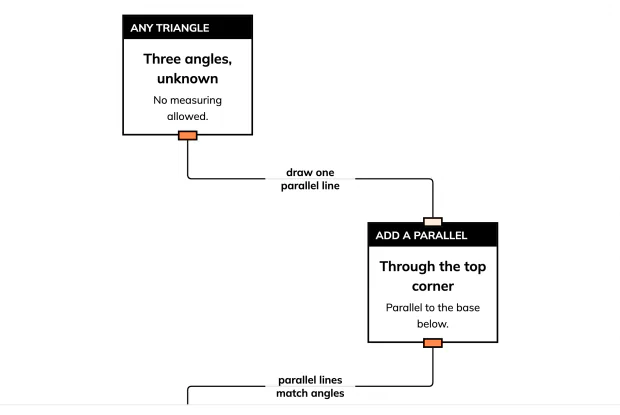
Why Do a Triangle's Angles Always Add to 180°?
Everyone is told that a triangle's angles total 180 degrees. Almost nobody is shown why, so it gets filed as a fact to trust. Follow the five-step proof from one parallel line to the conclusion and assemble the argument yourself in an interactive playground.
What Are the Types of Quadrilaterals?
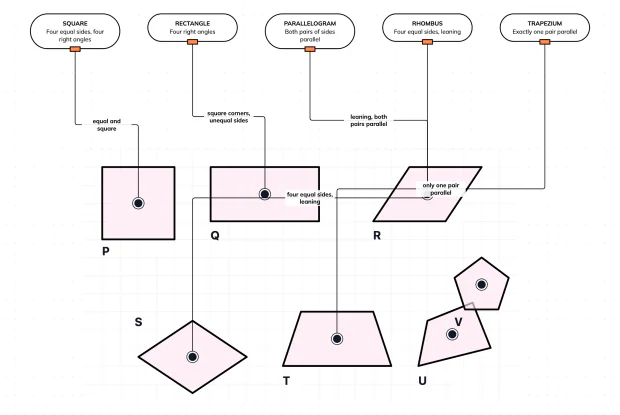
Square, rectangle, rhombus, parallelogram and trapezium are not five separate boxes to sort shapes into — they are conditions, and a shape can satisfy several at once. That is why every square is also a rectangle. Match each name to the shape that earns it on a grid.
When Are Two Shapes Really the Same?
"The same" is ambiguous in geometry, and the ambiguity causes real errors. Learn the two precise versions — congruent and similar — and where they part, then build both branches in an interactive playground.