Shapes and Their Families
A shape is not a picture you recognise; it is a set of conditions it either meets or does not. This track sorts shapes the way geometry actually does it — by asking what must be true. A polygon has to close, and every side has to be straight, which is what rules out the circle and the horseshoe. Triangles are then sorted on a single question, how many sides are equal, and the angles follow with nothing measured, because equal sides force equal angles. The proof behind that comes next: draw one extra line and a triangle's three angles lie along it, which is why they total 180 degrees, and why the rule breaks on a globe. Quadrilaterals get the same treatment. The track closes by taking the word "same" apart, because same shape and same size are two different claims.
CodePLU Goal
Upgrading Human Mental Models
Learn how to think in Workflows
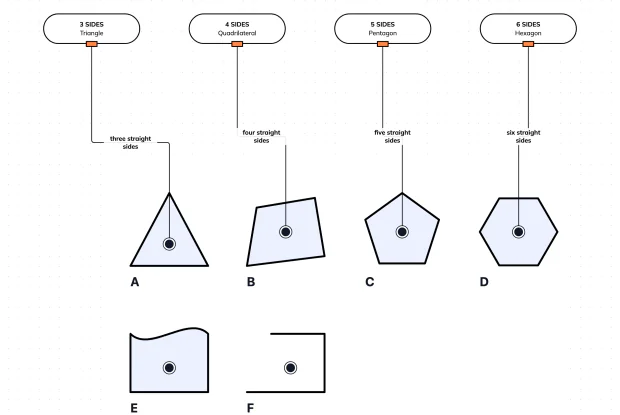
What Makes a Shape a Polygon?
A polygon has to pass two tests: every side straight, and the outline joined up. Pass both and the shape earns a name, and the name is nothing more than how many sides it has. Sort real shapes from near-misses in an interactive playground.
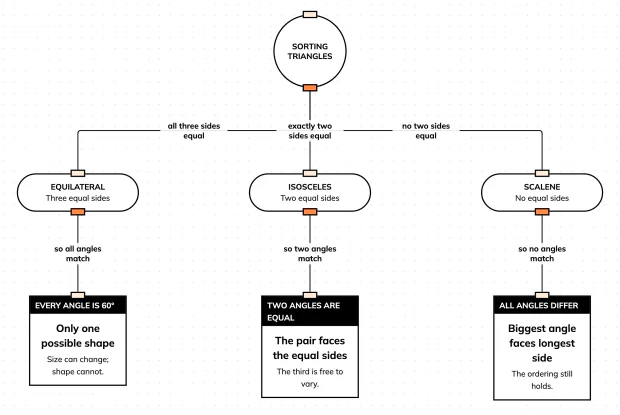
What Kinds of Triangle Are There?
Triangle types are usually memorised as a list of names. They are better understood as one decision — how many sides are equal — from which the angles follow with no extra information. Match each type to what its angles must do in an interactive playground.
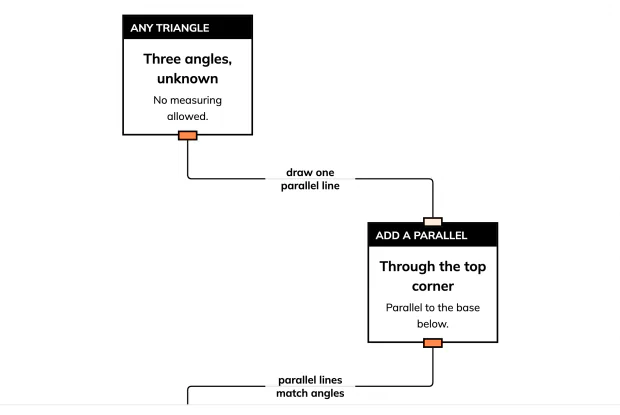
Why Do a Triangle's Angles Always Add to 180°?
Everyone is told that a triangle's angles total 180 degrees. Almost nobody is shown why, so it gets filed as a fact to trust. Follow the five-step proof from one parallel line to the conclusion and assemble the argument yourself in an interactive playground.
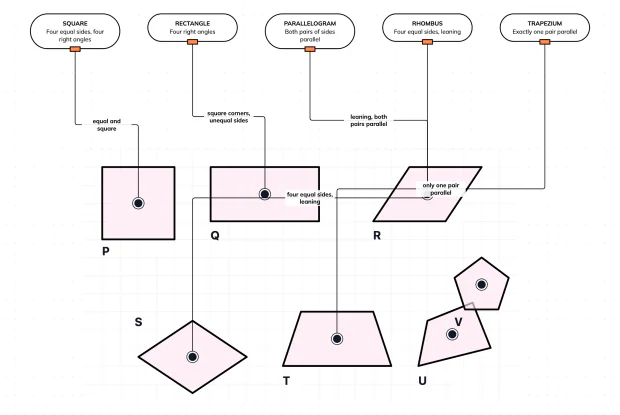
What Are the Types of Quadrilaterals?
Square, rectangle, rhombus, parallelogram and trapezium are not five separate boxes to sort shapes into — they are conditions, and a shape can satisfy several at once. That is why every square is also a rectangle. Match each name to the shape that earns it on a grid.
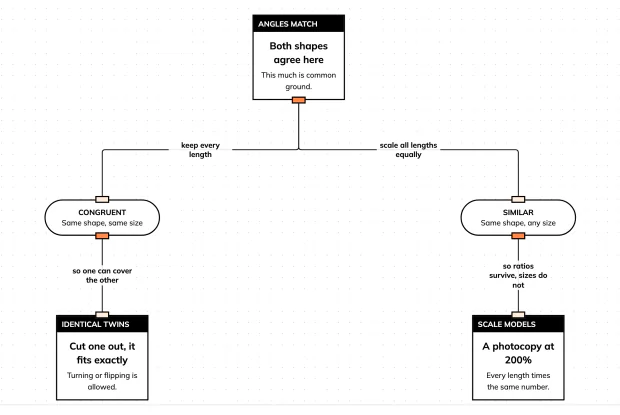
When Are Two Shapes Really the Same?
"The same" is ambiguous in geometry, and the ambiguity causes real errors. Learn the two precise versions — congruent and similar — and where they part, then build both branches in an interactive playground.