What Are the Types of Quadrilaterals?
Root Concept
A quadrilateral is any four-sided polygon, and the familiar names are conditions on its sides and angles that can overlap — so a square satisfies the rectangle condition and the rhombus condition at the same time.
CodePLU Goal
Upgrading Human Mental Models
Learn how to think in Workflows

Concept Development By codeplu.com
Why Can One Shape Have Several Correct Names?
A quadrilateral is any polygon with four sides. That is the whole definition, and it covers an enormous range of shapes — most of them lopsided and nameless. The familiar five, square and rectangle and rhombus and parallelogram and trapezium, are the ones that meet some extra condition worth having a word for.
And that is the idea people most often miss. These names are not five separate boxes with every shape belonging to exactly one. They are conditions, and a single shape can satisfy several at the same time. A square has four right angles, so it meets the rectangle condition. It also has four equal sides, so it meets the rhombus condition. All three names are correct for it at once.
So the right question is never which one is it, but which conditions does it satisfy. Asking it that way makes the family tree fall into place: parallelogram is the broad one, rectangle and rhombus are two different ways of being a special parallelogram, and a square is what you get when a shape manages both at once.
Conditions, Not Categories
What are the five conditions?
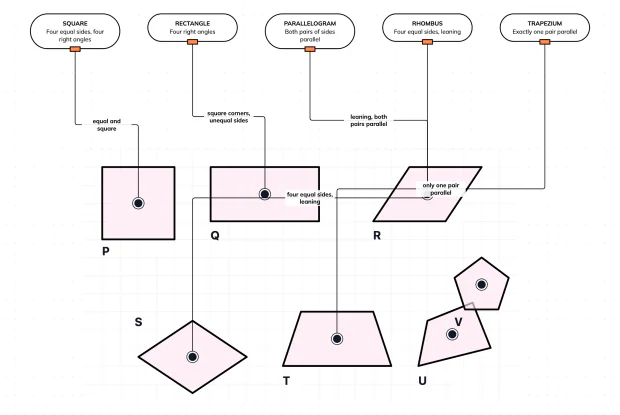
A parallelogram has both pairs of opposite sides parallel — that is its only requirement, and it is the one the others build on. A rectangle has four right angles, which forces both pairs of sides to be parallel too, so every rectangle is automatically a parallelogram. A rhombus has four equal sides, which also forces the sides to be parallel, so every rhombus is a parallelogram as well. A square has four right angles and four equal sides, meeting the rectangle condition and the rhombus condition together. A trapezium is the outlier: it has exactly one pair of parallel sides, and the word exactly is doing the work there, because a shape with two parallel pairs has stepped up into parallelogram territory instead. Five conditions, and only the trapezium is defined by what it does not have as much as by what it does.
Why is every square also a rectangle?
Because a rectangle is defined by its angles, not by its sides being different. The condition is four right angles, and a square has four right angles, so a square satisfies it completely. Nothing in the definition of a rectangle says the sides must be unequal — that is an assumption people add without noticing, usually because the rectangle they picture is a long one. It genuinely catches adults out, and it is worth sitting with, because the same pattern appears everywhere in mathematics: a definition says what must be true, and anything else is free to vary. The practical consequence is that any fact about rectangles is automatically a fact about squares. Rectangles have equal diagonals, so squares do. The area of a rectangle is length times width, so a square's area is too — which is exactly why the square's formula is just the rectangle's with one number used twice.
How do you tell a rhombus from a parallelogram?
Count the sides. Both lean, both have opposite sides parallel, and at a glance they look like the same kind of shape — but a rhombus needs all four sides equal, and a general parallelogram does not. So every rhombus is a parallelogram, while most parallelograms are not rhombuses. On a grid this is settled in seconds, which is why the practice figure is drawn on one: counting squares along each side is not a matter of judgement. A rhombus is sometimes called a diamond in everyday speech, which is fine informally but worth dropping in maths, partly because diamond is not a defined term and partly because it suggests the shape must stand on a point. It need not. Turn a rhombus so a side sits flat along the bottom and it is exactly the same shape, with the same four equal sides, however much less diamond-like it looks.
Where does the trapezium fit in?
Slightly apart from the rest, because it is the one that does not have both pairs of sides parallel. It has exactly one pair, and that single parallel pair is enough to give it a name and enough to make its area calculable, but it is not enough to make it a parallelogram. So the family tree has parallelogram on one branch, with rectangle, rhombus and square nested inside it, and trapezium sitting on its own beside them. One warning about the word itself: British and American usage disagree. In British English a trapezium is the shape with one pair of parallel sides, which is the sense used here and throughout the rest of the world. In American English that shape is called a trapezoid, and trapezium means a quadrilateral with no parallel sides at all. If a textbook seems to contradict this one, that is almost certainly why.
Real World Example
Three Four-Sided Things and Why
The conditions are not academic — each one buys a property somebody needed:
A window pane
rectangle
Windows are rectangles because right angles are what buildings are made of, and a pane has to sit in a frame that meets the wall and the floor squarely. The rectangle condition also buys something useful for the glazier: equal diagonals. Measuring both diagonals of a frame and finding them equal proves all four corners are right angles without checking any of them individually, which is far quicker than a set square at each corner. It is the same trick a joiner uses on a door frame, and it works only because the definition is about angles.
A kite in the air
usually a rhombus
A traditional kite is often a rhombus — four equal sides, leaning, standing on a point. The equal sides matter aerodynamically, because they keep the sail symmetrical about its vertical spine so the kite pulls straight rather than veering. This is also the shape people habitually call a diamond, which is a good reminder that the everyday name and the mathematical one need not agree. Turn the same kite so that a side lies flat and it has not changed shape in the slightest, though almost nobody would call it a diamond in that position.
A flowerbed against a wall
trapezium
A bed that runs along a straight wall but tapers at one end is a trapezium: the wall edge and the front edge are parallel, and the two ends slant in. Gardeners and landscapers meet this shape constantly, because plots rarely have four convenient right angles. Its area is worked out by averaging the two parallel sides and multiplying by the distance between them, which amounts to turning it into a rectangle of the same area — the same instinct as boxing a triangle, applied to a shape with one pair of parallel edges to work with.
FAQs
Final Words
A quadrilateral is any four-sided polygon, and the five familiar names are conditions rather than boxes. Ask which conditions a shape satisfies, not which single name it gets, and the confusion disappears.
Parallelogram is the broad one. Rectangle adds right angles, rhombus adds equal sides, and a square is what happens when a shape manages both — which is why every square is honestly a rectangle, and every fact about rectangles applies to it.
The trapezium sits apart, with exactly one pair of parallel sides. And if a book seems to contradict that, check where it was printed: the British trapezium is the American trapezoid, and the two swap meanings across the Atlantic.
Continue This Track
This concept is part 4 of Shapes and Their Families.
What Makes a Shape a Polygon?
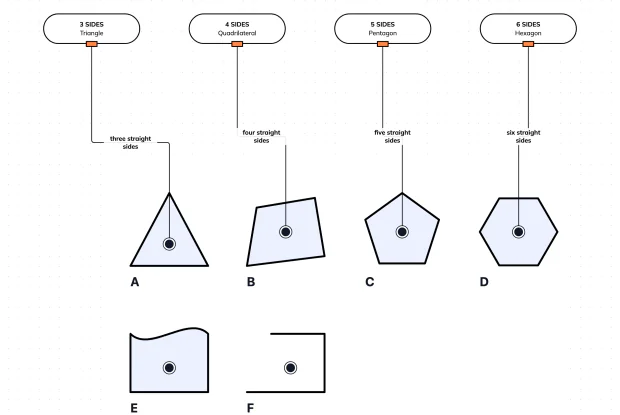
A polygon has to pass two tests: every side straight, and the outline joined up. Pass both and the shape earns a name, and the name is nothing more than how many sides it has. Sort real shapes from near-misses in an interactive playground.
What Kinds of Triangle Are There?
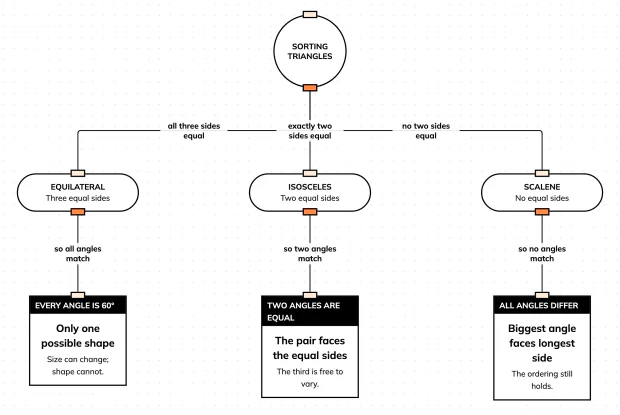
Triangle types are usually memorised as a list of names. They are better understood as one decision — how many sides are equal — from which the angles follow with no extra information. Match each type to what its angles must do in an interactive playground.
Why Do a Triangle's Angles Always Add to 180°?
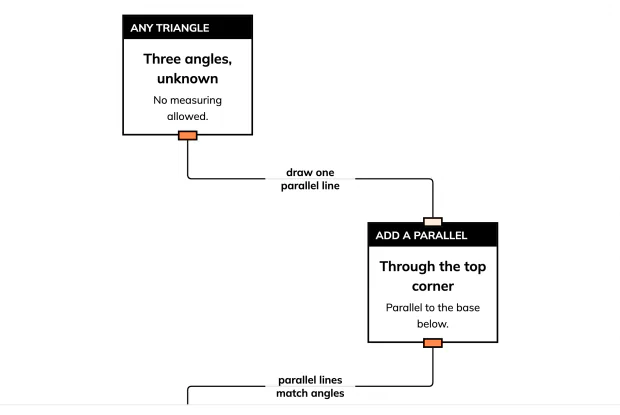
Everyone is told that a triangle's angles total 180 degrees. Almost nobody is shown why, so it gets filed as a fact to trust. Follow the five-step proof from one parallel line to the conclusion and assemble the argument yourself in an interactive playground.
What Are the Types of Quadrilaterals?
Square, rectangle, rhombus, parallelogram and trapezium are not five separate boxes to sort shapes into — they are conditions, and a shape can satisfy several at once. That is why every square is also a rectangle. Match each name to the shape that earns it on a grid.
When Are Two Shapes Really the Same?
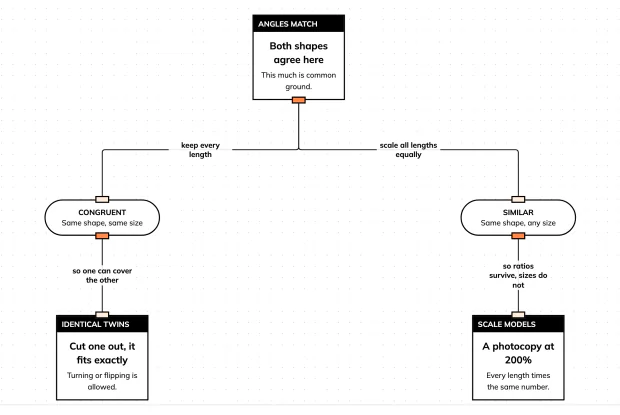
"The same" is ambiguous in geometry, and the ambiguity causes real errors. Learn the two precise versions — congruent and similar — and where they part, then build both branches in an interactive playground.