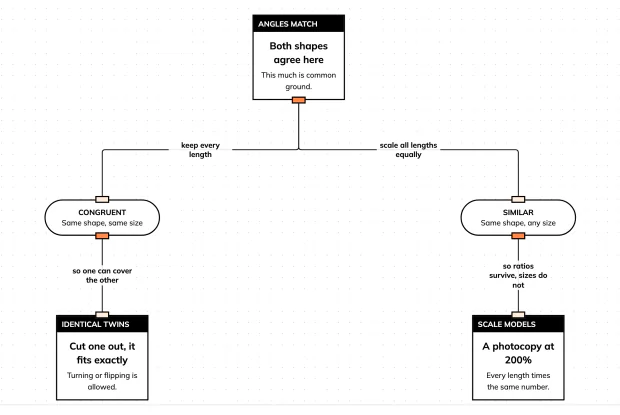
What Kinds of Triangle Are There?
Root Concept
Equal sides force equal angles, so counting how many sides match tells you what the angles must do without measuring a single one.
CodePLU Goal
Upgrading Human Mental Models
Learn how to think in Workflows

Concept Development By codeplu.com
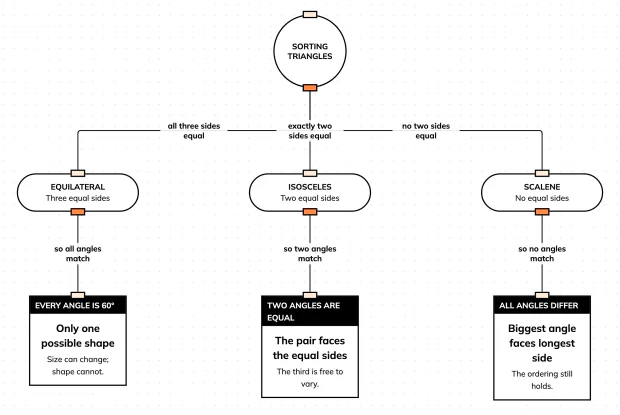
Triangles sorted by equal sides, with the angle consequence of each
Why Learn Three Names Instead of One Rule?
Triangle vocabulary is usually handed over as a list: equilateral, isosceles, scalene, plus right-angled, acute and obtuse. Six words, learned in one lesson, and mostly forgotten because nothing connects them. The names are worth knowing, but they are the least interesting part. What is worth knowing is that the first three are not really three separate facts — they are three answers to a single question, and the answer to that question determines the angles for free.
The question is: how many of the sides are the same length? All three, exactly two, or none. That is the whole taxonomy. And the reason it matters is a rule sitting underneath it: in any triangle, equal sides force equal angles. Not usually, not approximately — always, and the converse holds too. So counting equal sides tells you how many equal angles there must be without measuring anything.
That connection is what makes the classification useful rather than decorative. Told that a triangle has two equal sides, you already know two of its angles match, which is often exactly the step a problem needs. Told that all three sides are equal, you know every angle is 60 degrees, because three equal angles have to share 180 between them. The names are labels on a piece of reasoning, and the reasoning is short enough to rebuild any time you forget the labels.
One Question, Three Answers, and What Follows
Why do equal sides force equal angles?
Because a triangle with two equal sides can be folded onto itself. Imagine the line running from the point where the two equal sides meet, down to the middle of the third side: it divides the triangle into two halves that are mirror images. Anything true of one half is true of the other, so the two base angles cannot differ — there is no way to make one bigger without breaking the symmetry that the equal sides created. This is the reason the rule is exact rather than a tendency, and it is why the pairing of a side with the angle opposite it comes up constantly in geometry.
Why must an equilateral triangle have 60-degree angles?
Two facts combine. Equal sides force equal angles, so all three angles are the same. And the angles of any triangle add to 180 degrees, which the next tutorial proves rather than asserts. Three equal things adding to 180 means each is 60. Notice that no measurement was involved and no special case was memorised — the number falls out. It also means the equilateral triangle is the only triangle whose shape is completely fixed by its type: you can scale it up or down, but you cannot make a differently proportioned one.
What is free to vary in an isosceles triangle?
The angle at the top, and with it the whole character of the shape. Two equal sides guarantee that the two base angles match, but they do not say what those angles are. Pull the apex upward and the triangle becomes tall and narrow with two large base angles; push it down and it becomes wide and flat with two small ones. All of these are isosceles. So the type constrains the shape without determining it — which is the difference between it and equilateral, and a distinction worth being precise about.
Is there anything predictable about a scalene triangle?
Yes, and it is a rule people often miss because scalene sounds like the category of triangles with no properties. All three sides differ, so all three angles differ — but they differ in a fixed order. The largest angle always sits opposite the longest side, and the smallest opposite the shortest. So even with nothing equal, the ordering is completely determined by the side lengths. That is genuinely useful: shown a triangle with a marked longest side, you can name its largest angle before doing any calculation.
How do right-angled, acute and obtuse fit in?
They are a second, independent classification, sorting by the largest angle rather than by equal sides: one angle exactly 90 degrees, all angles under 90, or one angle over 90. Because the two schemes ask different questions, a triangle has one label from each — a triangle can be isosceles and right-angled at the same time, and the 45-45-90 triangle is exactly that. Treating these as one list of six mutually exclusive types is the most common confusion here, and separating them into two questions clears it up permanently.
Real World Example
What You Can Say Without Measuring Anything
In each case, only the side lengths are given. See how much about the angles follows immediately:
Sides 5, 5, 5
Every angle is 60°
Three equal sides force three equal angles, and three equal angles sharing 180 degrees must be 60 each. The shape is fully determined — only its size is still open.
Sides 7, 7, 4
Two angles are equal
The two equal sides guarantee the two angles facing them match. The remaining angle, at the point where the equal sides meet, is not fixed by the type — and the short base tells you it is a narrow one.
Sides 3, 4, 5
All angles differ, largest opposite the 5
Nothing is equal, so nothing matches — but the ordering is fixed. The biggest angle faces the side of length 5. This particular triangle is also right-angled, which is a fact from the second classification.
FAQs
Final Words
Three triangle names, one question. Count the equal sides and the angles follow, because equal sides force equal angles — a rule that comes from symmetry rather than from convention. All three equal gives 60 degrees each and a shape that cannot vary. Exactly two equal gives a matching pair and an apex free to move. None equal gives no matches, but still a fixed ordering: biggest angle opposite longest side.
Keep the two classifications separate and the vocabulary stops being a list of six. Sides answer one question, the largest angle answers another, and a triangle carries a label from each. The next tutorial proves the fact this one leaned on twice without justification — that the angles of any triangle add to 180 degrees.
Continue This Track
This concept is part 2 of Shapes and Their Families.
What Makes a Shape a Polygon?
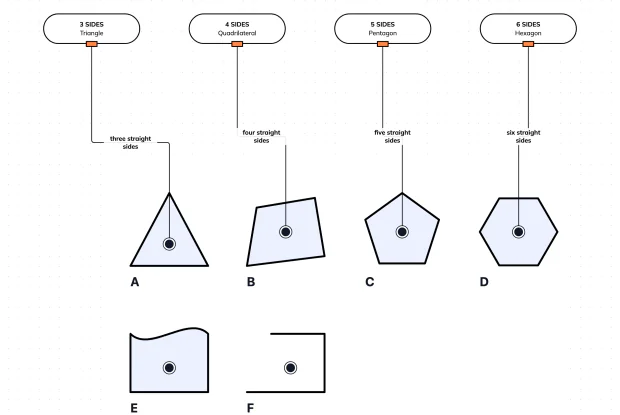
A polygon has to pass two tests: every side straight, and the outline joined up. Pass both and the shape earns a name, and the name is nothing more than how many sides it has. Sort real shapes from near-misses in an interactive playground.
What Kinds of Triangle Are There?
Triangle types are usually memorised as a list of names. They are better understood as one decision — how many sides are equal — from which the angles follow with no extra information. Match each type to what its angles must do in an interactive playground.
Why Do a Triangle's Angles Always Add to 180°?
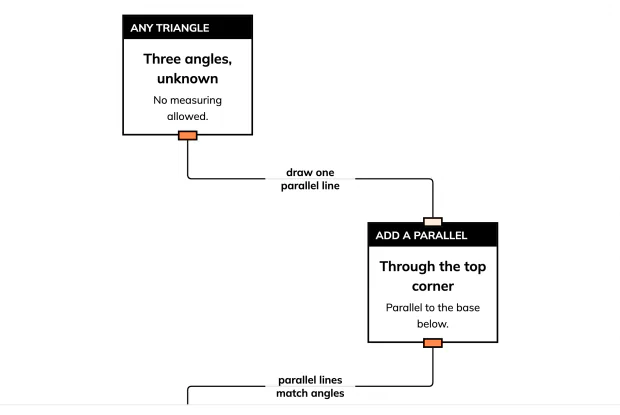
Everyone is told that a triangle's angles total 180 degrees. Almost nobody is shown why, so it gets filed as a fact to trust. Follow the five-step proof from one parallel line to the conclusion and assemble the argument yourself in an interactive playground.
What Are the Types of Quadrilaterals?
Square, rectangle, rhombus, parallelogram and trapezium are not five separate boxes to sort shapes into — they are conditions, and a shape can satisfy several at once. That is why every square is also a rectangle. Match each name to the shape that earns it on a grid.
When Are Two Shapes Really the Same?
"The same" is ambiguous in geometry, and the ambiguity causes real errors. Learn the two precise versions — congruent and similar — and where they part, then build both branches in an interactive playground.