Why Does a Powder React So Much Faster Than a Block?
Root Concept
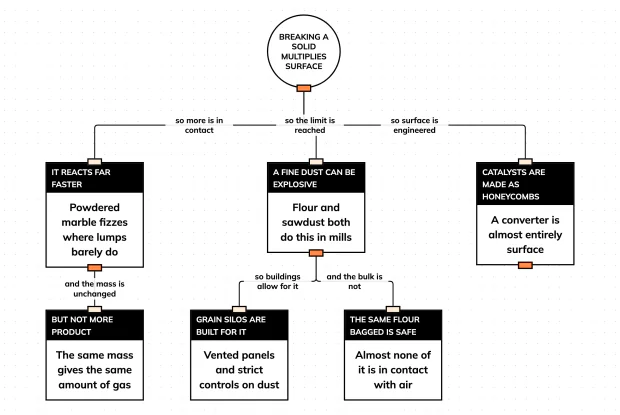
A reaction involving a solid can only happen where its surface meets the other reactant, so most of a lump is unavailable until the outside has reacted away; breaking the solid up exposes that buried material and multiplies the rate without changing the mass or the amount of product.
CodePLU Goal
Upgrading Human Mental Models
Learn how to think in Workflows

Concept Development By codeplu.com
One property of a solid, and three consequences that have nothing to do with each other.
Most of a Lump Is Not Available
A reaction between a solid and a liquid or a gas can only happen where the two are actually touching, which is the solid’s surface. Everything underneath is surrounded by more of the same solid and takes no part at all until whatever is above it has reacted away and exposed it.
That has a consequence most people underestimate. In an ordinary lump, the overwhelming majority of the material is interior — unavailable, waiting. Cut the lump in half and two new faces appear that were previously buried. Keep cutting and the amount of exposed surface climbs enormously while the mass stays exactly the same, because every cut turns interior into exterior.
Grinding a solid to powder is that process taken to its limit, and the effect on rate is correspondingly large. The same mass of marble chips that fizzes gently in acid will react vigorously as a powder, because far more of it is in contact at any moment. Nothing about the chemistry has changed and neither has the amount of product — only how quickly it arrives.
The playground follows that one property into three places it matters: a beaker, a flour mill, and the inside of a car exhaust. None of the three leads to the others.
Following One Property
How much difference does cutting actually make?
More than the arithmetic suggests at a glance. Take a cube and cut it into eight smaller cubes by halving each dimension: the mass is unchanged and the total surface area has doubled. Do it again and it doubles again. Because surface grows with the square of the size while volume grows with the cube, making the pieces ten times smaller gives ten times the surface for the same mass — and powder is very much smaller than that. The same relationship governs why a cell has to be small and why a mouse loses heat faster than an elephant, both of which the biology category covers from the other direction.
Why does the final amount not change?
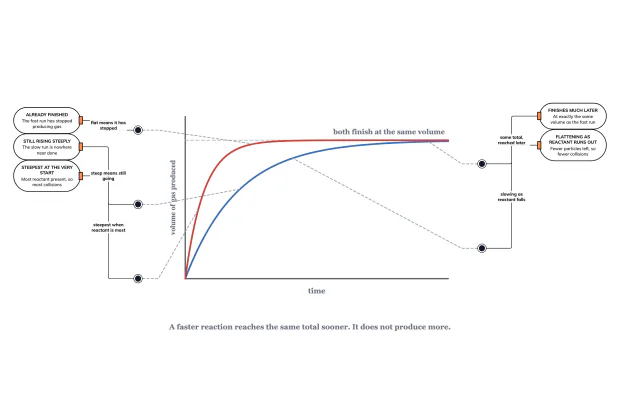
Because the mass has not changed and neither has anything else about the chemistry. Grinding a solid rearranges where its particles are, not how many there are, so the same number of reactant particles is present and the same number of product particles can be made. On a rate graph this is the distinction from two tutorials ago made visible: the powder gives a much steeper curve that flattens far sooner, at exactly the same height as the lumps. Faster, not more — which is the single most useful check on whether a rate claim is being described correctly If a claim about speed has quietly become a claim about quantity, something has gone wrong in the telling.
Why is a dust cloud dangerous when a sack is not?
Because suspending a powder in air exposes essentially all of it at once. In a sack, the flour grains are pressed against one another and only the outermost layer touches air, so it burns slowly if at all. Thrown into the air as a cloud, every grain is surrounded by oxygen and the whole mass can react almost simultaneously — which is an explosion rather than a fire. Flour, custard powder, sawdust, coal dust and powdered metals have all done this in industrial settings, and it is the reason mills and silos are built with vented panels and strict housekeeping rules about dust. Nothing here is a demonstration to try.
Where else is surface deliberately engineered?
Almost anywhere a reaction has to happen quickly at a surface. A catalytic converter spreads precious metal over a ceramic honeycomb precisely to maximise the area the exhaust gases meet, as the previous tutorial described. Industrial catalysts are made as pellets riddled with pores for the same reason. The principle also runs the other way in biology: the lining of the small intestine is folded and covered in villi to maximise absorbing surface, and a leaf’s internal air spaces do the same job for gas exchange. The chemistry and the biology are solving an identical problem. Wherever something has to happen at a boundary, the design pressure is always towards more boundary in less space.
Real World Example
The Same Property at Three Scales
Surface area is the most physically obvious of the rate factors, and the consequences of getting it wrong are correspondingly large.
Step 1
Marble chips against marble powder
The standard school comparison uses the same mass of calcium carbonate twice, once as chips and once ground up, with the same acid. The powder reacts visibly faster and the gas is collected to show it — and both runs finish with the same volume. It is the cleanest demonstration of the distinction, because the only thing deliberately changed is the size of the pieces. The experiment is done with eye protection and with the gas collected rather than left to escape. Everything else — the acid, the mass, the temperature — is deliberately held the same, which is what makes the comparison mean anything.
Step 2
Dust explosions destroyed mills for centuries
Flour mills, grain elevators and sawmills have been wrecked by dust explosions for as long as they have existed, and coal dust has caused some of the worst mining disasters on record. The material is not unusually flammable — flour in a bag is nothing of the sort. What makes it dangerous is that a fine powder suspended in air has essentially all of its mass in contact with oxygen, so a reaction that would smoulder across a surface instead happens throughout a volume at once. The precautions in such buildings are about housekeeping and venting rather than about the material being treated as a fuel.
Step 3
A converter is bought by the square metre, not the gram
The platinum in a catalytic converter would make a lump smaller than a coin, and spread over a honeycomb it presents an area measured in thousands of square metres. That is the whole design: the reaction happens where exhaust gases touch metal, so the engineering problem is exposing as much metal as possible using as little of it as possible. It is the same lever as grinding marble, applied to make something precious go further rather than to make a reaction quicker. The same reasoning, run for cost rather than for speed. Surface is the quantity being bought, not metal.
FAQs
Final Words
A reaction involving a solid happens only where that solid meets the other reactant, so almost all of a lump is unavailable — surrounded by more of itself and waiting for the outside to react away. Breaking the solid up turns interior into exterior, and because surface grows with the square of a length while volume grows with the cube, the multiplication is far larger than it looks. The mass never changes.
Which is why the same mass of marble gives the same volume of gas as chips or as powder, and only the speed differs — faster, not more. It is also why a sack of flour is harmless and a cloud of it explosive, and why a converter is a honeycomb so a coin’s worth of platinum presents thousands of square metres. One property, and the consequences run from a beaker to a silo. What none of this track asked is how much product a reaction gives, which the next one does.
Continue This Track
This concept is part 5 of How Fast Does a Reaction Go.
What Has to Happen for a Reaction to Occur?
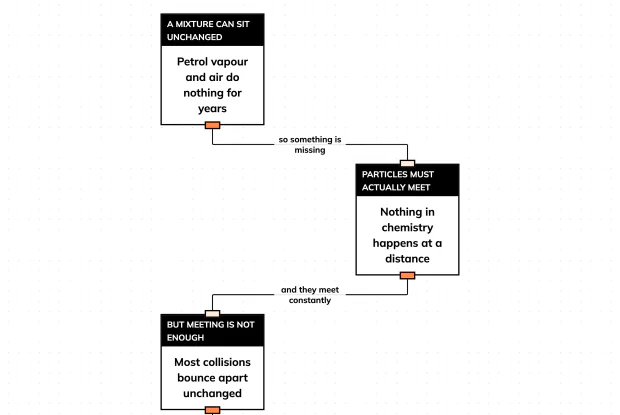
Petrol vapour and air sit together for years without reacting, then go off in milliseconds. Work out what was missing, and what a reaction rate counts, in an interactive playground.
What Makes a Reaction Go Faster? Only Two Things
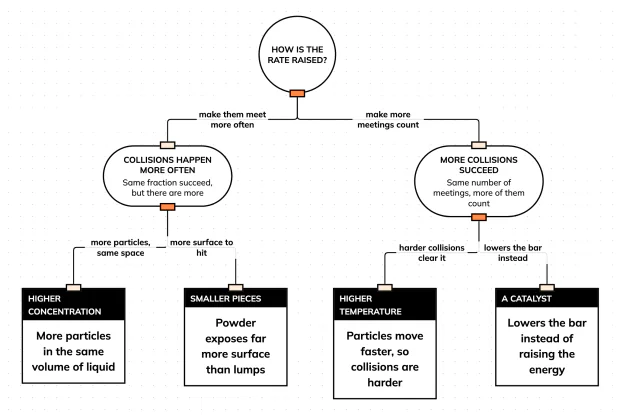
Temperature, concentration, surface area and catalysts look like four unrelated tricks. They are two, and knowing which is which tells you what each one will do. Sort them in an interactive playground.
How Do You Read a Rate Graph? Steepness Is Rate
Two curves, one reaction, two speeds. The steepness tells you the rate and the final height tells you the amount — and they are different things. Label both curves in an interactive playground.
What Does a Catalyst Actually Do? It Lowers the Bar
A catalyst speeds a reaction up without being used up and without adding any energy. Work out how that is possible, in an interactive playground.
Why Does a Powder React So Much Faster Than a Block?
A lump of flour burns slowly and a cloud of it explodes. Same substance, same mass, and the only difference is how much of it the air can reach. Trace the consequences in an interactive playground.