How Fast Does a Reaction Go
Five parts on speed, opening with a puzzle that has to be solved before anything else makes sense: petrol and air sit together for years and then react in milliseconds, and both facts need explaining at once. The particles have to meet — which rules out nothing, since they are already colliding billions of times a second — so what separates a reaction from a mixture sitting still is that a collision also has to be hard enough to start breaking bonds, and almost none of them is. That turns a rate into a count of successful collisions per second, and the second part uses it to show that the four factors everybody memorises are really two mechanisms: make the particles meet more often, or make more of those meetings count. There is no third number to adjust, which is why the list is short. The middle part reads a rate graph properly, since the curve answers two questions and they are easy to merge — steepness is the rate and the final height is the total, so a faster reaction reaches the same amount sooner rather than producing more. The fourth part takes the one lever that is not used up and refuses the usual explanation of it: a catalyst gives nothing any energy, and works by lowering the bar rather than raising the particles. The last part follows surface area out of the beaker, to why a sack of flour is harmless and a cloud of it is not.
CodePLU Goal
Upgrading Human Mental Models
Learn how to think in Workflows
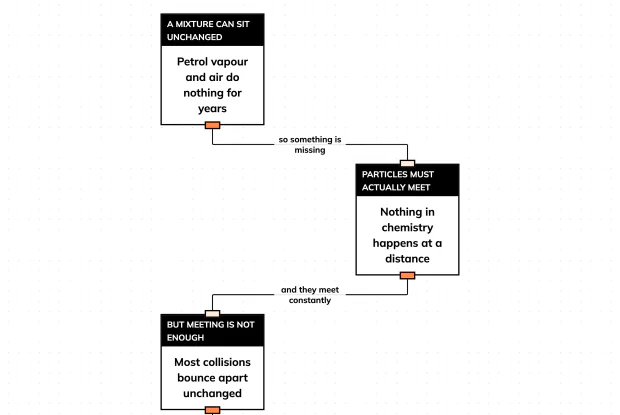
What Has to Happen for a Reaction to Occur?
Petrol vapour and air sit together for years without reacting, then go off in milliseconds. Work out what was missing, and what a reaction rate counts, in an interactive playground.
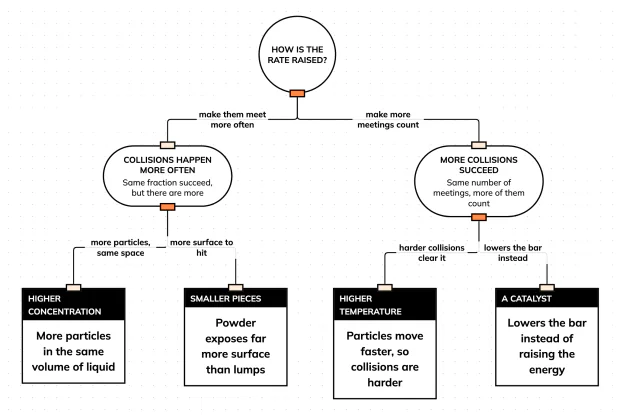
What Makes a Reaction Go Faster? Only Two Things
Temperature, concentration, surface area and catalysts look like four unrelated tricks. They are two, and knowing which is which tells you what each one will do. Sort them in an interactive playground.
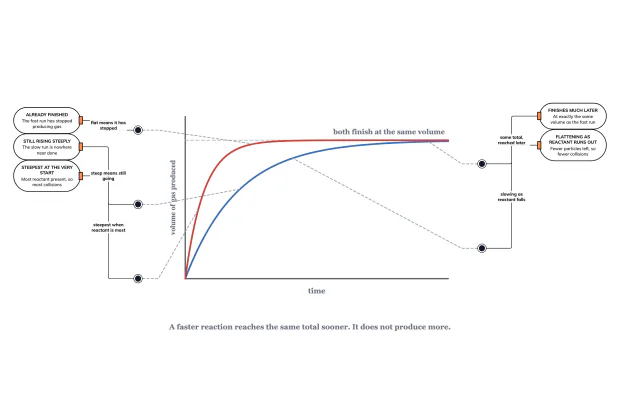
How Do You Read a Rate Graph? Steepness Is Rate
Two curves, one reaction, two speeds. The steepness tells you the rate and the final height tells you the amount — and they are different things. Label both curves in an interactive playground.
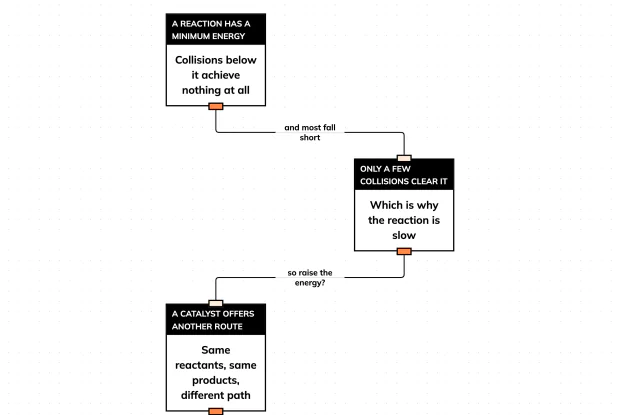
What Does a Catalyst Actually Do? It Lowers the Bar
A catalyst speeds a reaction up without being used up and without adding any energy. Work out how that is possible, in an interactive playground.
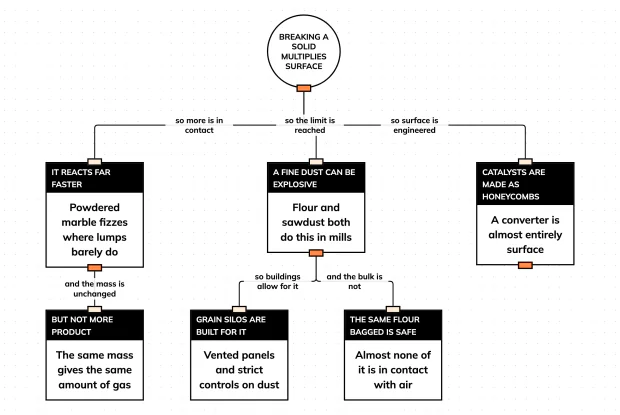
Why Does a Powder React So Much Faster Than a Block?
A lump of flour burns slowly and a cloud of it explodes. Same substance, same mass, and the only difference is how much of it the air can reach. Trace the consequences in an interactive playground.