What Makes a Reaction Go Faster? Only Two Things
Root Concept
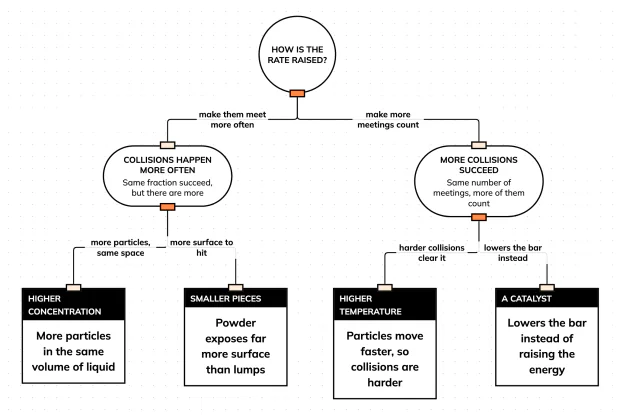
A reaction can only be speeded up in two ways — by making collisions more frequent or by making a larger fraction of them successful — so concentration and surface area work by the first route, a catalyst by the second, and temperature is the one lever that does both at once.
CodePLU Goal
Upgrading Human Mental Models
Learn how to think in Workflows

Concept Development By codeplu.com
Two mechanisms, not four tricks. Temperature belongs on the right and quietly does the left-hand job as well.
Four Levers, Two Mechanisms
Rates are usually taught as a list of four things that make reactions faster: temperature, concentration, surface area and catalysts. Memorised as a list they are four unrelated tricks, and there is no way to tell what a fifth one would be or why these four are the ones.
The previous tutorial gives the structure. A rate is a count of collisions per second that are hard enough to react, which means there are exactly two numbers you can change: how many collisions happen, and what fraction of them succeed. Every possible way of speeding a reaction up has to work through one of those, because there is nothing else in the count to adjust.
Concentration and surface area both work the first way. Putting more particles into the same volume, or breaking a solid up so more of it is exposed, means more encounters per second — and the same proportion of them clears the bar as before, so there are simply more successes. Nothing about the individual collisions has changed.
A catalyst works the second way, and does it by lowering the bar rather than giving anything more energy — the next tutorial is about how. Temperature is the awkward one: it does both, speeding the particles up so they collide more often AND hit harder, with the second effect by far the larger. That is why it is on the right of the board and why the prose has to say so.
What Each Lever Does
Why does concentration matter?
Because it decides how crowded the solution is. A more concentrated solution has more reactant particles in the same volume, so any given particle meets another one more often, and more encounters per second means more successful ones per second. The individual collisions are no harder than before — the same small fraction clears the activation energy — there are just more of them to take a fraction of. The same argument applies to gases under pressure, which is only a different word for the same crowding: squeezing a gas into half the volume doubles how often its particles meet, which is why pressure appears in industrial rate calculations and rarely in a school beaker.
Why does breaking a solid up help?
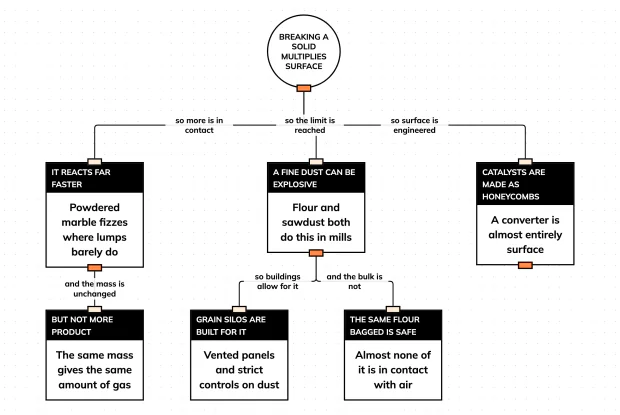
Because a reaction between a solid and a liquid or gas can only happen where they touch, and that is the surface. Particles inside a lump are surrounded by other particles of the same solid and are unavailable until everything outside them has reacted away. Breaking the lump into smaller pieces exposes material that was previously buried, so more of the solid is in contact and more collisions happen each second. The mass has not changed and neither has the chemistry; what changed is how much of it the other reactant can reach. The last tutorial in this track follows that one lever a long way. Grinding a reactant changes nothing about what it is, only about how much of it is available at once.
Why does temperature do both jobs?
Because temperature is a measure of how fast the particles are moving, as the first track established. Faster particles cover ground more quickly, so they meet more often — that is the first mechanism. They also arrive with more energy, so a much larger fraction of those meetings clears the activation energy — that is the second, and it is the dominant one by a wide margin. The usual rule of thumb is that a ten degree rise roughly doubles the rate of many reactions, and almost none of that doubling comes from the extra frequency. Treating temperature as a frequency effect is a common and quite serious misreading It is the energy of the collisions that matters, and the extra meetings are close to a rounding error beside it.
Is there a fifth lever?
Not at this level, and the structure explains why. A rate is collisions per second multiplied by the fraction that succeed, and anything that changes a rate has to change one of those two numbers. Light matters for a handful of reactions, by supplying the energy some collisions need, which is the second mechanism again. Stirring helps when a reaction would otherwise be limited by reactants not reaching each other, which is the first. The four on the board are not an arbitrary list somebody settled on — they are the practical ways of moving two numbers. That is the difference between a list to recall and a structure to reason from: given a new condition, you can work out which number it moves and therefore what it will do.
Real World Example
The Same Two Mechanisms Outside a Laboratory
Every one of these is a rate being deliberately moved, and each works through one of the two mechanisms rather than by any special trick.
Step 1
A pressure cooker works on both numbers at once
Sealing a pan raises the pressure, which raises the boiling point, so the water inside reaches well above 100 °C instead of stopping there. The food cooks faster because the chemical changes involved are running at a higher temperature — more collisions, and far more of them hard enough. It is the temperature doing the work rather than the pressure directly, which is worth separating, because the pressure is only there to allow the higher temperature in the first place. Take the lid off and the water sits at 100 °C however hard the heat is turned up, which is the point the first track made about a boiling liquid holding its temperature.
Step 2
A fridge and a freezer buy different amounts of time
Chilling food slows the reactions that spoil it, and freezing slows them much further, which is the same lever applied harder. Neither stops the chemistry: a freezer buys months rather than permanence, and food left in one long enough still deteriorates. Preserving by drying works differently and is worth contrasting — it removes the water that the reactions need rather than slowing them down, so it is not a rate method at all. Salting and canning work on the same principle, removing something the spoiling reactions need rather than slowing the reactions themselves A fridge slows chemistry; drying removes a reactant.
Step 3
Industrial plants trade rate against everything else
Running a reaction hotter makes it faster, and a chemical plant could in principle run very hot indeed. It does not, because heat costs money, high temperatures damage equipment, and for some reactions a higher temperature reduces how much product you end up with. The conditions chosen are always a compromise between how fast and how much, which is why an industrial process is quoted with a temperature and a pressure rather than simply being run flat out. Rate is one variable among several, and it is rarely the one that wins the argument on its own.
FAQs
Final Words
There are four levers and only two mechanisms, and knowing which is which is worth more than the list. A rate is a count of collisions per second multiplied by the fraction that are hard enough, so anything that changes a rate has to move one of those two numbers — there is nothing else in the count to touch.
Concentration and surface area both work on the first number. More particles in the same space, or more of a solid exposed, means more encounters per second while the same fraction of them succeeds. A catalyst works on the second, by lowering the bar rather than giving anything more energy. Temperature does both, which is why it is the most effective lever of the four, and almost all of its effect comes from the harder collisions rather than the extra frequency. The next tutorial takes the catalyst, which is the only one of the four that is not used up.
Continue This Track
This concept is part 2 of How Fast Does a Reaction Go.
What Has to Happen for a Reaction to Occur?
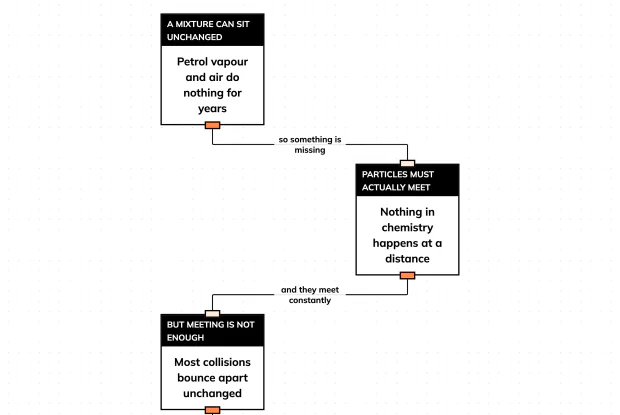
Petrol vapour and air sit together for years without reacting, then go off in milliseconds. Work out what was missing, and what a reaction rate counts, in an interactive playground.
What Makes a Reaction Go Faster? Only Two Things
Temperature, concentration, surface area and catalysts look like four unrelated tricks. They are two, and knowing which is which tells you what each one will do. Sort them in an interactive playground.
How Do You Read a Rate Graph? Steepness Is Rate
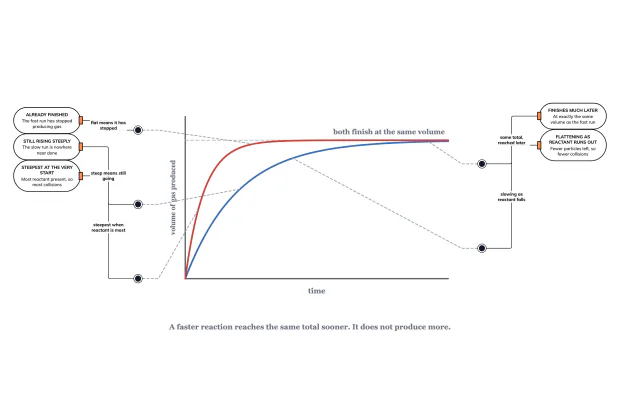
Two curves, one reaction, two speeds. The steepness tells you the rate and the final height tells you the amount — and they are different things. Label both curves in an interactive playground.
What Does a Catalyst Actually Do? It Lowers the Bar
A catalyst speeds a reaction up without being used up and without adding any energy. Work out how that is possible, in an interactive playground.
Why Does a Powder React So Much Faster Than a Block?
A lump of flour burns slowly and a cloud of it explodes. Same substance, same mass, and the only difference is how much of it the air can reach. Trace the consequences in an interactive playground.