What Has to Happen for a Reaction to Occur?
Root Concept
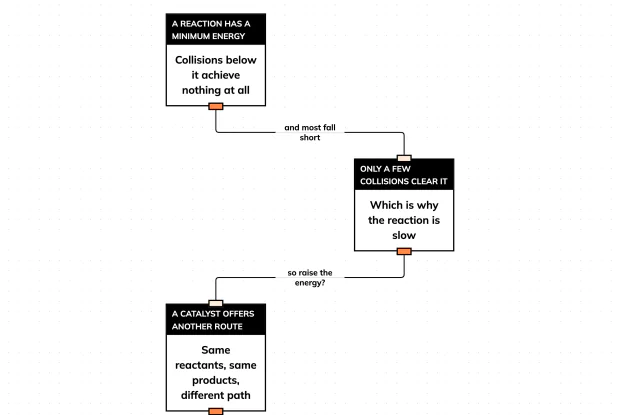
A reaction happens only when particles collide with at least a minimum amount of energy, so most collisions achieve nothing and the rate of a reaction is a count of how many successful collisions occur each second.
CodePLU Goal
Upgrading Human Mental Models
Learn how to think in Workflows

Concept Development By codeplu.com
The chain starts from something that does nothing. Each step rules out an explanation that is not enough on its own.
A Mixture That Does Nothing, Until It Does
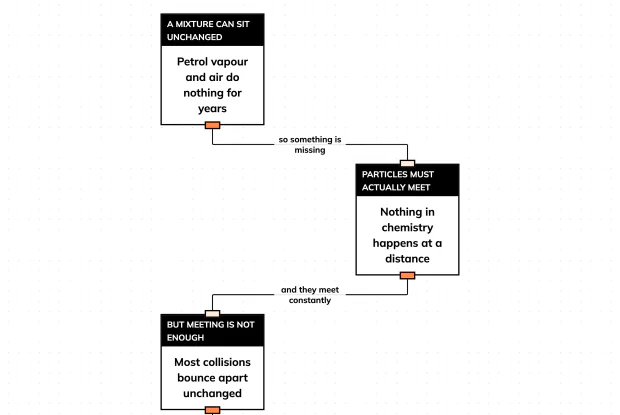
A car’s fuel tank holds petrol and the air above it holds oxygen, and the reaction between them releases enough energy to move a tonne of metal. They sit together for years and nothing happens. Then a spark arrives and the whole thing is over in a fraction of a second.
Both facts need explaining at once, and that is harder than it looks. The bonding track established that reactions happen because the products are lower in energy than the reactants — but if that were the whole story, the petrol would react the moment it met the air. Something is preventing it, and whatever that something is, a spark removes it.
The explanation starts with a requirement so obvious it is easy to skip: the particles have to meet. Nothing in chemistry happens at a distance, so reactants that never touch cannot react. But that cannot be the whole answer either, because petrol and oxygen molecules in a tank are colliding constantly — billions of times a second — and almost nothing comes of it.
So collisions happen and reactions mostly do not, which means only some collisions count. What separates them is energy: a collision has to be hard enough to start breaking the bonds that are already there. That is why the rate of a reaction is not a measure of how many particles are present but a count of how many collisions per second are violent enough to succeed.
Why Most Collisions Achieve Nothing
Why is meeting not enough?
Because a reaction has to break bonds before it can make any, and breaking a bond costs energy — the point the bonding track insisted on. Two molecules drifting into each other gently simply bounce apart with everything intact, because nothing in that encounter supplied what breaking a bond requires. Only a collision violent enough to start the job gets anywhere. The minimum needed has a name, activation energy, and it is a property of the particular reaction rather than of the substances in general. A reaction with a low activation energy goes readily at room temperature; one with a high activation energy may need a flame to get started even though it releases energy once it does.
How many collisions actually succeed?
Very few, and the numbers are worth seeing because they are so lopsided. Particles in a gas or a liquid collide billions of times per second, and in a typical reaction at room temperature only a tiny fraction of those collisions have enough energy to do anything. That is the reconciliation the overview asked for: petrol and oxygen in a tank really are colliding constantly, and essentially none of those collisions is hard enough. The reaction is not blocked by some barrier standing between them. It is simply that almost no individual encounter clears the bar, and the few that do are too rare to notice. Rarity, not obstruction, is what keeps the tank safe.
Does the direction of the collision matter?
For many reactions, yes, and it is a second filter on top of the energy one. Two particles can meet with ample energy and still not react if they meet the wrong way round, because the parts that need to come together did not. This matters most for larger molecules, where only one region of a long structure is actually reactive, and hardly at all for single atoms, which have no orientation to get wrong. At this level the energy requirement does most of the explaining, and orientation is worth knowing about as the reason even a hard collision sometimes fails It is also why enzymes are so particular about shape, which the biology category describes without ever naming the mechanism.
So what exactly is a rate?
How much reactant is used up, or product made, in a given time — and underneath that, a count of successful collisions per second. The two descriptions are the same thing seen from outside and from inside. Measured in a laboratory, a rate is something like the volume of gas produced per second or the mass lost per minute. Explained at the particle level, it is the number of collisions each second that clear the activation energy. That connection is what makes the next tutorial possible: anything that increases the number of successful collisions per second speeds the reaction up, and there are only a few ways to do that.
Real World Example
Three Mixtures That Are Waiting for a Collision
A mixture sitting still is not a mixture with nothing to gain. It is one where almost no collision is hard enough.
Step 1
A petrol engine supplies the energy on a schedule
Petrol vapour and air are mixed deliberately and then compressed, which raises the temperature and brings the particles closer together — two things that both increase the number of hard collisions. A spark then supplies a large amount of energy at one point, starting the reaction there, and the energy released drives the rest. Everything an engine does to the mixture is an attempt to control when the collisions become hard enough, which is why ignition timing is measured in fractions of a degree of crankshaft rotation. Nothing about the chemistry changed; the conditions around it did.
Step 2
A hydrogen and oxygen mixture is famously patient
Hydrogen and oxygen can be mixed and left indefinitely at room temperature. The reaction between them releases a great deal of energy, as the bonding track calculated — 486 kilojoules per two moles of water — and none of it is released, because the activation energy is high and almost no collision reaches it. A spark or a suitable catalyst starts it instantly and it then proceeds violently. The energy released was always available; what was missing was any way to start A mixture doing nothing is not a mixture with nothing to gain, which is the single most useful idea in this tutorial.
Step 3
Food in a fridge is a reaction being slowed down
Milk souring and meat spoiling are chemical changes carried out largely by microorganisms, and both run more slowly when cold. Lowering the temperature lowers the energy of the particles, so fewer collisions clear the bar and everything happens at a smaller fraction of the speed. A fridge does not stop the chemistry and does not claim to — it buys days rather than permanence, which is exactly what a rate change rather than a block should be expected to do. Freezing slows it further still, which is why the two appliances buy very different amounts of time.
FAQs
Final Words
Petrol and air sit together for years and then react in milliseconds, and explaining both at once is what collision theory is for. The particles have to meet, which rules out nothing on its own — they are colliding billions of times a second already. What separates a reaction from a mixture sitting still is that a collision also has to be hard enough to start breaking the bonds that are there, and almost none of them is.
That minimum is called the activation energy, and it belongs to the particular reaction rather than to the substances. It is also why a strongly exothermic reaction can need a match: the energy a reaction gives out only becomes available after some bonds have been broken, and that first step is paid for from outside. The useful consequence is that a rate counts successful collisions per second — so anything raising that count speeds the reaction up, which is the next tutorial.
Continue This Track
This concept is part 1 of How Fast Does a Reaction Go.
What Has to Happen for a Reaction to Occur?
Petrol vapour and air sit together for years without reacting, then go off in milliseconds. Work out what was missing, and what a reaction rate counts, in an interactive playground.
What Makes a Reaction Go Faster? Only Two Things
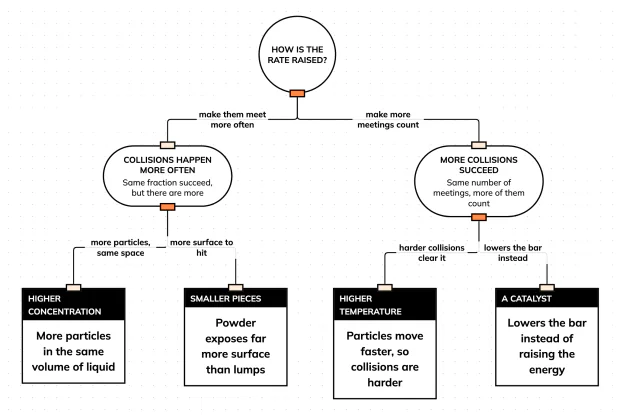
Temperature, concentration, surface area and catalysts look like four unrelated tricks. They are two, and knowing which is which tells you what each one will do. Sort them in an interactive playground.
How Do You Read a Rate Graph? Steepness Is Rate
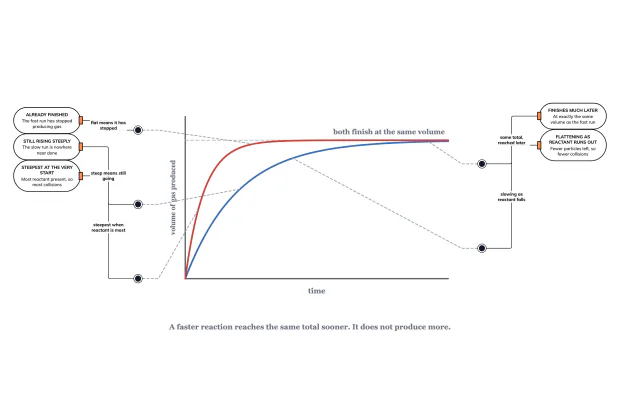
Two curves, one reaction, two speeds. The steepness tells you the rate and the final height tells you the amount — and they are different things. Label both curves in an interactive playground.
What Does a Catalyst Actually Do? It Lowers the Bar
A catalyst speeds a reaction up without being used up and without adding any energy. Work out how that is possible, in an interactive playground.
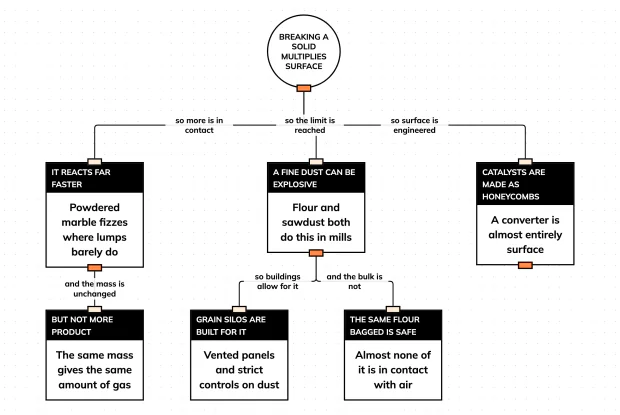
Why Does a Powder React So Much Faster Than a Block?
A lump of flour burns slowly and a cloud of it explodes. Same substance, same mass, and the only difference is how much of it the air can reach. Trace the consequences in an interactive playground.