What Does a Catalyst Actually Do? It Lowers the Bar
Root Concept
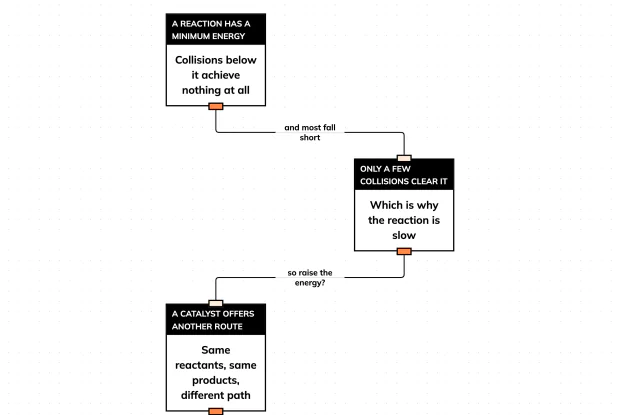
A catalyst speeds a reaction up by providing an alternative route with a lower activation energy, so a larger fraction of the collisions already occurring is now enough to react — it adds no energy to the particles and is not used up, which is why a small amount works indefinitely.
CodePLU Goal
Upgrading Human Mental Models
Learn how to think in Workflows

Concept Development By codeplu.com
The third step is a question the chain answers by rejecting it. Nothing is given more energy at any point.
Something for Nothing, Apparently
A catalyst speeds a reaction up, is not used up by it, and can be recovered afterwards and used again. A tiny quantity will convert an unlimited amount of reactant, given time. Stated like that it sounds like something for nothing, and the usual explanations make it worse — a catalyst is often said to give the reaction energy, or to make the particles move faster, and neither is true.
The bonding track promised that this tutorial would come, and the reason it needs its own place is that the honest explanation is a genuinely clever idea rather than a fact to accept.
Start from what is limiting the reaction. The first tutorial in this track established that a collision has to clear a minimum energy — the activation energy — and that almost none of them does. That is why an uncatalysed reaction can be so slow despite constant collisions.
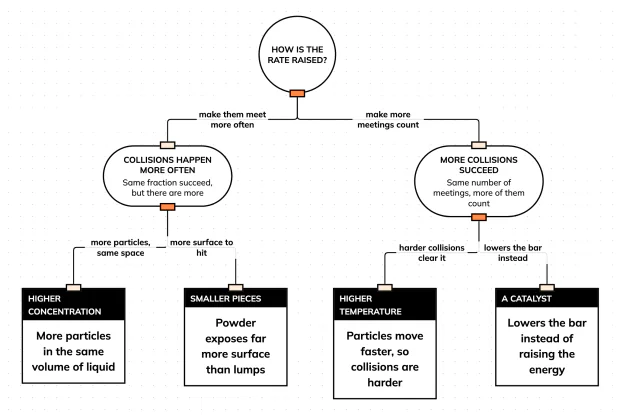
There are two ways to get more collisions over a bar: raise the particles, or lower the bar. Heating does the first. A catalyst does the second, by offering a different route from the same reactants to the same products — one that happens to need less energy to get going. The particles are moving exactly as they were. More of them are now enough.
How the Trick Works
What does an alternative route mean?
That the reactants reach the products by a different sequence of steps, usually involving the catalyst itself. A typical surface catalyst holds the reactant molecules onto itself, weakening particular bonds and bringing the right parts of two molecules close together in the right orientation — which also disposes of the orientation problem from the first tutorial. Bonds then break and form in a sequence that costs less at every stage than the direct collision would have. At the end the product leaves and the catalyst surface is exactly as it was, ready for the next pair. That is why it is not consumed: it takes part and is then handed back.
Why does lowering the bar help so much?
Because the fraction of collisions clearing a given energy falls away very steeply as that energy rises, so a modest reduction in the bar admits a disproportionate number of collisions. This is the same steepness that makes a ten degree temperature rise roughly double a rate, working from the other direction. It is why a catalyst can change a rate by factors of thousands rather than by a few per cent, and why reactions that are impossibly slow without one become practical with it. The collisions were always happening. What changed is how many of them counted. The steepness of that relationship is doing all the work, and it is the same steepness behind the temperature rule of thumb.
What does a catalyst not change?
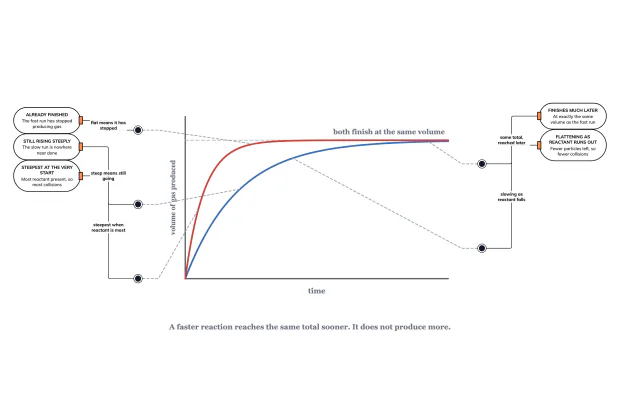
The products, the amount of them, and whether the reaction gives out energy or takes it in. A catalyst changes the route, not the destination, so the same substances are produced and the overall energy change is identical — an exothermic reaction stays exothermic by exactly the same amount. It does not change the final yield either: on a rate graph, a catalysed run is steeper and levels off sooner, at the same height, which is the figure from the previous tutorial doing another job. Anything that claimed to produce more product is describing something other than a catalyst. Route and destination are separate, and almost every wrong claim about catalysts confuses the two.
What is an enzyme?
A biological catalyst, and the biology category is full of them without ever explaining what one is. Every enzyme is a protein folded into a particular shape, and the shape is what makes it work: it holds its particular reactant in a particular orientation and provides a lower-energy route, exactly as an industrial catalyst does. That is also why heat destroys them — unfolding the protein destroys the shape, so the route disappears. Digestion, respiration and photosynthesis all depend on them, and all three run at body or leaf temperatures that would otherwise be far too cool for the chemistry involved. Without them a body would have to be hot enough to cook itself to run the same chemistry at the same speed.
Real World Example
Three Catalysts Doing Very Different Jobs
Catalysis is not a laboratory curiosity. Most industrial chemistry and essentially all biochemistry depends on it.
Step 1
A catalytic converter is mostly surface
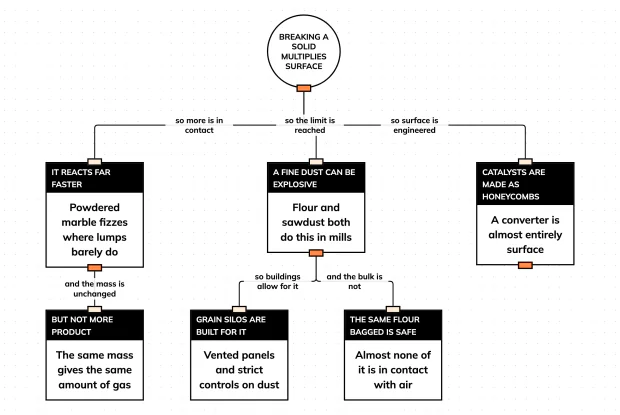
A car’s catalytic converter holds platinum, palladium and rhodium spread extremely thinly over a ceramic honeycomb. The honeycomb exists to maximise surface, because the reaction happens where the gases touch the metal — which is the surface-area lever from two tutorials ago applied to the catalyst rather than the reactant. Exhaust gases pass through, carbon monoxide and unburnt fuel are converted to carbon dioxide, and the metals are unchanged. The same converter works for the life of the car, because nothing is being used up. The metals are expensive, which is why converters are worth stealing and why they are recovered when a car is scrapped.
Step 2
The ammonia process runs on an iron catalyst
Nitrogen and hydrogen combine to make ammonia, the basis of most fertiliser, and the nitrogen molecule is held together so strongly that the reaction is hopelessly slow on its own. An iron catalyst provides a surface route that weakens that bond, and the process becomes practical at temperatures and pressures a plant can actually maintain. The balanced equation from the reactions track, N₂ + 3H₂ → 2NH₃, is unchanged by the catalyst — only the speed is. The ratio the plant feeds its gases in comes from the equation; the conditions it runs them at come from the catalyst.
Step 3
Enzymes let a cell work at thirty-seven degrees
Breaking down starch, releasing energy from glucose and building proteins all involve reactions that would need high temperatures or strong chemicals outside a body. Enzymes provide lower-energy routes so they run quickly at body temperature instead, and each one is specific to its reaction because its shape fits one particular molecule. A cell contains thousands of different enzymes for exactly that reason, which is a very different design from a converter using one metal for several jobs. Specificity is the price of working in a mixture as complicated as a cell, where the wrong reaction would be worse than a slow one.
FAQs
Final Words
A catalyst looks like something for nothing and is not. The thing limiting a slow reaction is that almost no collision clears the activation energy, and there are two ways to get more collisions over a bar: raise the particles or lower the bar. Heating does the first. A catalyst does the second, by offering a different route from the same reactants to the same products that costs less to get started.
Nothing is given any energy, and the particles move exactly as they did before — the collisions that were already happening and already failing are simply now enough. The catalyst takes part and is handed back unchanged at the end of each cycle, which is why a small quantity works indefinitely. And because the route changed rather than the destination, the products, the yield and the overall energy change are all identical: a catalysed run is steeper and finishes sooner, at exactly the same height.
Continue This Track
This concept is part 4 of How Fast Does a Reaction Go.
What Has to Happen for a Reaction to Occur?
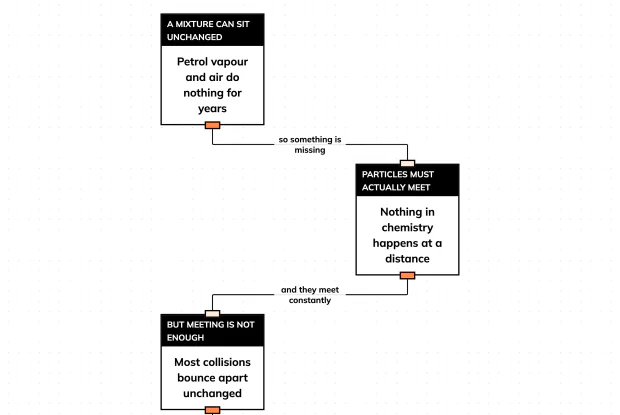
Petrol vapour and air sit together for years without reacting, then go off in milliseconds. Work out what was missing, and what a reaction rate counts, in an interactive playground.
What Makes a Reaction Go Faster? Only Two Things
Temperature, concentration, surface area and catalysts look like four unrelated tricks. They are two, and knowing which is which tells you what each one will do. Sort them in an interactive playground.
How Do You Read a Rate Graph? Steepness Is Rate
Two curves, one reaction, two speeds. The steepness tells you the rate and the final height tells you the amount — and they are different things. Label both curves in an interactive playground.
What Does a Catalyst Actually Do? It Lowers the Bar
A catalyst speeds a reaction up without being used up and without adding any energy. Work out how that is possible, in an interactive playground.
Why Does a Powder React So Much Faster Than a Block?
A lump of flour burns slowly and a cloud of it explodes. Same substance, same mass, and the only difference is how much of it the air can reach. Trace the consequences in an interactive playground.