Why Does a Plant Need Minerals Too? Sort It Out
Root Concept
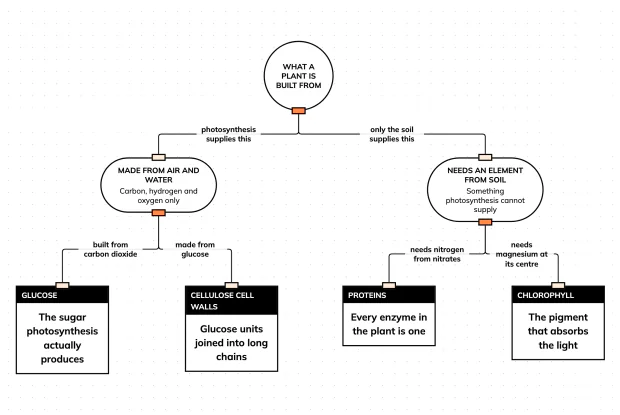
Photosynthesis produces glucose, which contains only carbon, hydrogen and oxygen, so a plant must absorb mineral ions from the soil to obtain the other elements it needs, notably nitrogen for proteins and magnesium for chlorophyll.
CodePLU Goal
Upgrading Human Mental Models
Learn how to think in Workflows

Concept Development By codeplu.com
Count the elements in glucose and the right-hand column becomes obvious. It has no nitrogen in it.
What Photosynthesis Cannot Make
A primary-level tutorial in this subject makes the point that a plant does not eat soil, and that a tree is mostly built out of air. Both of those are true and both are worth keeping. This tutorial adds the part that was left out, which is what the soil is genuinely for.
Start with what photosynthesis actually produces. Glucose has the formula C6H12O6: six carbon atoms, twelve hydrogen, six oxygen, and nothing else. The carbon and oxygen came from carbon dioxide, the hydrogen from water. So anything a plant builds that contains only those three elements can be made from glucose with no further ingredients at all — and a great deal of a plant is like that. Cellulose, the material of every cell wall, is simply glucose units joined into long chains. Starch is the same. Oils and fats are made of the same three elements.
But proteins contain nitrogen, and glucose has no nitrogen in it. Chlorophyll has a magnesium atom at its centre, and glucose has no magnesium. No amount of photosynthesis will ever produce either element, because they were not among the raw materials. The plant has to get them from somewhere else, and the only place available is the soil, as mineral ions dissolved in the water the roots take up. That is the real answer to what soil is for.
What the Soil Supplies
Why can glucose not be turned into protein?
Because you cannot build something out of an element that is not there. Proteins are chains of amino acids, and every amino acid contains nitrogen in the group that gives it its name. Glucose contains carbon, hydrogen and oxygen in fixed proportions and no nitrogen at all, and no chemical process available to a living cell creates one element from another. A plant with unlimited light, carbon dioxide and water, growing in a nitrogen-free medium, would make sugar and starch and cellulose perfectly well and would be unable to make a single enzyme. Since enzymes control every reaction including photosynthesis itself, it would not grow at all beyond what its seed provided.
What does a plant do with nitrates?
It combines them with sugars it has made to build amino acids, and joins those into proteins. Nitrogen reaches the roots as nitrate ions dissolved in soil water, which the previous track showed are produced by bacteria — some living free in the soil, some in nodules on the roots of legumes, and some releasing nitrogen compounds as they decompose dead material. The plant cannot use nitrogen gas from the air however much of it there is, which is why the bacteria matter so much. A plant short of nitrate grows poorly and its older leaves turn yellow, because it moves what nitrogen it has to the new growth where it is needed most.
Why does chlorophyll need magnesium?
Because the molecule is built around it. A chlorophyll molecule has a flat ring structure with a single magnesium atom held at the centre, and that arrangement is what allows it to absorb light and pass the energy on. Without magnesium the molecule cannot be completed. The visible consequence is striking: a plant short of magnesium turns yellow between the veins of its older leaves while the veins themselves stay green, a pattern called chlorosis. And because chlorophyll is what drives photosynthesis, a magnesium shortage in the soil becomes a shortage of food, even where light and carbon dioxide are plentiful. The plant is not short of raw materials for sugar; it is short of the machinery that turns them into it.
How do minerals get into a root?
By active transport, which is the mechanism from Track 4 rather than the simple soaking-up people often imagine. Mineral ions are usually more concentrated inside the root cells than in the soil water around them, so diffusion would move them the wrong way. Root hair cells therefore spend energy pumping ions in against the concentration gradient, which is why roots need oxygen and why waterlogged soil kills plants — the roots cannot respire, so they cannot power the pumping. Water, by contrast, enters passively by osmosis. The two substances arrive together, in the same stream of water, and by completely different means — one costing the plant energy and the other costing it nothing.
Real World Example
Growing Plants Without Any Soil
The cleanest demonstration that soil supplies elements rather than food is that plants grow perfectly well with no soil at all, provided the right ions are in the water.
Step 1
Remove the soil entirely
In hydroponics a plant is grown with its roots in a water solution, or in an inert material such as gravel or rock wool that holds no nutrients of its own. There is no soil anywhere in the system. If soil were food, nothing would grow. Plants grown this way can match or exceed the growth of the same plants in good earth, which settles the question immediately: whatever soil contributes, it is not bulk material that becomes part of the plant. That came from the air and the water all along, exactly as the primary-level tutorial said.
Step 2
Add the ions back one at a time
The solution has to contain the mineral ions a plant needs — nitrates, phosphates, potassium, magnesium and several others in much smaller amounts. Leave one out and the deficiency appears, reliably and in a form specific to that element. Omit nitrate and growth is stunted with yellowing older leaves; omit magnesium and yellowing appears between the veins. These experiments are how the requirements were worked out in the first place, and they are the reason the list is known with any confidence rather than guessed at. Each element on it earned its place by a plant visibly failing without it.
Step 3
Why anyone bothers
Hydroponics is now used commercially for salad crops and tomatoes, often in the same greenhouses that control the limiting factors from two tutorials ago. The attraction is control: the grower sets the concentration of every ion, water is recirculated rather than drained away, and soil-borne diseases are absent. The drawbacks are cost and fragility, since a system with no soil has no reserve of anything and a pump failure is serious within hours. It is a demonstration of the principle that happens also to be a business, which is a reasonable sign that the principle is right.
FAQs
Final Words
Glucose is carbon, hydrogen and oxygen, and that is the whole of what photosynthesis delivers. Everything a plant builds from those three elements alone — cellulose, starch, oils — it can make unaided. Everything else needs an element that was never among the raw materials, and those come from the soil as dissolved ions: nitrogen for proteins, magnesium for chlorophyll, and a dozen more in smaller amounts.
That is why a plant does not eat soil and still cannot live without it, and why hydroponics works. This track opened the leaf, found the structure of every layer answering a demand, watched two cells open and close a hole at the cost of water, derived the rule that one shortage at a time sets the rate, and tested for the product. The next track turns the whole thing around and asks what any living thing — plant or animal — does with the food once it has it.
Continue This Track
This concept is part 5 of How a Plant Feeds Itself.
What Is Inside a Leaf? Six Layers, Six Jobs
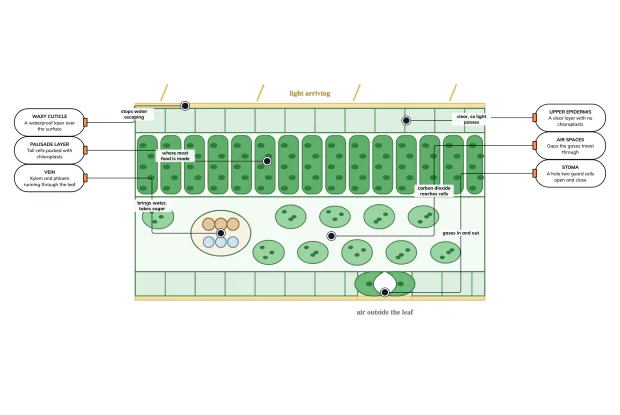
A leaf is not a green sheet but a stack of layers, each solving one problem. Cut one across and label the cuticle, palisade, air spaces, vein and stoma by the job each does, in an interactive playground.
How Does a Stoma Open and Close? Follow the Water
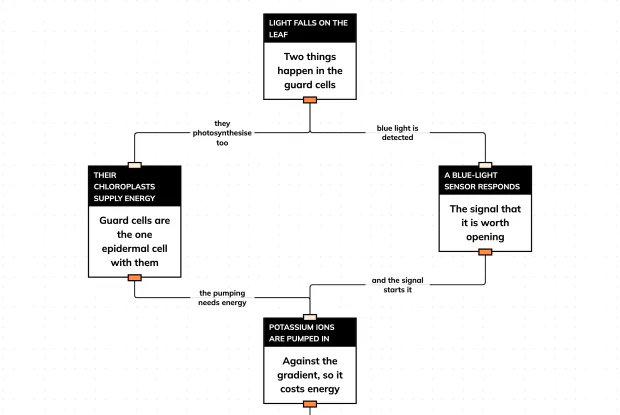
A stoma is not a fixed hole — two guard cells open and close it by taking in water and bending. Trace the chain from light to an open pore, and the cost that comes with it, in an interactive playground.
What Limits How Fast a Plant Photosynthesises?
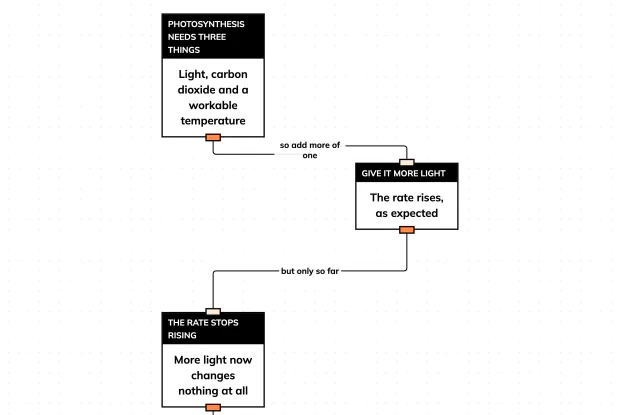
Adding more light speeds photosynthesis up — until it suddenly does not. Reason your way from that one observation to the limiting factor rule in an interactive playground.
How Do You Prove a Leaf Made Starch? Six Steps
Photosynthesis makes sugar, which a leaf stores as starch — and iodine turns blue-black on starch. Follow the classic test in order in an interactive playground, and see why each step is there.
Why Does a Plant Need Minerals Too? Sort It Out
Photosynthesis produces glucose, which contains only carbon, hydrogen and oxygen. Proteins and chlorophyll need elements it cannot supply. Sort what a plant builds in an interactive playground.