What Limits How Fast a Plant Photosynthesises?
Root Concept
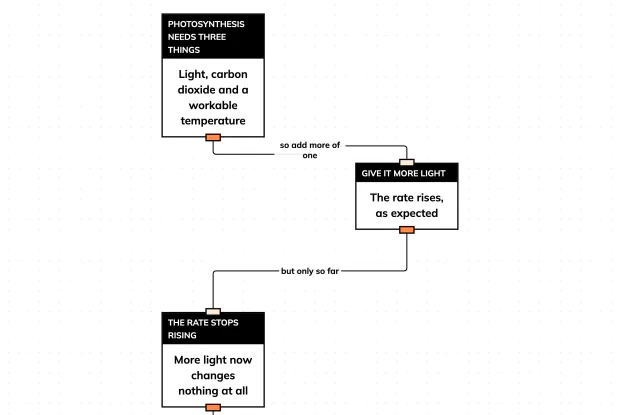
The rate of photosynthesis is set by whichever requirement is in shortest supply, called the limiting factor, so increasing any other factor has no effect until the limiting one is raised.
CodePLU Goal
Upgrading Human Mental Models
Learn how to think in Workflows

Concept Development By codeplu.com
Each step follows from the one above it. The rule at the bottom is not a new fact, only the conclusion.
Why More of a Good Thing Suddenly Stops Helping
Photosynthesis needs light, carbon dioxide, water and a temperature its enzymes can work at. A reasonable first guess is that more of any of these gives more photosynthesis. That guess is right, and then abruptly stops being right, and the reason it stops is one of the most useful ideas in plant biology.
Take a water plant in a beaker and count the oxygen bubbles it produces, which is a direct measure of how fast it is photosynthesising. Move a lamp closer and the bubbles come faster. Move it closer again and they come faster still. Keep going and at some point the bubbling stops increasing. The lamp is brighter than ever and the plant has stopped responding to it.
Nothing has broken. The plant has simply run out of something else. Light was the thing in shortest supply, so adding light helped; once there is plenty of light, the shortage has moved somewhere else — usually to carbon dioxide — and light is no longer what is holding the process back. The factor in shortest supply is called the limiting factor, and the rule is that the rate follows it and only it. That is why adding more of anything else achieves nothing, and why identifying which factor is limiting is the whole question. The playground works through that reasoning one step at a time.
Working Through the Reasoning
What does a graph of this look like?
Plot the rate of photosynthesis against light intensity and the line rises steeply at first and then levels off into a flat plateau. The sloping part is the region where light is limiting: every extra bit of light is used, so the rate climbs in proportion. The flat part is the region where it is not: light is in surplus and something else has become the bottleneck. The point where the line bends is where the limiting factor changes over from light to whatever is next in short supply. The same shape appears if you plot the rate against carbon dioxide concentration instead, for exactly the same reason, which is a good sign that the explanation is about the principle rather than about light.
How do you prove which factor is limiting?
By raising a different one and seeing whether anything happens. If the rate is on the plateau and you increase the carbon dioxide concentration, the whole line lifts and the plateau sits higher — which tells you that carbon dioxide was the thing in short supply. If instead you raise the carbon dioxide and nothing at all changes, it was not carbon dioxide and you look elsewhere. This is the practical form of the rule and it is genuinely useful: a factor that is limiting produces a response when you change it, and a factor that is not produces nothing. Only one factor is limiting at any moment, though which one it is can change through the day.
Why does temperature behave differently?
Because it affects enzymes rather than supplies. Light and carbon dioxide are raw materials, and more of a raw material is never directly harmful. Temperature works on the enzymes controlling the reactions, so raising it speeds those reactions up only to a point. Past that, the enzymes begin to denature — the same unfolding from the food preservation tutorial — and the rate falls, often sharply. A graph of rate against temperature therefore rises to a peak and then drops, rather than rising to a plateau and staying there. Too much light or carbon dioxide simply stops helping; too much heat actively destroys the machinery, which is why a greenhouse is held at a target temperature rather than made as warm as possible.
Is water ever the limiting factor?
In the strict sense it very rarely is, which surprises people. The amount of water used directly in photosynthesis is tiny compared with the amount a plant takes up, so a plant short of water is almost never short of it for this reaction specifically. What happens instead is indirect and was the subject of the previous tutorial: a plant short of water closes its stomata to stop losing more, and with the stomata shut no carbon dioxide can get in. Photosynthesis then slows dramatically, but the limiting factor is carbon dioxide, and the lack of water is the reason that shortage exists. It is worth separating the two, because "the plant needs water" and "water is the limiting factor" are different claims and only the first is true here.
Real World Example
A Commercial Tomato Greenhouse
A greenhouse is a device for taking each limiting factor in turn and raising it until something else becomes the limit. Working out which to raise next is the whole business.
Step 1
Raise the temperature first
In a cool climate the first thing holding the crop back is temperature, because the enzymes are working slowly. The glass itself does much of the work by trapping heat, and growers add heating on top of that to hold the temperature near the optimum for the crop. Pushing higher does not keep helping, because past the optimum the enzymes begin to denature and the rate falls away again. So this factor is raised to a target and held there rather than maximised, which is the practical difference between a factor that plateaus and one that peaks.
Step 2
Then add light
With temperature no longer the constraint, light usually becomes it, particularly in winter and at the short end of the day. Growers install lamps and run them for extra hours, which lifts the rate along the sloping part of the light graph. Eventually the plants stop responding: the lamps are on, the plants are warm, and more light is changing nothing. That is the plateau from the playground, reached deliberately, and it is the signal that the limiting factor has moved on to something else. A grower who kept buying lamps at this point would be spending money for no return whatever.
Step 3
Then add carbon dioxide
The remaining shortage is usually carbon dioxide, which makes up only about four hundredths of one per cent of ordinary air. Growers therefore pipe carbon dioxide into sealed greenhouses, often two or three times the outdoor concentration, and the yield rises again. This is the limiting factor rule used as a tool rather than illustrated as a principle: each factor is raised only once it is actually the one holding things back, because raising any of the others while it is not limiting costs money and changes nothing at all. The sequence is not fixed either — which factor is limiting shifts with the season and with the time of day.
FAQs
Final Words
The reasoning runs in five steps and none of them is difficult on its own. Photosynthesis needs several things; adding more of one speeds it up; at some point it stops speeding up; that means the one you were adding is no longer the shortage; so the rate is being set by whichever requirement is scarcest. That last sentence is the limiting factor rule, and it was derived rather than announced.
The practical value is that it tells you what to change. A grower with plants that have stopped responding to light knows not to buy more lamps, and a student asked why a graph has a plateau knows the shortage has moved. It also explains the odd case where a plant short of water is really short of carbon dioxide. The next tutorial leaves rates behind and asks a different question: how would you actually prove a leaf has made anything at all?
Continue This Track
This concept is part 3 of How a Plant Feeds Itself.
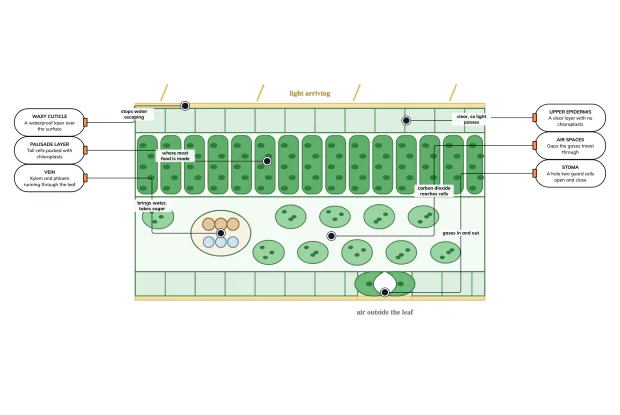
What Is Inside a Leaf? Six Layers, Six Jobs
A leaf is not a green sheet but a stack of layers, each solving one problem. Cut one across and label the cuticle, palisade, air spaces, vein and stoma by the job each does, in an interactive playground.
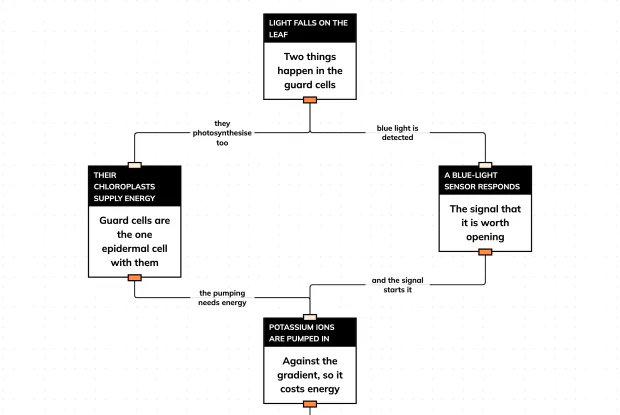
How Does a Stoma Open and Close? Follow the Water
A stoma is not a fixed hole — two guard cells open and close it by taking in water and bending. Trace the chain from light to an open pore, and the cost that comes with it, in an interactive playground.
What Limits How Fast a Plant Photosynthesises?
Adding more light speeds photosynthesis up — until it suddenly does not. Reason your way from that one observation to the limiting factor rule in an interactive playground.
How Do You Prove a Leaf Made Starch? Six Steps
Photosynthesis makes sugar, which a leaf stores as starch — and iodine turns blue-black on starch. Follow the classic test in order in an interactive playground, and see why each step is there.
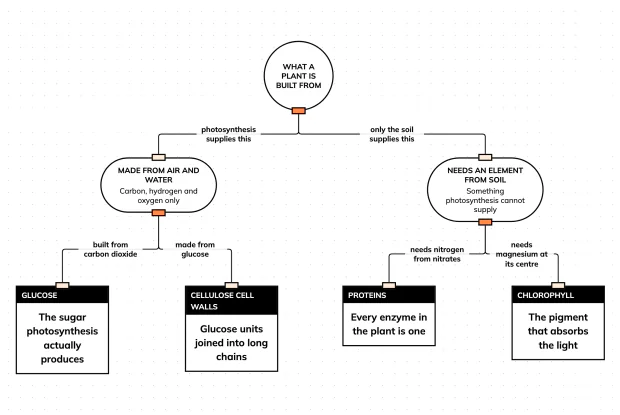
Why Does a Plant Need Minerals Too? Sort It Out
Photosynthesis produces glucose, which contains only carbon, hydrogen and oxygen. Proteins and chlorophyll need elements it cannot supply. Sort what a plant builds in an interactive playground.