How a Plant Feeds Itself
An earlier tutorial in this subject establishes what photosynthesis needs and what it produces, at a level a younger reader can follow. This track asks the questions that one leaves open, starting by cutting a leaf across: light arrives from above so the chloroplast-packed cells are at the top under a transparent layer, carbon dioxide has to reach every cell so the tissue below them is mostly connected air, and because the surface would dry out it is sealed with wax and the openings are underneath. Those openings are not holes but gaps between two cells that bend apart when water enters them by osmosis, and the board makes unavoidable the fact that admitting carbon dioxide and losing water vapour are one event rather than two. From there the track derives the limiting factor rule from a single observation — more light helps until abruptly it does not — then turns to evidence, walking through the starch test in an order where the two steps that look skippable, destarching and the foil, are the two carrying the whole argument. It closes on what photosynthesis cannot do: glucose is carbon, hydrogen and oxygen, so proteins and chlorophyll need elements that only the soil supplies.
CodePLU Goal
Upgrading Human Mental Models
Learn how to think in Workflows
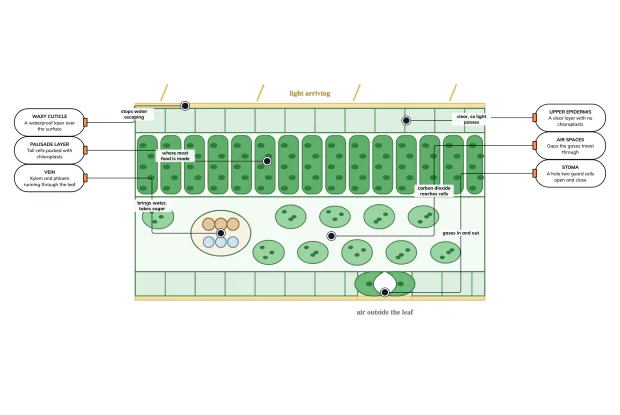
What Is Inside a Leaf? Six Layers, Six Jobs
A leaf is not a green sheet but a stack of layers, each solving one problem. Cut one across and label the cuticle, palisade, air spaces, vein and stoma by the job each does, in an interactive playground.
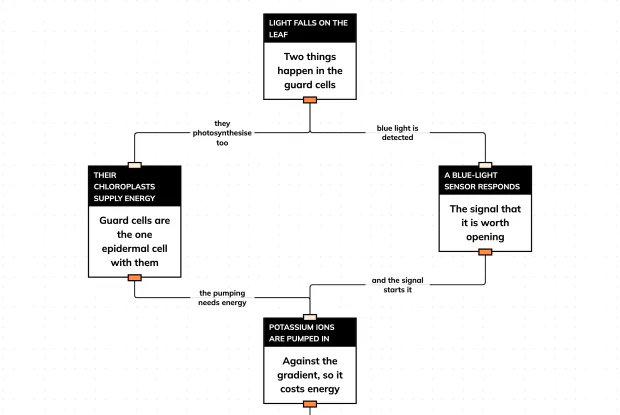
How Does a Stoma Open and Close? Follow the Water
A stoma is not a fixed hole — two guard cells open and close it by taking in water and bending. Trace the chain from light to an open pore, and the cost that comes with it, in an interactive playground.
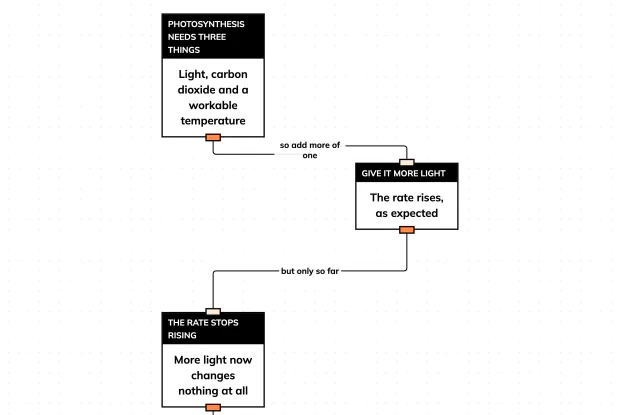
What Limits How Fast a Plant Photosynthesises?
Adding more light speeds photosynthesis up — until it suddenly does not. Reason your way from that one observation to the limiting factor rule in an interactive playground.
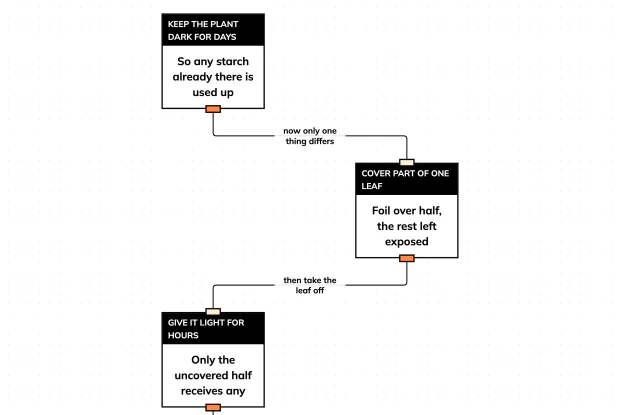
How Do You Prove a Leaf Made Starch? Six Steps
Photosynthesis makes sugar, which a leaf stores as starch — and iodine turns blue-black on starch. Follow the classic test in order in an interactive playground, and see why each step is there.
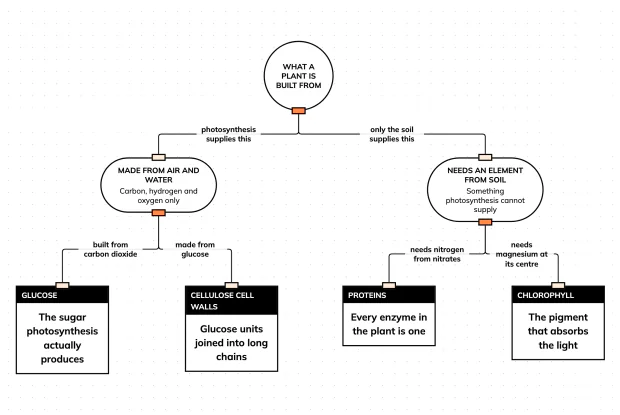
Why Does a Plant Need Minerals Too? Sort It Out
Photosynthesis produces glucose, which contains only carbon, hydrogen and oxygen. Proteins and chlorophyll need elements it cannot supply. Sort what a plant builds in an interactive playground.