How Does a Stoma Open and Close? Follow the Water
Root Concept
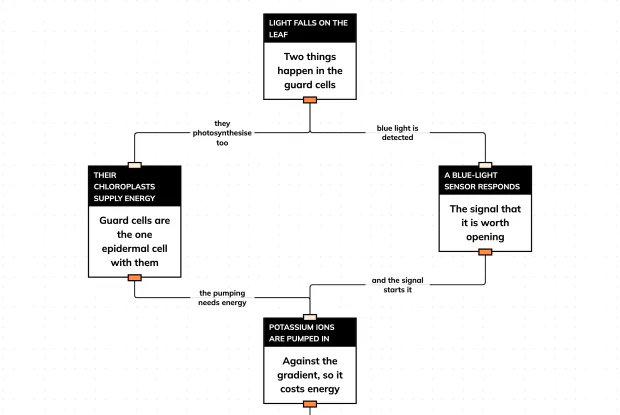
A stoma opens when its two guard cells absorb water by osmosis and become turgid, and because their inner walls are thicker and less elastic than their outer walls they curve apart as they swell, leaving a pore between them that admits carbon dioxide and allows water vapour to escape.
CodePLU Goal
Upgrading Human Mental Models
Learn how to think in Workflows

Concept Development By codeplu.com
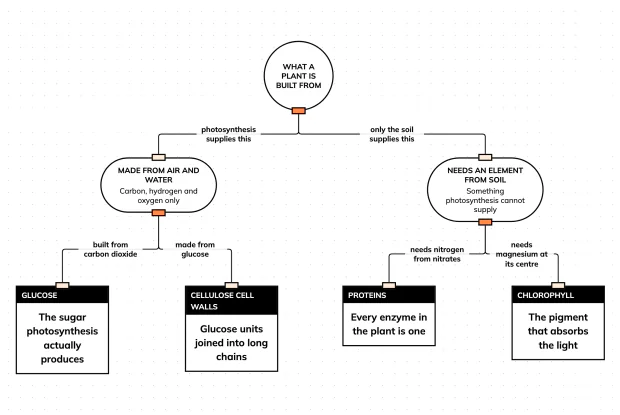
The two branches at the bottom are the same event. A plant cannot take one without the other.
A Hole That Can Change Its Mind
The previous tutorial left the openings on the underside of a leaf described simply as holes. If they were holes the problem would be unsolvable, because a plant on a hot dry day would go on losing water through them until it died. They are not holes. Each one is a gap between two cells that can change shape, and the plant controls it.
The mechanism is osmosis, which was the subject of a tutorial two tracks ago, and it is worth seeing the same idea do real work here. In light, guard cells actively take in potassium ions, which makes the solution inside them more concentrated than the solution outside. Water therefore moves into them by osmosis, exactly as it moved into a cell in dilute surroundings in Track 4. The guard cells swell and become turgid.
What makes swelling open a hole rather than simply making two cells bigger is the way their walls are built. The wall facing the pore is thicker and stiffer than the wall on the outside. When the cell swells, the stretchy outer wall gives way more than the stiff inner one, so the whole cell curves — and since both guard cells curve away from the line between them, a gap opens up. In the dark the ions leave, water follows them out, the cells go limp and fall back together, and the pore closes. The playground traces that chain, and then the two things that follow from the pore being open — which are not both good news.
Each Link in the Chain
Why do the guard cells take in salts first?
Because water cannot be pumped directly, and making the inside more concentrated is the only way to make it come. Osmosis moves water from where a solution is dilute to where it is concentrated, and nothing a cell does can reverse that. So the guard cell spends energy actively transporting potassium ions in from the surrounding cells — the active transport from Track 4, working against the concentration gradient and costing the cell energy. Once those ions are inside, the water follows on its own and no further energy is needed. The sequence is important and often got backwards: the salts move first and deliberately, and the water moves second and passively.
Why does swelling make the cells bend?
Because the two sides of the cell are not built the same. The inner wall, the one facing the pore, is noticeably thicker and less elastic than the outer wall. When water enters and pressure inside the cell rises, every part of the wall is pushed outward, but the thin outer wall stretches considerably more than the thick inner one. A tube that lengthens on one side and not the other has no choice but to curve, and it curves away from the stiff side. Both guard cells do this at the same time and both curve away from the pore between them, so the gap opens. Lose the pressure and the elastic outer wall pulls the cell straight again.
What does an open stoma cost?
Water, continuously, and far more of it than most people expect. A plant loses the great majority of the water its roots take up as vapour escaping through open stomata, a process called transpiration. The reason is that the air spaces inside a leaf are saturated with moisture while the air outside almost never is, so whenever a pore is open water vapour diffuses out down that gradient. The plant cannot avoid this, because the same opening that lets carbon dioxide in lets water vapour out — they are the same hole. All a plant can do is decide when the exchange is worth making, which is what the closing half of the mechanism is for: in the dark the ions leave, water follows them out, the cells go limp and fall back together.
When does a plant close its stomata anyway?
When the water is more valuable than the carbon dioxide. At night there is no light, so no photosynthesis is happening and carbon dioxide is of no immediate use; most plants close their stomata and stop losing water for nothing. In hot dry conditions many plants close them during the middle of the day even though the light is strongest, because losing water faster than the roots can replace it would wilt the plant. Photosynthesis slows while they are shut, which is a real cost, and the plant is choosing the lesser of two losses. Some desert plants go further and open their stomata only at night, taking in carbon dioxide in the cool and storing it chemically until there is light to use it.
Real World Example
A Potted Plant on a Windowsill
Nothing about guard cells can be seen without a microscope, but the consequences of the chain are visible on any houseplant left in the sun.
Step 1
Morning: the stomata open
Light falls on the leaves and the guard cells begin taking in potassium ions, water follows by osmosis, and within an hour or so the pores are open across the undersides of every leaf. Carbon dioxide starts diffusing in through the air spaces and photosynthesis gets going. Water is being lost at the same time, but the soil is damp, the roots are supplying more than enough, and the plant is making sugar. This is the arrangement working exactly as it should, and it is also the state in which the plant is most exposed.
Step 2
Midday: the leaves droop
By early afternoon the pot is dry and the sun is strong. Water is leaving the leaves faster than the roots can replace it, and cells throughout the leaf lose the internal pressure that was holding them firm — the same turgor that holds the guard cells bent. A plant held up by water pressure rather than by wood goes limp when that pressure falls, which is what wilting is. The guard cells lose pressure too and the stomata shut, which stops the water loss but also stops the carbon dioxide supply — so the plant has protected itself at the cost of the thing it opened them for.
Step 3
Evening: watering reverses it
Water the pot and within an hour or two the leaves lift again. Nothing was repaired, because nothing was broken: water moved into the root cells by osmosis, travelled up the xylem, refilled the leaf cells, and the pressure that holds them firm was restored. The plant was never damaged in the way a wilted plant appears to be, though a plant left wilted long enough does suffer real harm. The whole episode is the same osmosis from Track 4, operating on a scale large enough to see across a room, and running in both directions within a single afternoon.
FAQs
Final Words
Light starts it, salts move first and water follows them, and the cells bend because their inner walls are stiffer than their outer ones. That is the whole mechanism, and every step of it is osmosis and active transport from two tracks ago doing a real job in a real structure.
What the board makes hard to miss is the pair of branches at the bottom. An open pore admits carbon dioxide and releases water vapour, and those are not two separate events that a plant could arrange differently — they are one event seen from two sides. Every adaptation in the previous tutorial, from a waxy cuticle to a cactus spine, is an attempt to shift that trade without escaping it. The next tutorial asks what sets the speed of the whole process once the carbon dioxide is in.
Continue This Track
This concept is part 2 of How a Plant Feeds Itself.
What Is Inside a Leaf? Six Layers, Six Jobs
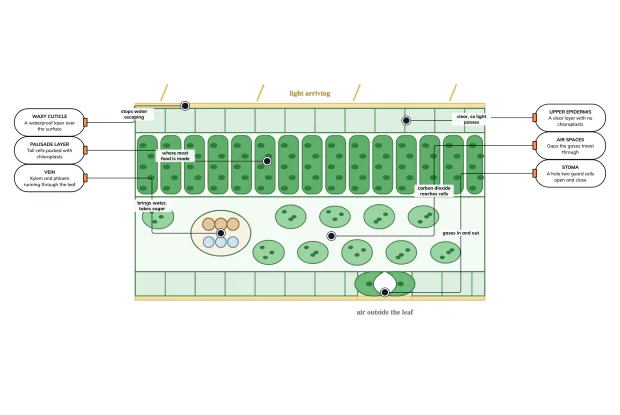
A leaf is not a green sheet but a stack of layers, each solving one problem. Cut one across and label the cuticle, palisade, air spaces, vein and stoma by the job each does, in an interactive playground.
How Does a Stoma Open and Close? Follow the Water
A stoma is not a fixed hole — two guard cells open and close it by taking in water and bending. Trace the chain from light to an open pore, and the cost that comes with it, in an interactive playground.
What Limits How Fast a Plant Photosynthesises?
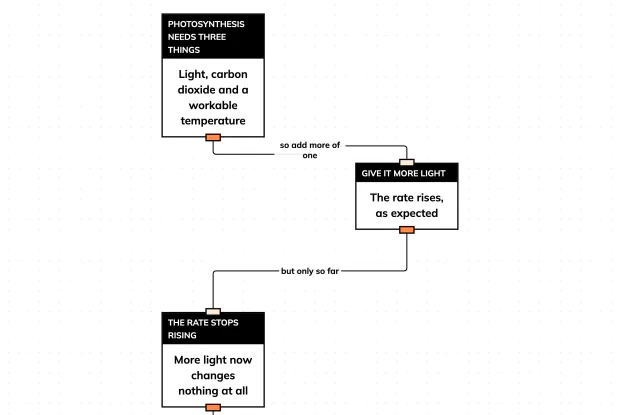
Adding more light speeds photosynthesis up — until it suddenly does not. Reason your way from that one observation to the limiting factor rule in an interactive playground.
How Do You Prove a Leaf Made Starch? Six Steps
Photosynthesis makes sugar, which a leaf stores as starch — and iodine turns blue-black on starch. Follow the classic test in order in an interactive playground, and see why each step is there.
Why Does a Plant Need Minerals Too? Sort It Out
Photosynthesis produces glucose, which contains only carbon, hydrogen and oxygen. Proteins and chlorophyll need elements it cannot supply. Sort what a plant builds in an interactive playground.