What Is Inside a Leaf? Six Layers, Six Jobs
Root Concept
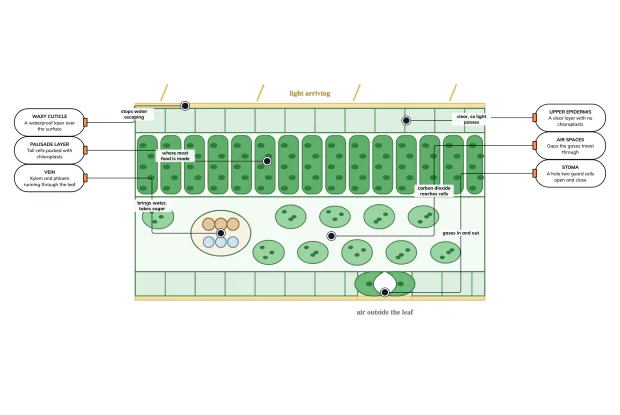
A leaf is organised in layers whose positions follow from their functions: a transparent upper epidermis under a waterproof cuticle, a palisade layer of chloroplast-packed cells near the light, a spongy layer of air spaces for gas exchange, veins supplying water and removing sugar, and stomata underneath.
CodePLU Goal
Upgrading Human Mental Models
Learn how to think in Workflows

Concept Development By codeplu.com
Nothing here is arranged by accident. Ask what each layer needs and its position follows.
A Flat Green Thing, Until You Cut It Open
An earlier tutorial established what photosynthesis needs — light, carbon dioxide and water — and what it produces. It did not ask how a leaf is built to supply all three at once, and that turns out to be a demanding problem with a rather elegant solution.
Light arrives from above, so cells that use it should be near the top. Carbon dioxide is in the air outside and has to reach every cell, so there must be a route in and a way for the gas to get around once it is inside. Water arrives from the roots, which are a long way below, so something must carry it up and distribute it. Sugar is made in the leaf and needed everywhere else, so something must carry that away. And the whole arrangement has to do all of this while sitting in sunshine and moving air without drying out.
Cut a leaf across and every one of those demands has a structure answering it. The cells with the most chloroplasts are packed into a layer near the top, directly under a transparent layer that does not block the light. Below them the tissue is mostly empty space, which is where the gases move. Veins run through carrying water in and sugar out. The surface is waterproofed with wax, and the holes that let gas in are on the underside, where the sun does not shine on them directly. The playground is that cross-section, and the job of each layer is the label on it.
Why Each Layer Is Where It Is
Why are the palisade cells at the top and tall?
Because they do most of the photosynthesis and light is strongest where it arrives. Palisade cells sit directly under the transparent upper epidermis, are packed with far more chloroplasts than any other cell in the leaf, and are arranged standing upright in a close row. The shape matters as much as the position. A tall narrow cell presents a long column of chloroplasts to light coming straight down, so a photon that misses the first chloroplast may still meet one further down the same cell. Packing them side by side with almost no gaps means very little light passes between them unused. This is a layer built for catching light and almost nothing else.
Why is the layer below mostly air?
Because carbon dioxide has to reach every photosynthesising cell, and gases move through air hundreds of times faster than through water or tissue. The spongy mesophyll is a loose arrangement of rounded cells with large connected gaps between them, and those gaps form a continuous air system reaching from the stomata on the underside right up to the palisade cells. Carbon dioxide entering a stoma diffuses through that space and dissolves into the thin film of water on each cell surface before crossing the membrane — the diffusion from Track 4, over a distance short enough for diffusion to be fast. Oxygen leaves by exactly the same route in reverse.
Why is the leaf waterproofed on top but full of holes underneath?
Because it has two incompatible needs and solves them in different places. Carbon dioxide can only get in through an opening, and any opening that lets gas in also lets water vapour out. The leaf therefore seals the surface with a waxy cuticle, which stops water escaping through the epidermis itself, and concentrates the openings on the underside. Underneath is cooler and shaded, so the air immediately outside the hole is more humid and less water is lost through it than the same hole on top would lose. The compromise is never fully resolved, only moved: a leaf still loses far more water than it uses, and the openings have to be closeable. The next tutorial is about the two cells that control each one.
What are the veins doing in the middle?
Supplying one thing and removing another, using the two tissues from the tutorial on xylem and phloem. Xylem brings water up from the roots and delivers it into the leaf, where it is used in photosynthesis and lost as vapour through the stomata. Phloem carries the sugar made in the leaf away to wherever the plant needs it — growing tips, roots, developing fruit. The veins branch finely enough that no cell in the leaf is far from one, which matters because water has to reach every cell and sugar has to be collected from every cell. The visible network of lines on a leaf is this system seen from outside.
Real World Example
Why a Cactus Looks Nothing Like This
Every feature in the playground is a compromise between catching light and losing water. Change how scarce the water is and the compromise moves, which is why desert plants look the way they do.
Step 1
A broad flat leaf is a water problem
The shape that catches light best is the shape that loses water fastest, because both depend on surface area. A broad flat leaf presents a large area to the sun, which is the point, and also a large area carrying thousands of stomata through which water vapour escapes. In a wet climate that is an easy trade, since the roots can replace what is lost. In a desert it is not, and a plant built this way would be dead within days. The structure in the playground is not the only solution; it is the solution when water is cheap.
Step 2
A cactus trades the leaf away entirely
A cactus spine is a leaf. It has been reduced to almost nothing, which removes nearly all the surface area and so nearly all the water loss, and the job of photosynthesis has moved into the stem — which is why a cactus stem is green and thick. The cuticle is much heavier than on an ordinary leaf, the stomata are fewer and sunk into pits where moving air cannot reach them easily, and the whole plant stores water internally. Catching light has been sacrificed almost completely in order to keep water, which is a sensible trade where sunlight is the one thing never in short supply.
Step 3
Most plants sit somewhere between
The two extremes make the pattern visible, and nearly every plant is a point on the line between them. Plants in deep shade tend to have broader, thinner leaves with less palisade tissue, because light is the scarce thing and water is not. Plants in exposed windy places often have small thick leaves, hairy surfaces that trap humid air near the stomata, or leaves that roll up when dry. Pine needles are another version of the same trade. Reading a leaf as a set of answers to light and water makes these look like variations rather than a list of unrelated oddities.
FAQs
Final Words
Six layers, and each one answers a question the leaf cannot avoid. Light arrives from above, so the chloroplast-packed palisade cells are at the top, under an epidermis clear enough not to block it. Carbon dioxide has to reach every cell, so the layer beneath is mostly connected air. Water and sugar have to move, so veins run through. And because the surface would otherwise dry out, it is sealed with wax and the openings are underneath.
Reading the structure this way — as a set of answers rather than a list of names — is what makes a cactus spine and a pine needle look like the same problem solved under different conditions. The openings on the underside have been described as holes so far, as though they were simply gaps. They are not: each one is controlled by two cells that can close it, and how they do that is the next tutorial.
Continue This Track
This concept is part 1 of How a Plant Feeds Itself.
What Is Inside a Leaf? Six Layers, Six Jobs
A leaf is not a green sheet but a stack of layers, each solving one problem. Cut one across and label the cuticle, palisade, air spaces, vein and stoma by the job each does, in an interactive playground.
How Does a Stoma Open and Close? Follow the Water
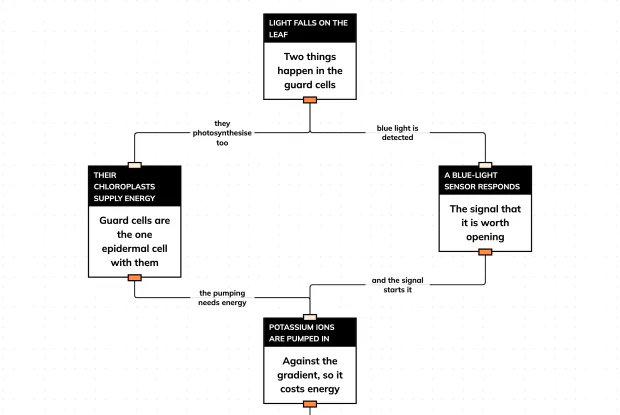
A stoma is not a fixed hole — two guard cells open and close it by taking in water and bending. Trace the chain from light to an open pore, and the cost that comes with it, in an interactive playground.
What Limits How Fast a Plant Photosynthesises?
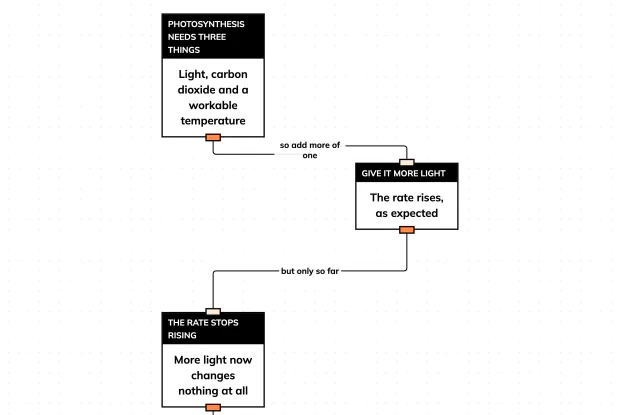
Adding more light speeds photosynthesis up — until it suddenly does not. Reason your way from that one observation to the limiting factor rule in an interactive playground.
How Do You Prove a Leaf Made Starch? Six Steps
Photosynthesis makes sugar, which a leaf stores as starch — and iodine turns blue-black on starch. Follow the classic test in order in an interactive playground, and see why each step is there.
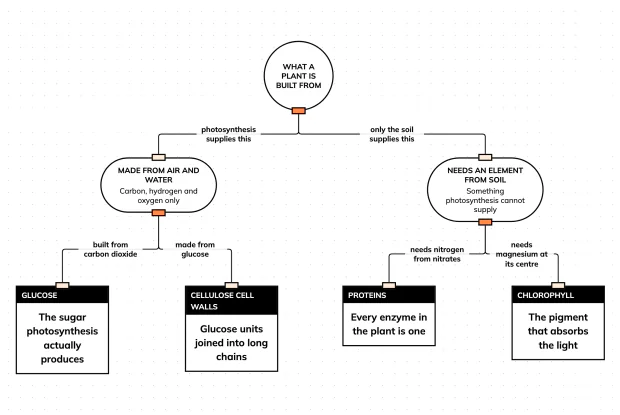
Why Does a Plant Need Minerals Too? Sort It Out
Photosynthesis produces glucose, which contains only carbon, hydrogen and oxygen. Proteins and chlorophyll need elements it cannot supply. Sort what a plant builds in an interactive playground.