How Do You Prove a Leaf Made Starch? Six Steps
Root Concept
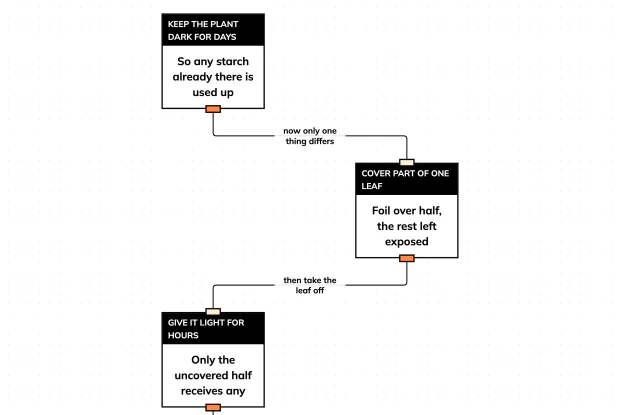
A leaf can be tested for starch by destarching the plant in darkness, covering part of a leaf, exposing it to light, then killing the leaf in boiling water, removing its chlorophyll in hot ethanol, and applying iodine, which turns blue-black only where starch has been made.
CodePLU Goal
Upgrading Human Mental Models
Learn how to think in Workflows

Concept Development By codeplu.com
Leave out the first step or the foil and the result proves nothing, however good the colour looks.
Turning a Claim Into Something You Can See
Everything in this track so far has described photosynthesis as something that happens. Nothing has shown it happening. The starch test is how a school laboratory closes that gap, and it is worth doing carefully because the usual mistakes are mistakes about evidence rather than about chemistry.
The chain of reasoning is short. Photosynthesis produces glucose, which is soluble and would disturb the water balance of the cells if it accumulated, so a plant quickly converts what it does not immediately use into starch, which is insoluble and stores compactly. Starch therefore builds up in a leaf that has been photosynthesising. And iodine solution turns a strong blue-black in the presence of starch while staying its ordinary orange-brown without it. So a leaf that goes blue-black with iodine was making food, and one that does not was not.
What turns that into an experiment rather than a demonstration is the two steps most often skipped. The plant is kept in the dark for a day or two first, so that any starch already in its leaves is used up and the test starts from nothing — otherwise a positive result might simply be last week's starch. And part of one leaf is covered with foil, so that the covered and uncovered halves differ in exactly one respect. Without those two steps the colour at the end means very little.
Why Each Step Is There
Why destarch the plant first?
Because otherwise a positive result proves nothing about what happened during the experiment. A leaf on a healthy plant usually contains starch already, made over previous days, and iodine cannot tell you when starch was made — only that it is present. Leaving the plant in complete darkness for a day or two means it cannot photosynthesise, while it continues to respire and to move sugar to the rest of the plant, so the stored starch in the leaves is gradually used up. Testing a leaf at that point should give no blue-black at all, and checking that it does not is a sensible thing to do before going further. The experiment then starts from a known zero.
What is the foil actually for?
It makes the experiment a comparison instead of an observation. With half a leaf covered and half exposed, both halves are on the same plant, in the same air, at the same temperature, with the same water supply and the same age. The only thing that differs between them is light. So if starch appears in the exposed half and not the covered half, light is the only candidate explanation, and the covered half is a control in the proper sense. Comparing two different leaves, or two different plants, would leave several other differences available and the conclusion would not follow. The whole logic of the experiment lives in that strip of foil.
Why boil the leaf, and then use ethanol?
They do two different jobs and the order matters. Boiling water kills the leaf, stopping any further chemistry, and breaks down the cell membranes and softens the tissue so that liquids can get in and out afterwards. The ethanol then dissolves the chlorophyll out, which turns the ethanol green and leaves the leaf a pale cream colour. That step is purely about being able to see the result: iodine going blue-black on a dark green leaf would be impossible to read. The leaf is usually dipped briefly back into hot water afterwards, because ethanol leaves it brittle and the water softens it enough to spread out flat. Skip the boiling and the ethanol barely penetrates; skip the ethanol and the result cannot be read.
Why is the ethanol heated in a water bath?
Because ethanol is highly flammable and must not be put over a flame. It boils at about seventy-eight degrees, so a tube of ethanol standing in hot water from a kettle gets quite hot enough to dissolve chlorophyll quickly, with no naked flame anywhere near the vapour. This is one of the few school practicals where the safety instruction and the method are the same instruction, and it is worth understanding rather than simply obeying: ethanol vapour is heavier than air, spreads along a bench, and will ignite from a burner some distance away. The usual arrangement is to turn the burner off entirely once the water is hot, so the heat source and the flammable vapour are never present at the same moment.
Real World Example
A Variegated Leaf Instead of Foil
A second version of the test uses a leaf that is naturally green in some places and white in others, which changes what is being shown without changing a single step of the method.
Step 1
The plant supplies its own comparison
A variegated leaf — a spider plant or a variegated geranium — has patches containing chlorophyll and patches that do not. Both kinds of patch are on the same leaf, receiving the same light, the same air and the same water, and differing in exactly one respect. That is the same logic as the foil, with one difference: the foil experiment varies the light and holds the chlorophyll constant, while this one varies the chlorophyll and holds the light constant. Two different claims are being tested with the same apparatus, which is a useful thing to notice about experiments generally.
Step 2
Draw the leaf before destroying it
This step is easy to forget and ruins the experiment when it is. The ethanol removes the chlorophyll, which is exactly what made the green and white regions distinguishable in the first place, so by the time the iodine goes on there is no way of telling which part was which. The leaf has to be sketched or photographed beforehand, with the pattern marked, so that the final blue-black regions can be matched against where the green used to be. In the foil version the same problem does not arise, since the foil itself marks the boundary.
Step 3
The blue-black follows the green exactly
After iodine, the regions that were green turn blue-black and the regions that were white stay orange-brown, with the boundary matching the original pattern closely enough to be convincing. The conclusion is that chlorophyll is necessary for photosynthesis, which the foil version cannot show at all. Run both and you have established two separate requirements — light in one case, chlorophyll in the other — using identical chemistry. Which claim an experiment supports depends entirely on what was held constant and what was allowed to vary, and not at all on how striking the final colour looks at the end.
FAQs
Final Words
Six steps, and the two that look optional are the two that matter most. Destarching means a blue-black result cannot be left over from last week. The foil means the covered and uncovered halves differ in exactly one respect, so a difference between them has only one explanation. The boiling, the ethanol and the iodine are chemistry, and the chemistry is the easy part.
What the test actually establishes is narrow and worth stating precisely: starch was made where there was light, and was not made where there was not. Swap the foil for a variegated leaf and the same six steps establish something different — that chlorophyll is needed — because a different thing was held constant. This track has one tutorial left, and it takes up something photosynthesis cannot supply at all.
Continue This Track
This concept is part 4 of How a Plant Feeds Itself.
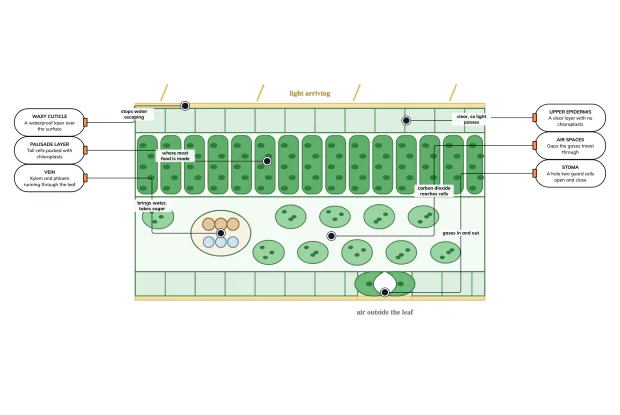
What Is Inside a Leaf? Six Layers, Six Jobs
A leaf is not a green sheet but a stack of layers, each solving one problem. Cut one across and label the cuticle, palisade, air spaces, vein and stoma by the job each does, in an interactive playground.
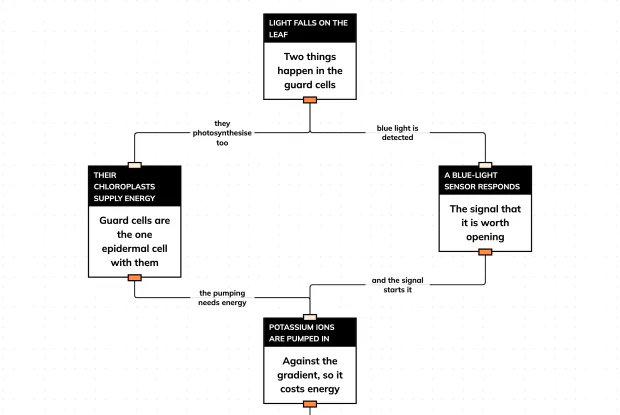
How Does a Stoma Open and Close? Follow the Water
A stoma is not a fixed hole — two guard cells open and close it by taking in water and bending. Trace the chain from light to an open pore, and the cost that comes with it, in an interactive playground.
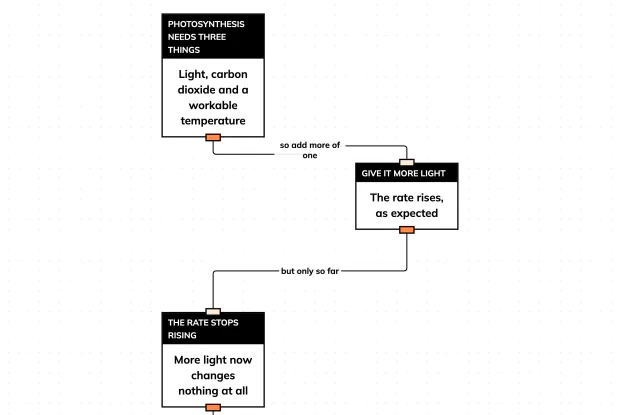
What Limits How Fast a Plant Photosynthesises?
Adding more light speeds photosynthesis up — until it suddenly does not. Reason your way from that one observation to the limiting factor rule in an interactive playground.
How Do You Prove a Leaf Made Starch? Six Steps
Photosynthesis makes sugar, which a leaf stores as starch — and iodine turns blue-black on starch. Follow the classic test in order in an interactive playground, and see why each step is there.
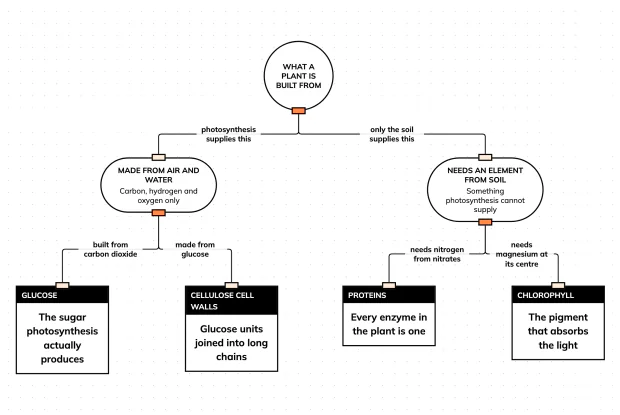
Why Does a Plant Need Minerals Too? Sort It Out
Photosynthesis produces glucose, which contains only carbon, hydrogen and oxygen. Proteins and chlorophyll need elements it cannot supply. Sort what a plant builds in an interactive playground.