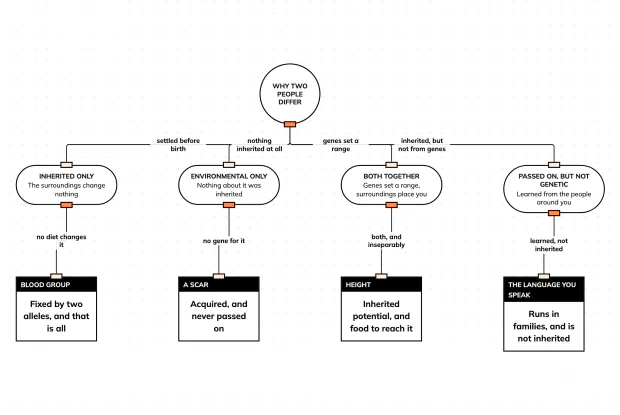
Why Can a Gene Be Carried Without Showing?
Root Concept
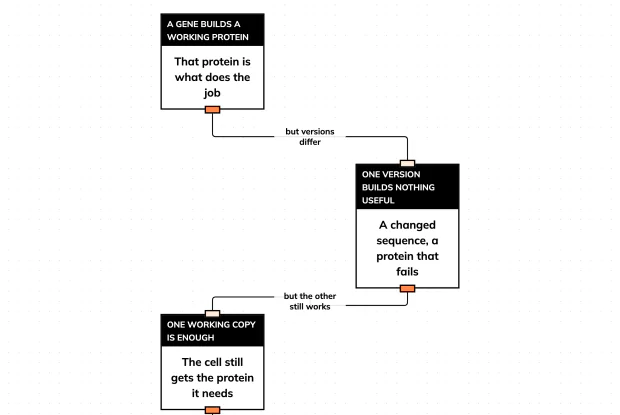
A gene usually works by building a protein, so a version that builds a working protein produces its effect even when only one copy is present and is described as dominant, while a version that builds nothing useful shows only when both copies are that version and is described as recessive.
CodePLU Goal
Upgrading Human Mental Models
Learn how to think in Workflows

Concept Development By codeplu.com
Dominance is not a contest between alleles. It is what happens when one copy is enough.
Dominant Is a Result, Not a Rule
Dominant and recessive are normally introduced as definitions to be accepted: one allele masks the other, the masked one only appears when both copies are present, and that is that. Learned this way the words sound like a rule about which allele is stronger, as though the two were in some sort of contest. They are not, and the actual explanation is both simpler and more useful.
Start from what a gene does. Most genes carry the instructions for building a protein, and the protein is what has the effect — the gene itself does nothing directly.
Now suppose a gene exists in two versions. One carries instructions that produce a working protein. The other carries a changed sequence that produces a protein which does not work, or produces none at all. An individual carrying one of each has one working set of instructions, and in most cases one working copy makes enough protein for the job to get done. So the individual looks exactly like someone carrying two working copies. The non-working version is there, will be passed on, and is completely invisible.
That is dominance, and nothing masked anything. The working version shows whenever it is present because it does something; the non-working version shows only when there is no working copy left, because only then is the protein missing. The playground works that chain through, and the words come out at the end rather than being assumed at the start.
Following the Reasoning
Why is one working copy usually enough?
Because cells generally make more of a protein than they strictly need, and because the amount can often be adjusted. A cell with one working copy of a gene instead of two typically produces somewhat less of the protein, and in most cases that is still plenty for whatever the protein does. The outcome looks the same from outside, which is all the phenotype records. It is not a universal arrangement — there are genes where one copy is not enough and a heterozygous individual shows an intermediate effect — but it is the common case, and it is why dominance is the common pattern rather than a law. The phenotype is a coarse measure, and a great deal can vary underneath it without anything visible changing at all.
So what does recessive actually mean?
That the effect appears only when both copies are that version. It is a description of when something shows, not a claim that the allele is weak or rare or harmful. A recessive allele in a heterozygous individual is present, is being copied every time that cell divides, and will be passed to half that individual's gametes. Nothing about it is suppressed in any active sense — it is simply producing a protein that does not do the job, while the other copy quietly does it. Someone carrying a recessive allele without showing it is called a carrier, and there is no way to tell from the outside. That is why a characteristic can vanish from a family for generations and then reappear, which looks mysterious until you know the allele was there the whole time.
Is dominance always this clear-cut?
No, and the tidy version taught first is a simplification worth knowing as a simplification. Some genes show incomplete dominance, where one working copy produces a noticeably reduced effect and the heterozygous individual looks intermediate — a red flower and a white one giving pink offspring is the standard example. Some show codominance, where both alleles are fully expressed at once, as the AB blood group in the previous tutorial does. And a great many characteristics are controlled by several genes together, where talking about one dominant allele makes no sense at all — height and skin colour are both like this, and both vary continuously rather than falling into categories. Dominance is one pattern among several, and it is taught first because it is the simplest, not because it is the rule.
Why are harmful alleles so often recessive?
Because a version that produces a working protein is unlikely to be the harmful one, and most harmful versions are ones where something has stopped working. That puts them on the recessive side of the chain in the playground almost automatically. It also explains why such alleles persist in a population rather than disappearing: carriers show no effect at all, so nothing removes the allele from them, and it can be passed on quietly for many generations. A dominant harmful allele has no such hiding place: it shows in everyone who carries it, so it is exposed in every generation, which is one reason such alleles are rarer. The asymmetry is a consequence of the chain in the playground rather than a separate fact to learn.
Real World Example
Why Some Cats Are Ginger and Most Are Not
Cat coat colour is a convenient example because the genetics is well understood, the results are visible from across a room, and one of the genes behaves in an unusual way that illustrates the limits of the tidy version.
Step 1
Black and brown come from one pigment
A gene controls an enzyme that builds the dark pigment in a cat's hair. The common version builds the enzyme properly and gives black fur. A changed version builds an enzyme that works less well, producing a browner pigment, and a further version produces less again. A cat with one black version and one brown version is black, because the working enzyme is being made and the pigment gets built. Black is dominant over brown — not because it wins a contest, but because one working copy makes enough enzyme to produce black pigment, and the second copy adds nothing you could see.
Step 2
White spotting works the other way round
A separate gene affects whether pigment cells reach the skin during development. One version lets them spread normally, giving a fully coloured coat. Another interferes with the spreading, leaving patches with no pigment cells at all, which appear white. Here the interfering version is the dominant one, because a cat with one copy of it already has disrupted spreading — the interference happens whether or not a normal copy is also present. Dominance follows from what the protein does, not from which version seems more normal. A version that actively interferes with something will show up with one copy just as readily as a version that builds something useful.
Step 3
Ginger sits on the X chromosome
The gene for ginger is on the X chromosome, which breaks the whole two-copies picture for male cats, who have only one X. A male cat therefore has one allele rather than two, and whichever he has is what shows — there is no second copy to hide behind. A female has two, and one carrying both versions ends up tortoiseshell, with patches of each. This is why almost every tortoiseshell cat is female, and it is a reminder that the pair in the first tutorial is the usual arrangement rather than the only one.
FAQs
Final Words
The chain is short and it reaches the definitions rather than starting from them. A gene builds a protein and the protein does the job. One version builds a working protein and another builds nothing useful. One working copy is usually enough to get the job done, so an individual carrying one of each looks exactly like one carrying two working copies. The non-working version is therefore invisible, and shows only when there is no working copy left at all.
That is what dominant and recessive mean, and seen this way neither word describes a contest or a ranking. It also explains why a characteristic can skip generations entirely, since a carrier shows nothing and passes the allele on regardless. The next tutorial turns that into a method: given what two parents carry, what can their offspring be, and in what proportions?
Continue This Track
This concept is part 2 of Why You Look Like Your Parents.
What Is an Allele? Two Copies, Possibly Different
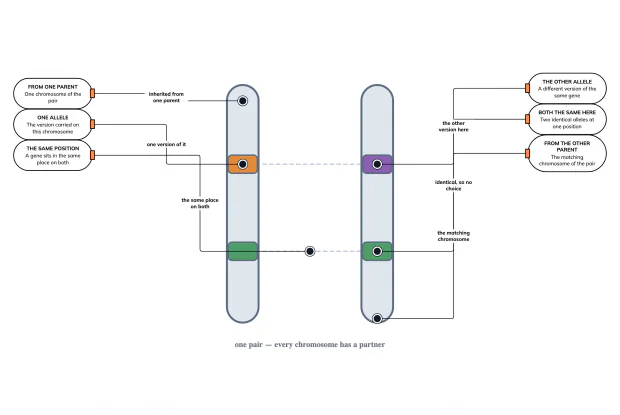
You carry two copies of every gene, one from each parent, at the same place on a matching pair of chromosomes. Label the pair in an interactive playground and the word allele stops being abstract.
Why Can a Gene Be Carried Without Showing?
Dominant and recessive are usually just defined. Reason instead from what a gene does — build a protein — to why one version hides the other, in an interactive playground.
How Do You Predict What the Offspring Get?
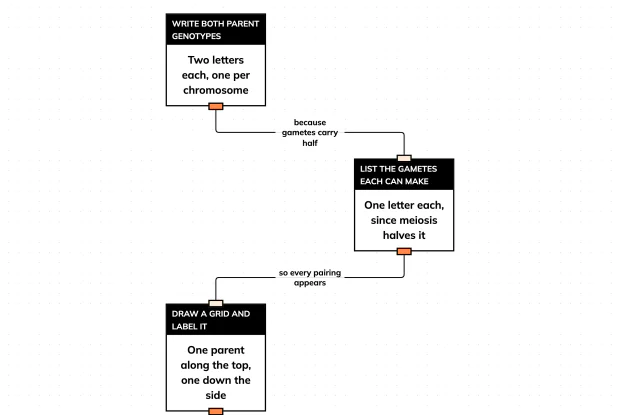
Given what two parents carry, a Punnett square predicts what their offspring can be and in what proportions. Follow the six steps in order in an interactive playground, and see why the answer is a probability.
Dominant Does Not Mean Common — Two Questions
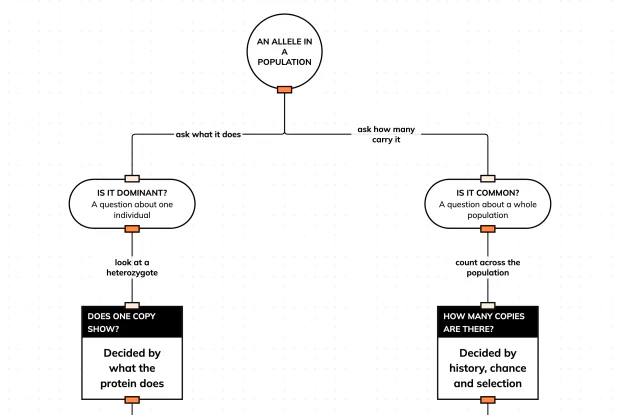
Dominant describes what shows in one individual. Common describes how many individuals carry it. Follow both questions from the same allele in an interactive playground and see why neither answer predicts the other.
Is It the Genes or the Surroundings? Sort It Out
Some differences are written in the genes, some come entirely from how someone lived, and most are both. Sort four of them in an interactive playground and see why running in a family proves nothing.