Dominant Does Not Mean Common — Two Questions
Root Concept
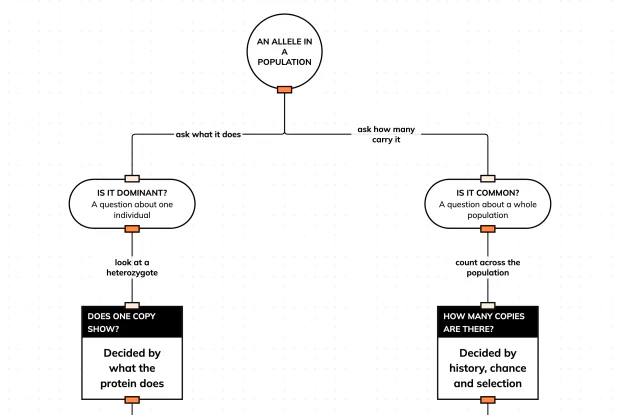
Whether an allele is dominant is a question about how it is expressed in a single individual, while whether it is common is a question about its frequency across a population, and the two are determined by entirely different things so neither predicts the other.
CodePLU Goal
Upgrading Human Mental Models
Learn how to think in Workflows

Concept Development By codeplu.com
The two branches never meet. Knowing one answer tells you nothing whatever about the other.
A Word That Sounds Like It Means Something Else
Dominant is an unfortunate word. In ordinary English it suggests prevailing, winning, being the main one — so when a textbook says an allele is dominant, it is almost irresistible to read that as meaning most people have it. Very nearly everybody makes this mistake at some point, and it is worth taking apart carefully rather than simply being warned against.
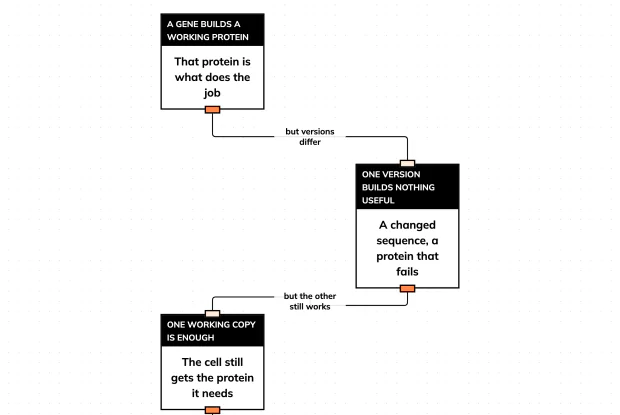
The previous tutorials settled what dominant actually means: an allele whose effect shows when only one copy is present, usually because it produces a working protein and one working copy is enough. That is a statement about what happens inside a single individual who carries one of each version. It is decided by what the proteins do, and you can answer it by looking at one heterozygous organism.
Common is a completely different kind of statement. It asks how many copies of an allele exist across a whole population, and the answer depends on the history of that population — which individuals happened to have offspring, which versions offered any advantage, how populations moved and mixed, and a great deal of plain chance. You can only answer it by counting across many individuals, and no amount of studying one organism will tell you.
The two branches in the playground start from the same allele and never meet again. There are rare dominant alleles and extremely common recessive ones, and the clearest way to stop confusing the words is to see several examples of each.
Why the Two Questions Are Unrelated
What decides whether an allele is dominant?
What its protein does, and nothing else. If the version produces a working protein and one working copy supplies enough for the job, then an individual with one copy shows the effect and the allele is dominant. If it produces a protein that actively interferes with something, it will also show with one copy and be dominant for a different reason. If it produces nothing useful, the effect appears only when no working copy is present, and it is recessive. All of that is a matter of chemistry inside a cell. It is fixed by the nature of the allele and would be the same whether one individual carried it or a billion did.
What decides whether an allele is common?
The history of the population, which is a quite separate subject. An allele becomes common if the individuals carrying it had more surviving offspring than those who did not, over many generations — which may be because it offered some advantage, or simply because the people who happened to carry it happened to do well. Populations that went through a period of small numbers carry whatever those few individuals had, regardless of merit. Migration mixes populations and changes the counts. None of this is influenced in any way by whether one copy of the allele is enough to show an effect. The two sets of causes have nothing in common: one is chemistry inside a cell and the other is centuries of who had children with whom.
Can you give examples of each combination?
All four exist, which is the clearest demonstration that the words are independent. Common and dominant: the ability to produce normal pigmentation. Common and recessive: blue eyes across much of northern Europe, where the recessive version is carried by a majority. Rare and dominant: Huntington's disease, caused by a dominant allele carried by a very small fraction of people — one copy is enough to show, and it is uncommon all the same. Rare and recessive: most of the inherited conditions caused by a non-working version of some gene. If dominance implied commonness, two of those four boxes would be empty, and they are not. Filling in the grid for yourself is probably the fastest way to stop making the mistake permanently.
Why does the mistake matter?
Because it leads to wrong predictions about real populations. Someone who believes dominant means common will expect a dominant allele to spread through a population simply by being dominant, which does not happen — being dominant changes nothing about how many copies get passed on. They will also expect recessive alleles to die out over time, which likewise does not happen, since a recessive allele hidden in carriers is passed on perfectly well and nothing removes it. Both expectations are wrong for the same reason: dominance affects what shows in an individual, not how many copies exist. The error also makes a population look as though it were tidying itself up over time, which it is not — allele frequencies change for reasons that have nothing to do with which version happens to be visible.
Real World Example
Blue Eyes, and Why Recessive Is Not Rare
Eye colour is a convenient illustration, provided it is treated as an illustration — the real genetics involves several genes and the simple version taught in schools is a simplification.
Step 1
The allele behaves recessively
In the simplified account, the version associated with brown eyes leads to more pigment being deposited in the iris, and one copy is enough to produce a brown eye. The version associated with blue eyes results in much less pigment, and the eye appears blue only when both copies are that version. That is textbook recessive behaviour and it follows from the chain in the second tutorial: one working copy supplies enough pigment, so the low-pigment version is invisible whenever a high-pigment copy is present. Nothing about that reasoning involves how many people have either version.
Step 2
And yet most people in some countries have it
In several northern European countries a majority of the population has blue eyes, which means a majority is homozygous for the recessive version and the great majority carries at least one copy of it. The allele is recessive and extremely common in the same breath, and there is nothing contradictory about that. Being recessive affected only whether it shows in someone carrying one copy; it did nothing whatever to how many copies ended up in the population. Anyone expecting a recessive allele to be rare has quietly assumed that the two branches of the playground are connected, and they are not.
Step 3
The frequency came from history, not from dominance
The current thinking is that the variant arose once, in one person, somewhere around the Black Sea several thousand years ago, and spread through populations in northern Europe for reasons that are still argued about. Whatever the explanation, it is a question about migration, population size and selection over millennia — the right-hand branch of the playground. The left-hand branch, about what happens in a heterozygous person, had no bearing on it at all. Had the variant been dominant instead, its frequency today would have depended on exactly the same history and might well be the same.
FAQs
Final Words
Two questions about the same allele, and they never touch. Is it dominant asks whether one copy is enough for the effect to show, is settled by what the protein does, and can be answered by looking at a single heterozygous individual. Is it common asks how many copies exist in a population, is settled by migration, selection, population history and chance, and can only be answered by counting across many individuals.
All four combinations exist. Huntington's disease is dominant and rare; blue eyes are recessive and carried by most people in parts of Europe. The mistake matters because it produces wrong predictions — that dominant alleles spread by being dominant, and that recessive ones die out — and both are wrong for the same reason. The last tutorial in this track, and in this subject, asks a different question about what you inherited: how much of what you are was in the genes at all.
Continue This Track
This concept is part 4 of Why You Look Like Your Parents.
What Is an Allele? Two Copies, Possibly Different
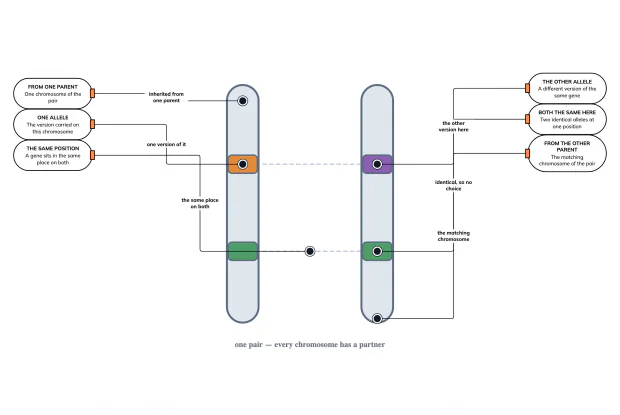
You carry two copies of every gene, one from each parent, at the same place on a matching pair of chromosomes. Label the pair in an interactive playground and the word allele stops being abstract.
Why Can a Gene Be Carried Without Showing?
Dominant and recessive are usually just defined. Reason instead from what a gene does — build a protein — to why one version hides the other, in an interactive playground.
How Do You Predict What the Offspring Get?
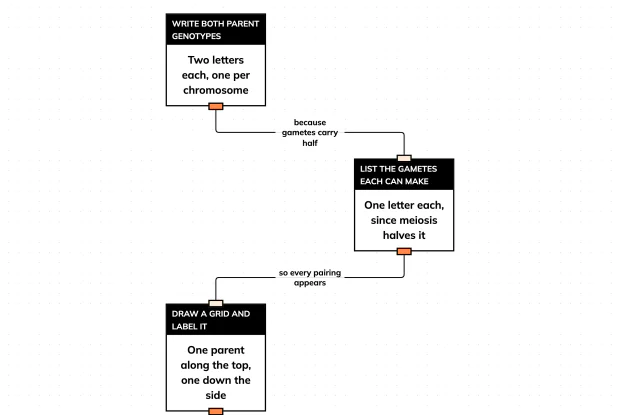
Given what two parents carry, a Punnett square predicts what their offspring can be and in what proportions. Follow the six steps in order in an interactive playground, and see why the answer is a probability.
Dominant Does Not Mean Common — Two Questions
Dominant describes what shows in one individual. Common describes how many individuals carry it. Follow both questions from the same allele in an interactive playground and see why neither answer predicts the other.
Is It the Genes or the Surroundings? Sort It Out
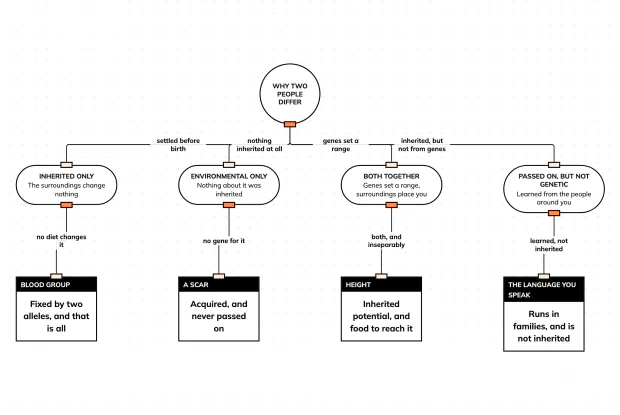
Some differences are written in the genes, some come entirely from how someone lived, and most are both. Sort four of them in an interactive playground and see why running in a family proves nothing.