Why You Look Like Your Parents
An earlier track zoomed from a cell down to a single gene, which answered what a gene is and left out what a zoom cannot show: there are two of every chromosome, so there are two copies of every gene, and they need not be the same. That is what an allele is, and this track starts by drawing it. Dominance is then reasoned out rather than defined — a gene builds a protein, one version builds a working one and another builds nothing useful, and since one working copy is usually enough, the failed version is carried and invisible until two of them meet. The Punnett square follows as a method whose five bookkeeping steps are easy and whose sixth is where almost everyone goes wrong, because a ratio is a probability for each offspring independently and not a quota a family will fill. The fourth tutorial separates two words that sound related and are not: dominant describes what shows in one individual and common counts copies across a population, which is why Huntington’s disease is dominant and rare while blue eyes are recessive and carried by most of northern Europe. And the track closes by narrowing the claim genes can make at all, since a scar is inherited by nobody, height is a range the surroundings place you within, and the language you speak runs in your family without a single allele being involved.
CodePLU Goal
Upgrading Human Mental Models
Learn how to think in Workflows
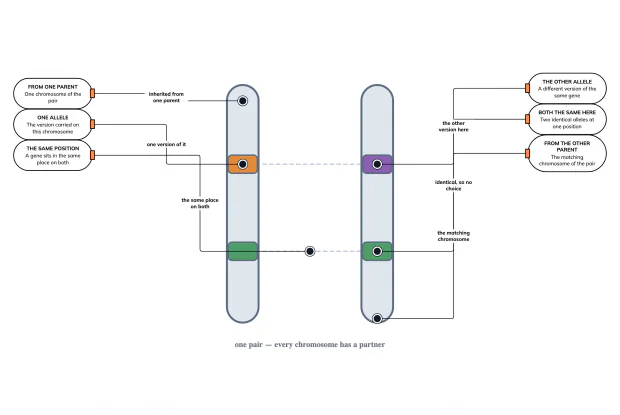
What Is an Allele? Two Copies, Possibly Different
You carry two copies of every gene, one from each parent, at the same place on a matching pair of chromosomes. Label the pair in an interactive playground and the word allele stops being abstract.
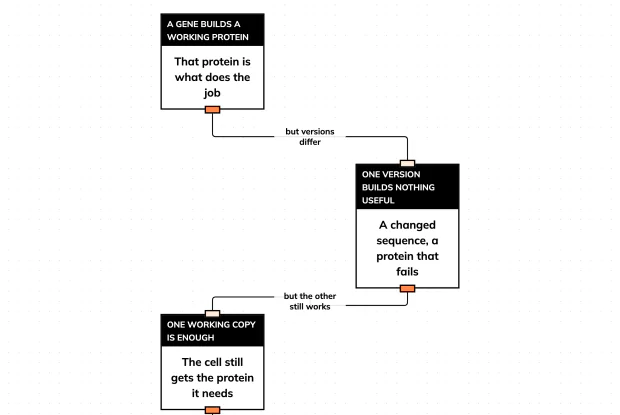
Why Can a Gene Be Carried Without Showing?
Dominant and recessive are usually just defined. Reason instead from what a gene does — build a protein — to why one version hides the other, in an interactive playground.
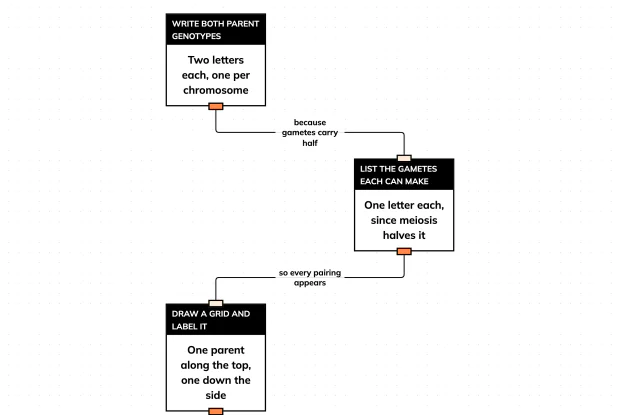
How Do You Predict What the Offspring Get?
Given what two parents carry, a Punnett square predicts what their offspring can be and in what proportions. Follow the six steps in order in an interactive playground, and see why the answer is a probability.
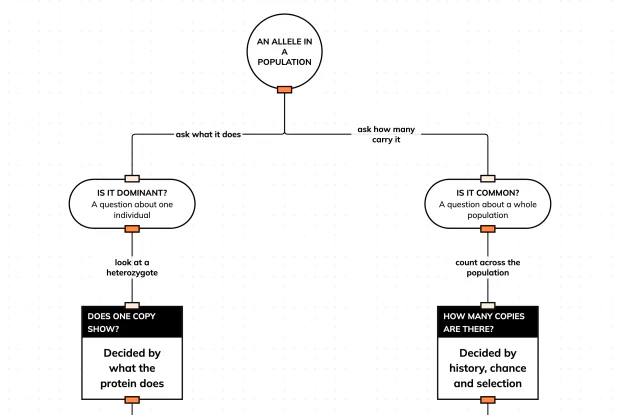
Dominant Does Not Mean Common — Two Questions
Dominant describes what shows in one individual. Common describes how many individuals carry it. Follow both questions from the same allele in an interactive playground and see why neither answer predicts the other.
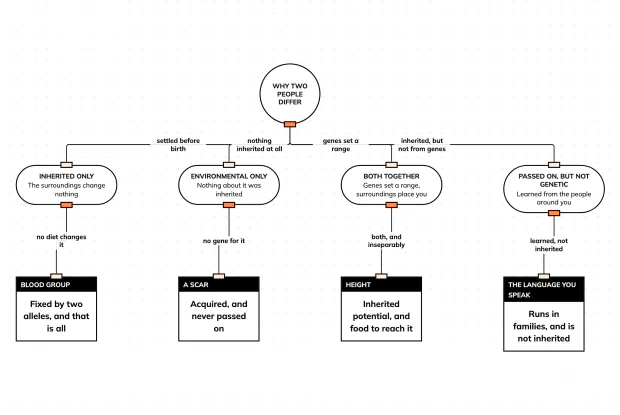
Is It the Genes or the Surroundings? Sort It Out
Some differences are written in the genes, some come entirely from how someone lived, and most are both. Sort four of them in an interactive playground and see why running in a family proves nothing.