Is It the Genes or the Surroundings? Sort It Out
Root Concept
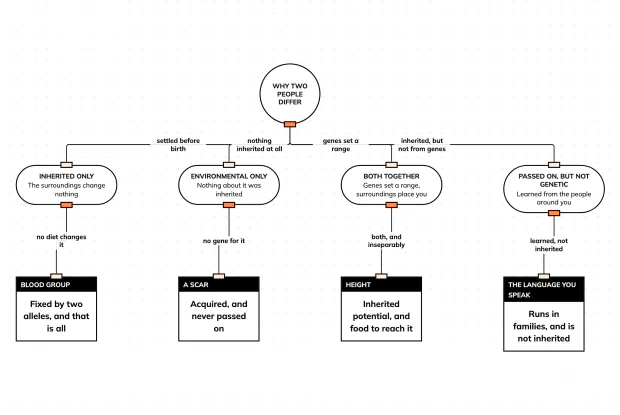
Variation between individuals arises from inherited alleles, from environmental influences, or from both acting together, and most characteristics fall into the third category, with genes setting a range and conditions determining where within that range an individual ends up.
CodePLU Goal
Upgrading Human Mental Models
Learn how to think in Workflows

Concept Development By codeplu.com
The fourth category is the trap. Something can run in a family and have nothing to do with genes.
Where Differences Actually Come From
This track has spent four tutorials on genes, which risks leaving the impression that genes account for the differences between people. They account for some of them, entirely. They account for others not at all. And for most of what anyone actually notices about another person, they set limits and the surroundings do the rest.
A few characteristics are settled by alleles and by nothing else. Blood group is the clearest: it was fixed at fertilisation and no diet, climate, exercise or upbringing will alter it. At the other extreme, a scar is written entirely by what happened to someone, has no genetic component whatever, and cannot be passed to a child however many generations acquire one.
Most things sit between. Height is the standard example. The alleles someone inherits set a range of possible heights, and where in that range they end up depends on nutrition during growth, on illness, and on other conditions. Two people with identical genes raised differently can end up noticeably different heights, and two people with quite different genes can end up the same height. Asking whether height is genetic or environmental has no answer, because the question assumes it must be one.
The fourth category is the one that causes trouble, because it looks like the first. A great many things run in families without being inherited at all — which language someone speaks, what they eat, what work they do. Running in a family is evidence of sharing a household, and that is a different thing from sharing an allele.
Sorting the Four
What does it mean for something to be purely inherited?
That the phenotype is determined by the genotype and conditions make no difference to it. Blood group qualifies: the two alleles someone received decide which markers appear on their red cells, and nothing about how they live changes that. So does eye colour, in the simplified version from the previous tutorial, and so do a number of inherited conditions. These characteristics are useful for teaching precisely because they are so clean — the Punnett squares in this track work exactly as predicted for them. They are also unrepresentative, since most of what varies between people is not like this at all, and a course that only shows these cases leaves a misleading impression of how tidy inheritance usually is.
Can an acquired characteristic be inherited?
No, and this was argued about for a long time before the answer was clear. A blacksmith who develops strong arms does not have children with strong arms as a result; a mouse whose tail is removed has offspring with tails. The reason is straightforward once the mechanism is known: offspring inherit the DNA in gametes, and nothing that happens to the rest of the body changes the DNA in those gametes. Body cells and gamete cells are separate, and the line from parent to offspring runs only through the second. What an organism does in its lifetime is not written back into what it passes on, however much of it there is and however long it goes on for.
What does it mean for genes to set a range?
That the alleles determine what is possible rather than what happens. Someone may carry the alleles for a potential height of around one metre eighty, and reach it with adequate nutrition through childhood or fall well short of it without. The genes did not specify a height; they specified a range of outcomes, and conditions placed the person within it. Most characteristics work this way, including nearly everything controlled by several genes at once, and it is why such characteristics vary continuously rather than falling into categories. There is no tall allele and short allele with a three-to-one ratio between them, which is why the Punnett squares earlier in this track apply to so few of the things people actually wonder about.
Why is running in the family such weak evidence?
Because families share far more than genes. They share a house, a climate, a diet, a language, an income, a set of habits and a set of expectations, and any of those can produce a pattern that looks inherited. Children of parents who speak a particular language speak it too, with complete reliability, and no allele is involved. Separating the two requires evidence that breaks the usual pairing — identical twins raised apart, adopted children compared with both sets of parents, or large populations where circumstances vary independently of ancestry. Observing that something runs in a family establishes almost nothing on its own, however striking the pattern looks, and is one of the easiest ways to reach a confident wrong conclusion.
Real World Example
A Hydrangea That Changes Colour
The cleanest demonstration that a phenotype is not simply read off a genotype is a plant that changes its appearance without any of its genes changing at all.
Step 1
The same plant, two colours
Many hydrangea varieties produce blue flowers in acidic soil and pink flowers in alkaline soil. This is not two varieties that look similar — it is one plant, which can be divided and the halves planted in different soils to give blue flowers on one and pink on the other. Both halves are genetically identical, since the plant was propagated vegetatively as the previous track described. The genotype has not changed by a single letter, and the phenotype is plainly different. Anyone who thinks a phenotype can simply be read off a genotype has to account for this flowerbed.
Step 2
The soil controls what the plant can take up
The mechanism is aluminium. Acidic soil makes aluminium available in a form the roots can absorb, and the aluminium combines with a pigment in the flowers to produce blue. In alkaline soil the aluminium is locked up in compounds the plant cannot take up, so the pigment stays pink. Nothing about the plant's instructions has altered; what has altered is a raw material reaching the place where those instructions are carried out, which is a thoroughly environmental effect. Gardeners exploit it deliberately, adding compounds to the soil to shift the colour one way or the other.
Step 3
But the genes still set the limits
Not every hydrangea does this. Some varieties lack the pigment involved altogether and stay white whatever the soil, and gardeners know perfectly well that no amount of soil treatment will turn those blue. So the genotype determines the range of colours available and the soil decides which of them appears — which is the third category in the playground, demonstrated in a flowerbed. Asking whether hydrangea colour is genetic or environmental gets no answer, because it is a badly formed question — and most questions of that shape about people are badly formed for the same reason.
FAQs
Final Words
Four answers to why two individuals differ, and only one of them is purely about genes. Blood group is settled by alleles and nothing else. A scar comes entirely from what happened to someone and cannot be passed on, because nothing that happens to a body is written back into its gametes. Height is both at once, with inherited alleles setting a range and conditions deciding where in it someone ends up. And the language someone speaks runs reliably in families while having nothing to do with inheritance at all.
That last category is the one worth carrying away, because it is why "it runs in the family" settles so little — families share a house, a diet and a language as well as chromosomes. This track began with two copies of a gene and ends with a hydrangea that changes colour without changing a letter of its DNA.
Continue This Track
This concept is part 5 of Why You Look Like Your Parents.
What Is an Allele? Two Copies, Possibly Different
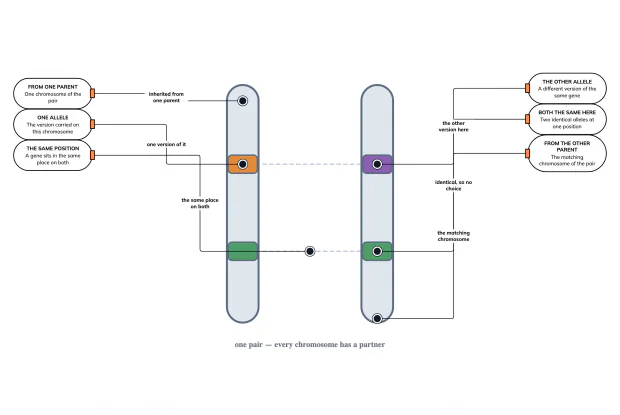
You carry two copies of every gene, one from each parent, at the same place on a matching pair of chromosomes. Label the pair in an interactive playground and the word allele stops being abstract.
Why Can a Gene Be Carried Without Showing?
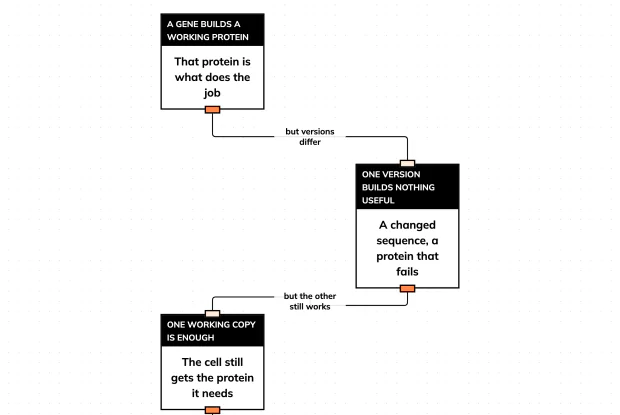
Dominant and recessive are usually just defined. Reason instead from what a gene does — build a protein — to why one version hides the other, in an interactive playground.
How Do You Predict What the Offspring Get?
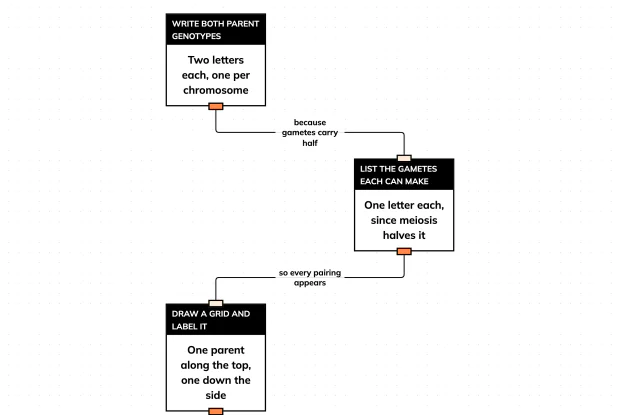
Given what two parents carry, a Punnett square predicts what their offspring can be and in what proportions. Follow the six steps in order in an interactive playground, and see why the answer is a probability.
Dominant Does Not Mean Common — Two Questions
Dominant describes what shows in one individual. Common describes how many individuals carry it. Follow both questions from the same allele in an interactive playground and see why neither answer predicts the other.
Is It the Genes or the Surroundings? Sort It Out
Some differences are written in the genes, some come entirely from how someone lived, and most are both. Sort four of them in an interactive playground and see why running in a family proves nothing.