What Is an Allele? Two Copies, Possibly Different
Root Concept
Chromosomes come in matching pairs, one of each inherited from each parent, carrying the same genes at the same positions; the two copies of a gene are called alleles and may be identical or different versions of it.
CodePLU Goal
Upgrading Human Mental Models
Learn how to think in Workflows

Concept Development By codeplu.com
Same gene, same position, two copies. Whether they match is the only question.
Two of Everything, and Sometimes They Differ
An earlier tutorial in this subject zoomed from a cell down to the nucleus, a chromosome, a strand of DNA and finally a gene, which answered the question of what a gene is. It left out something the zoom cannot show, because a zoom only ever looks at one thing: there are two of every chromosome.
The previous track established why. Chromosomes come in pairs, one member of each pair inherited from each parent, which is what made the arithmetic of meiosis work out. The consequence for genes is immediate and is the whole subject of this track. If there are two of every chromosome, and each carries the same genes in the same order, then there are two copies of every gene — and those two copies need not be the same.
Two copies of a gene sitting at the same position on a matching pair of chromosomes are called alleles. Sometimes they are identical, in which case there is nothing to decide. Sometimes they are different versions, carrying slightly different instructions for the same thing, and then something has to settle which version the organism actually shows. That question is what the rest of this track is about, and none of it makes sense until the picture is clear.
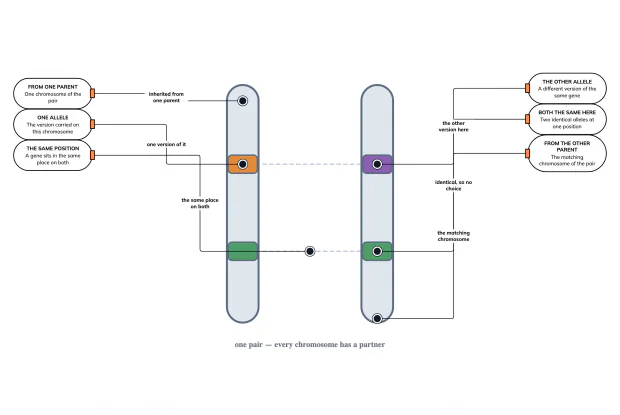
The playground is that picture: one pair, the same gene positions on both, matching at one place and differing at another.
Reading the Pair
Why does a gene have a fixed position?
Because a chromosome is a long molecule with the genes arranged along it in a definite order, like entries in a list, and the two members of a pair carry the same list. The position a particular gene occupies is called its locus, and in the figure the dashed lines join each locus on one chromosome to the matching locus on the other. This is what makes the pairing meaningful rather than coincidental: the two chromosomes are a pair precisely because they carry the same genes at the same places. It is also why the pairs could line up accurately during meiosis in the previous track — matching them up is possible only because they match.
What exactly is a different version of a gene?
A gene is a stretch of DNA carrying the instructions for building one thing, usually a protein. Two alleles of the same gene are two slightly different sequences at the same locus, both instructions for the same protein but not identical instructions. The difference may be a single letter in a sequence of thousands. The effect ranges from nothing at all to a great deal: one version may build a protein that works slightly differently, or more slowly, or that does not work at all. The word allele does not imply anything about how big the difference is, only that there is one. It is worth resisting the idea that there is a correct version and a faulty one — usually there are simply versions, and which is useful depends on circumstances.
What are homozygous and heterozygous?
Names for the two situations in the figure, and worth learning because everything later depends on telling them apart. Homozygous means the two alleles at a locus are identical — the green pair in the playground. Heterozygous means they are different versions — the orange and purple pair. The words apply one gene at a time, not to a whole organism, so the same individual is homozygous for some genes and heterozygous for others. An organism that is homozygous at a locus has no choice to make: both copies say the same thing. One that is heterozygous does, and that is where the next tutorial begins. The figure shows one of each, which is the whole reason it has two gene positions on it rather than one.
What is the difference between genotype and phenotype?
Genotype is which alleles an organism carries; phenotype is what it actually shows. The distinction matters because the two do not line up neatly. Two individuals with different genotypes can look identical, if one carries a version that is present but not showing. The same genotype can give different phenotypes in different conditions, since many characteristics depend on surroundings as well as genes — the last tutorial in this track takes that up. Keeping the two words apart is the single most useful habit in genetics, because almost every confusion in the subject is one being mistaken for the other. A rough test: if a statement could be checked by looking at the organism, it is about phenotype; if it could only be checked by looking at its DNA or its relatives, it is about genotype.
Real World Example
The ABO Blood Group
Blood group is the clearest everyday case of alleles, because the genotype is routinely tested and the phenotype has consequences that matter.
Step 1
One gene, one position, three versions
There is a single gene controlling ABO blood group, at one locus on chromosome nine, and it exists in three versions in the human population: one that builds the A marker on the surface of red blood cells, one that builds the B marker, and one that builds neither. Any individual carries two of these three, one from each parent, exactly as the playground shows. The gene has three alleles in the population, but no person has more than two, because no person has more than two copies of chromosome nine. This is the first place where keeping the population and the individual separate really matters.
Step 2
Six genotypes give four phenotypes
Counting the possible pairs gives six genotypes. They collapse into four blood groups, because several different pairs produce the same result: someone with the A version and the neither version has group A, and so does someone with two A versions, because the neither version builds no marker and contributes nothing visible. Those two people have different genotypes and identical phenotypes, which is the distinction from the last section made concrete. A routine blood test reveals the phenotype and leaves the genotype partly undetermined, which occasionally matters when working out how a group was inherited.
Step 3
Group AB shows both at once
Someone carrying one A version and one B version has blood group AB, with both markers present on their cells. Neither allele hides the other and neither overrides it — both are expressed fully. This is called codominance, and it is a useful reminder before the next tutorial that one version masking another is a common arrangement rather than a universal rule. Alleles are two versions at one position; what happens when they differ varies from gene to gene, and has to be found out for each one rather than assumed. The next tutorial deals with the commonest arrangement, not the only one.
FAQs
Final Words
Chromosomes come in matching pairs, one of each from each parent, carrying the same genes at the same positions. So every gene exists twice in every body cell, and the two copies sitting at that position are its alleles. Sometimes they are identical and there is nothing to settle. Sometimes they are different versions of the same instruction, and something has to decide which one the organism shows.
Two words carry most of the weight from here on. Genotype is which alleles are carried; phenotype is what actually appears. They are not the same, two different genotypes can produce identical phenotypes, and almost every muddle in genetics is one being mistaken for the other. The next tutorial takes the case where the two alleles differ and works out, from what a gene actually does, why one of them usually wins.
Continue This Track
This concept is part 1 of Why You Look Like Your Parents.
What Is an Allele? Two Copies, Possibly Different
You carry two copies of every gene, one from each parent, at the same place on a matching pair of chromosomes. Label the pair in an interactive playground and the word allele stops being abstract.
Why Can a Gene Be Carried Without Showing?
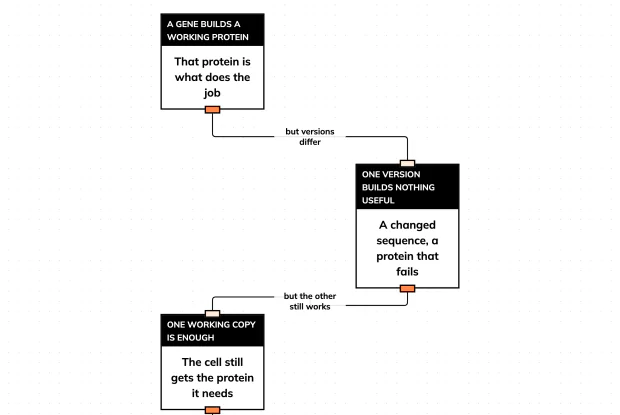
Dominant and recessive are usually just defined. Reason instead from what a gene does — build a protein — to why one version hides the other, in an interactive playground.
How Do You Predict What the Offspring Get?
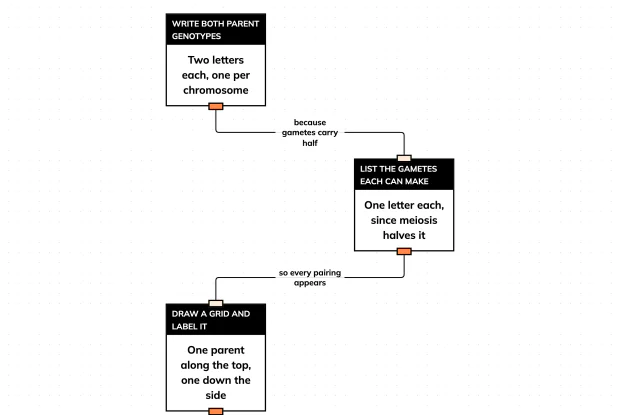
Given what two parents carry, a Punnett square predicts what their offspring can be and in what proportions. Follow the six steps in order in an interactive playground, and see why the answer is a probability.
Dominant Does Not Mean Common — Two Questions
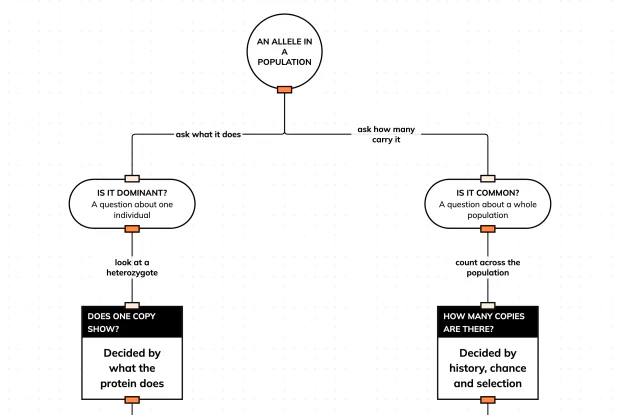
Dominant describes what shows in one individual. Common describes how many individuals carry it. Follow both questions from the same allele in an interactive playground and see why neither answer predicts the other.
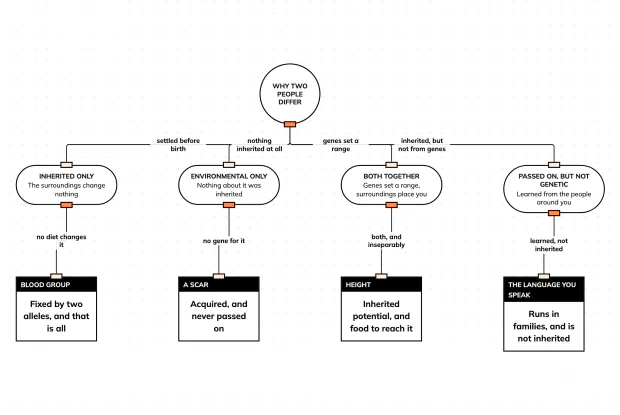
Is It the Genes or the Surroundings? Sort It Out
Some differences are written in the genes, some come entirely from how someone lived, and most are both. Sort four of them in an interactive playground and see why running in a family proves nothing.