What Does the Nucleus Actually Hold?
Root Concept
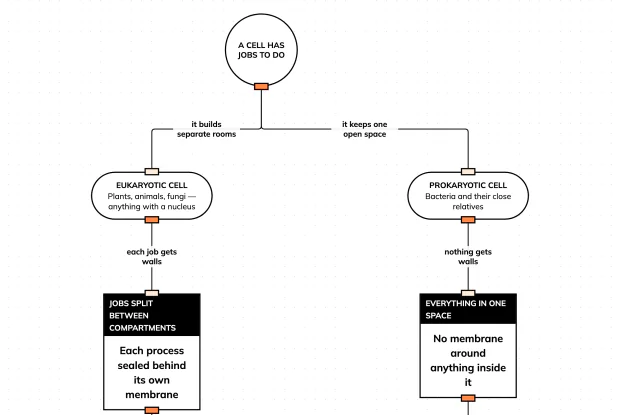
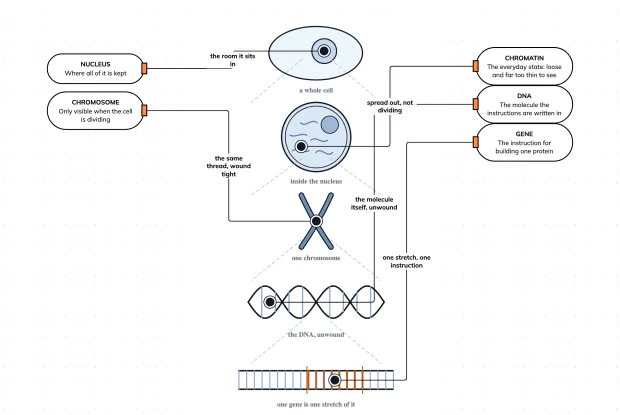
Chromatin, chromosomes, DNA and genes are the same material described at four different levels of magnification.
CodePLU Goal
Upgrading Human Mental Models
Learn how to think in Workflows

Concept Development By codeplu.com
Each panel is a close-up of the one above. Nothing new appears as you go down — it is the same material, magnified.
Four Words for One Thing
The first tutorial in this track gave the nucleus a one-line job: it holds the instructions. That was true and far too quick, because the instructions are the reason the rest of the cell exists, and the words used to describe them cause more confusion than almost anything else in school biology.
Here is the problem. A learner meets chromatin, chromosome, DNA and gene in the same chapter and quite reasonably assumes they are four different things, probably sitting side by side in the nucleus like four objects in a drawer. They are not. They are one material, described at four different magnifications, plus one word that describes a state rather than a thing.
The figure below is a zoom. It starts with a whole cell, enlarges the nucleus, picks one thread out of it, unwinds that thread into the molecule it is made of, and finally marks off a single stretch of that molecule. Nothing new appears at any step — you are looking at the same material the whole way down. Getting that nesting straight is most of what this topic asks of you, and it is what the playground is built to test.
The Nesting, and the Word That Describes a State
What is actually inside the nucleus?
Long threads, a dense blob, and a wrapper with holes in it. The threads are chromatin — DNA wound around small proteins that keep it tidy, the way a long cable is kept in order by being wound on spools. The dense blob is the nucleolus, where the parts of ribosomes are assembled before being sent out. The wrapper is the nuclear envelope, and it is a double membrane studded with thousands of pores. Those pores matter: the nucleus is not sealed. Messages and materials pass through them constantly in both directions, which is how instructions reach the ribosomes out in the cytoplasm without the DNA itself ever leaving. A sealed nucleus would be useless to the cell around it.
Why do chromosomes only appear when a cell divides?
Because a chromosome is not a different object from chromatin — it is chromatin packed tight. For most of a cell's life the threads are spread out and far too thin to see even with a good microscope, which is the state the figure's second panel shows. When a cell is about to divide it winds each thread up thousands of times over, until it becomes short and thick enough to be moved around without tangling, and at that point it is visible and we call it a chromosome. Think of a long skipping rope lying loose on the floor against the same rope coiled into a tight bundle. Same rope, and only one of the two is easy to carry.
So what exactly is a gene?
A stretch of the DNA molecule — a section, not a separate particle. Running along the molecule are sequences, and a particular stretch carries the instruction for building one protein. That stretch is a gene. A human cell holds around twenty thousand of them, spread across 46 chromosomes, and because proteins do most of the actual work in a body, a gene ends up influencing everything from the colour of an eye to how fast a reaction runs. The orange section in the bottom panel is a gene, and the important thing about the picture is that the orange part is not made of anything different. It is the same molecule, and only its sequence sets it apart.
Why keep all of it behind a membrane?
Because the DNA is the one thing a cell cannot replace. Every other part can be rebuilt from the instructions, but the instructions themselves have no backup, so they are kept in a separate compartment away from the traffic of the cytoplasm. When a protein is needed the cell does not send the gene out. It copies the relevant stretch, sends the copy through a pore, and the original stays where it is — the same reason a library lends photocopies of a rare document rather than the document. The pores are what make that arrangement workable rather than merely safe. Bacteria do none of this, having no nucleus at all, which is where this track goes next.
Real World Example
Why Every Cell Has the Same Instructions
Every cell in a body came from one original cell dividing, and each division copies the whole set of instructions. The consequences of that are stranger than they look.
Step 1
Everyone gets the complete set
A human body starts as a single cell and reaches some thirty trillion by dividing over and over, and at every division the entire DNA is copied first so that both new cells get a full set. That means a cell in your liver, a cell in your retina and a cell at the root of a hair all carry the same twenty thousand genes — not a relevant selection, but all of them. Nothing is thrown away when a cell takes up a particular job. The instructions for building a retina are sitting unused inside your liver cells right now.
Step 2
Each cell reads a different part
What makes a liver cell a liver cell is which genes it switches on. It reads the stretches that build the proteins a liver needs and leaves the rest shut down; a nerve cell reads a different selection from the same library. This is why cells with identical instructions end up looking and behaving nothing alike, and it explains something from the first tutorial in this track — why the number of mitochondria differs so much between cell types. The cell is following the parts of the instructions it has chosen to read, and ignoring the rest completely.
Step 3
Which is why a cutting grows a whole plant
Push a cut stem of many plants into soil and it grows roots, then leaves, then eventually flowers. Nothing was added. The stem cells always held the complete instructions, including the ones for building a root, and being cut switched those stretches back on. Gardeners have used this for thousands of years without knowing why it worked. Animal cells are far less willing to do it, which is one of the real differences between plants and animals — and a good demonstration that having the instructions and using them are two different things entirely. The information was never the limiting factor.
FAQs
Final Words
Chromatin, chromosome, DNA and gene are not four objects sitting side by side. They are one material seen at four magnifications, plus one word describing a state: chromatin is the loose everyday form, a chromosome is that same thread wound tight for division, DNA is the molecule the thread is made of, and a gene is a stretch of that molecule carrying one instruction.
The nucleus keeps all of it behind a double membrane with pores, and sends out copies rather than the original, because the instructions are the one part of a cell that cannot be rebuilt. Every cell in a body holds the complete set and uses only part of it. The last tutorial in this track meets the cells that do without a nucleus altogether, and asks what bacteria do instead.
Continue This Track
This concept is part 4 of What Everything Living Is Made Of.
What Is a Cell, and What Does Each Part Do?
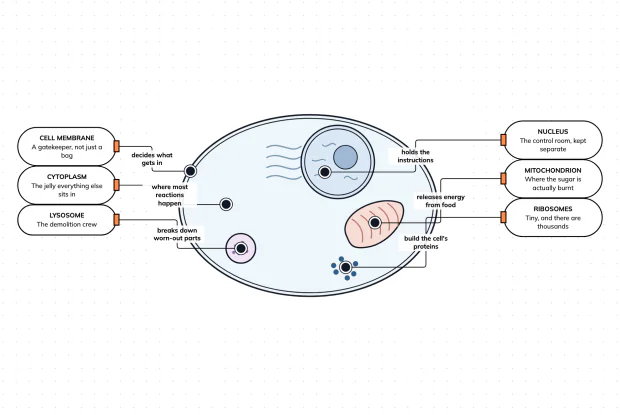
Every living thing is built from cells, and a cell is not a simple bag. Inside it, separate parts handle instructions, energy, building, demolition and what crosses the boundary. Match six parts to their jobs in an interactive playground.
Plant Cell or Animal Cell — What Tells Them Apart?
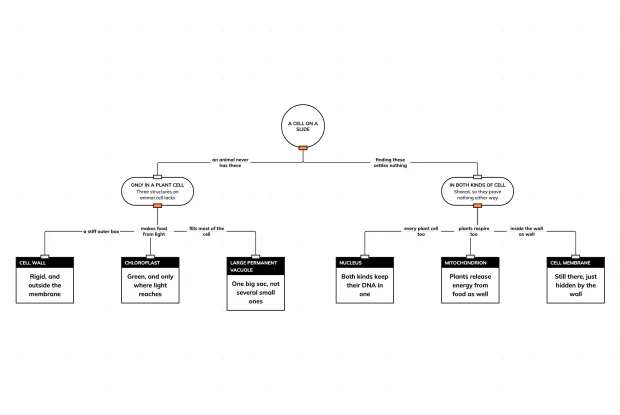
Plant and animal cells share almost everything. Only three structures are found in a plant cell and never in an animal one, and the shared parts settle nothing. Sort six structures in an interactive playground.
What Does the Cell Membrane Let Through?
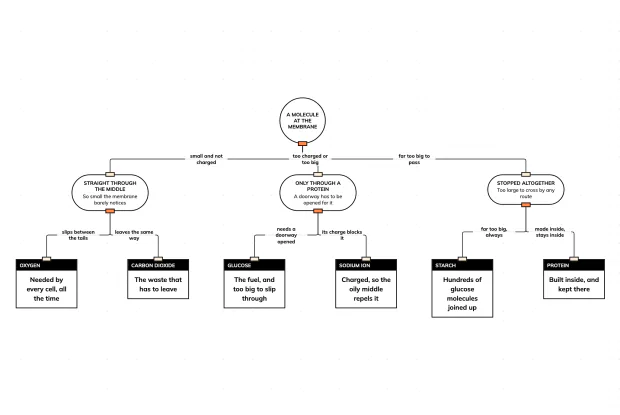
A cell membrane is a double layer of fat molecules with proteins set into it. Small uncharged molecules cross it freely, charged or larger ones need a protein doorway, and big ones never get through. Sort six molecules in an interactive playground.
What Does the Nucleus Actually Hold?
The nucleus holds DNA, but chromosome, chromatin and gene all describe that same material at different levels. Follow the zoom from a cell down to a single gene in an interactive playground.
Bacteria Have No Nucleus — So What Do They Have?
A bacterium has no nucleus and no membrane-bound organelles, yet it does everything a cell must do. Follow the two ways of organising a cell in an interactive playground.