Plant Cell or Animal Cell — What Tells Them Apart?
Root Concept
A plant cell has a cell wall, chloroplasts and a large permanent vacuole; everything else it shares with an animal cell.
CodePLU Goal
Upgrading Human Mental Models
Learn how to think in Workflows

Concept Development By codeplu.com
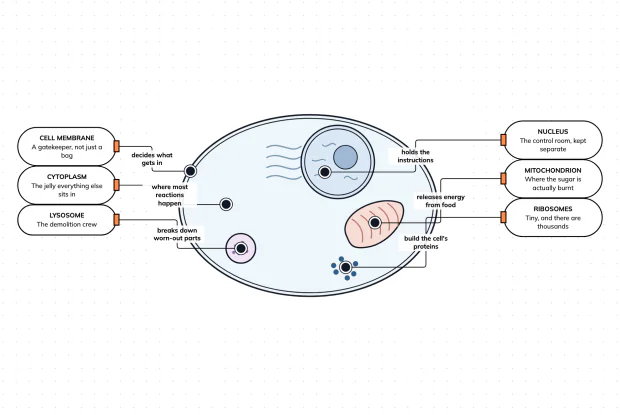
Only the three on the left decide which kind of cell you are looking at. The three on the right are in both and prove nothing.
A Short List of Differences
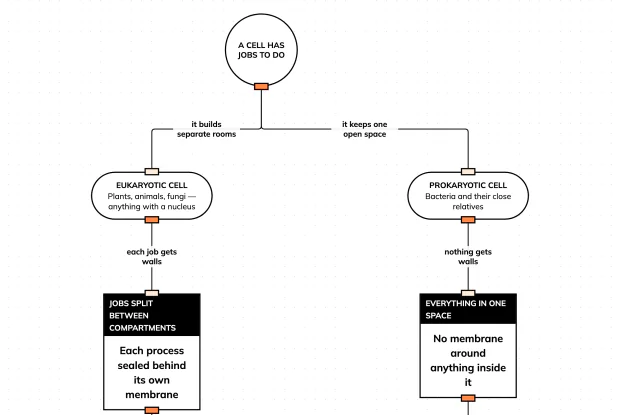
The last tutorial took one cell apart and gave each piece a job. That cell was an animal cell, and the obvious next question is whether a plant is built the same way. The answer is: almost entirely, yes.
This surprises people, because plants and animals could hardly be less alike from the outside. One of them moves, eats and has a skeleton; the other stands still and makes its own food. You would expect their cells to be built from different parts. They are not. A plant cell has a membrane, cytoplasm, a nucleus, mitochondria, ribosomes and endoplasmic reticulum, and every one of those does the same job it does in you.
Three structures are genuinely different, and those three are the whole of the answer: a cell wall, chloroplasts, and one large permanent vacuole. Everything a plant can do that an animal cannot traces back to them. The playground below asks you to sort six structures into the ones that settle the question and the ones that are in both — and it is the second group that costs people marks, because it is easy to believe an animal cell has no vacuoles or that a plant has no mitochondria. Neither is true.
Three Differences, and Three Things People Get Wrong
What does the cell wall actually do?
It holds the cell's shape. The wall is a rigid layer of cellulose sitting outside the cell membrane — outside, not instead of, which is the first thing to be clear about. A plant cell still has a membrane doing all the gatekeeping described in the last tutorial; the wall is an extra layer around it, and it is not fussy about what passes through. What the wall gives a plant is rigidity. An animal holds itself up with a skeleton and muscles, and a plant has neither, so every cell carries its own scaffolding. That is why plant cells are drawn as boxes and animal cells as rounded blobs: the wall forces a definite shape, and a membrane alone does not.
Why do only plant cells have chloroplasts?
Because only plants make their own food from light, and the chloroplast is where that happens. It holds chlorophyll, the green pigment that absorbs light, which is also the reason leaves are green — you are looking at the one colour chlorophyll does not absorb. An animal gets its energy by eating, so it has no use for the machinery and does not build it. One detail worth knowing, because questions use it: not every plant cell has chloroplasts. Root cells sit in the dark and have none at all. Chloroplasts are found where light reaches, concentrated in the leaves, which is exactly where you would put them. A plant cell drawn without any is usually a root cell rather than an animal one.
Why is the vacuole the one people get wrong?
Because the honest difference is not whether a vacuole is there but how big and how permanent it is. Animal cells do have vacuoles: small ones, several of them, formed as needed and then gone again. A plant cell has one enormous permanent vacuole that can take up most of the cell's volume, pushing everything else out to a thin layer against the wall. It is full of cell sap, and keeping it full is what presses the cell outwards against its wall and makes a stem stiff. Writing "animal cells have no vacuoles" is the common answer and it is wrong; the difference is in the size and the permanence.
So what does a plant cell share with yours?
Nearly everything else, and this is the half of the comparison that gets skipped. Both have a cell membrane, cytoplasm, a nucleus holding DNA, ribosomes building proteins and endoplasmic reticulum moving them around. Both have mitochondria, and that last one is worth saying plainly because it is so often got wrong: plants respire. They take in oxygen and release carbon dioxide, all day and all night, exactly as you do. Photosynthesis is something plants do as well as respiring, not instead of it. A plant that only photosynthesised would have no way to release the energy it had stored. The honest summary is that a plant cell is an animal cell with three things added, not a different design altogether.
Real World Example
Why a Wilted Plant Stands Up Again
A houseplant left too long goes limp, and a few hours after watering it is upright again. Nothing grew back. What changed is happening inside the vacuoles.
Step 1
Full vacuoles hold the plant up
In a well-watered plant each cell's large vacuole is full of sap and pressing outwards. The wall is rigid and will not stretch much, so the pressure builds and the cell becomes firm — the word for it is turgid. Millions of firm cells packed together make a stem that stands and a leaf that holds itself flat. This is the plant equivalent of an inflated tyre: the rubber gives the shape but the air gives the stiffness, and neither works without the other. It is why a plant needs no bones to stand a metre tall.
Step 2
Short of water, the pressure drops
When water runs short the vacuoles lose volume and stop pressing on the walls. The cells go slack — flaccid is the term — and without that internal pressure the stem can no longer hold its own weight. The plant droops. Notice that nothing has been destroyed at this stage and no cell has died; the structures are all still there and simply under-inflated, which is exactly why the damage is reversible. If the shortage goes on long enough the membrane eventually pulls away from the wall, and at that point the cell does not recover.
Step 3
An animal cell could not do this
Water the plant and within hours the vacuoles refill, the pressure returns and the plant is upright again. An animal cell has no way of performing the same trick, and the reason is the missing wall. Take an animal cell and let water flood in and there is nothing rigid to push back against, so it simply swells until it bursts. The wall is what lets a plant cell be pumped hard enough to act as a structural element. How water gets into a cell in the first place, and why it moves in one direction rather than the other, is the subject of the next track.
FAQs
Final Words
The list of real differences is three items long. A plant cell has a rigid cellulose wall outside its membrane, chloroplasts wherever light reaches it, and one large permanent vacuole; an animal cell has none of those. Everything else — membrane, cytoplasm, nucleus, mitochondria, ribosomes — is in both and tells you nothing about which kind you are looking at.
The two traps are worth carrying forward, because both come from describing the difference as presence rather than degree. Animal cells do have vacuoles, just small and temporary ones, and plants do have mitochondria and do respire, day and night. The next tutorial follows the one structure the wall is wrapped around — the membrane — and asks what actually decides whether something gets through it.
Continue This Track
This concept is part 2 of What Everything Living Is Made Of.
What Is a Cell, and What Does Each Part Do?
Every living thing is built from cells, and a cell is not a simple bag. Inside it, separate parts handle instructions, energy, building, demolition and what crosses the boundary. Match six parts to their jobs in an interactive playground.
Plant Cell or Animal Cell — What Tells Them Apart?
Plant and animal cells share almost everything. Only three structures are found in a plant cell and never in an animal one, and the shared parts settle nothing. Sort six structures in an interactive playground.
What Does the Cell Membrane Let Through?
A cell membrane is a double layer of fat molecules with proteins set into it. Small uncharged molecules cross it freely, charged or larger ones need a protein doorway, and big ones never get through. Sort six molecules in an interactive playground.
What Does the Nucleus Actually Hold?
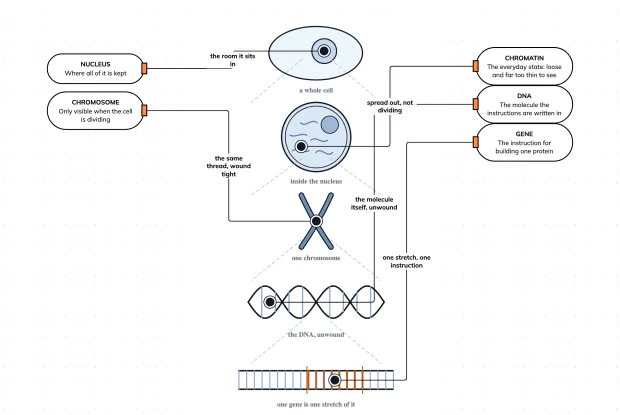
The nucleus holds DNA, but chromosome, chromatin and gene all describe that same material at different levels. Follow the zoom from a cell down to a single gene in an interactive playground.
Bacteria Have No Nucleus — So What Do They Have?
A bacterium has no nucleus and no membrane-bound organelles, yet it does everything a cell must do. Follow the two ways of organising a cell in an interactive playground.