Bacteria Have No Nucleus — So What Do They Have?
Root Concept
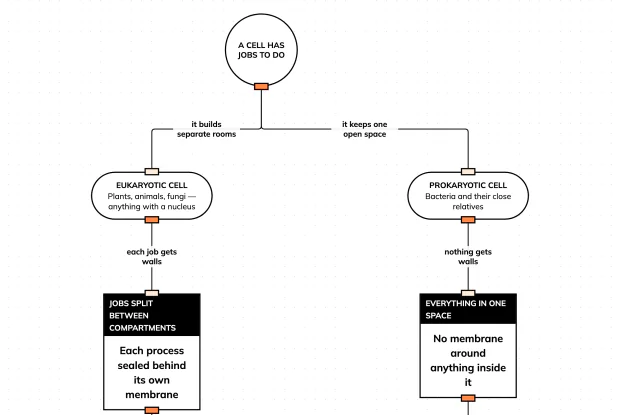
A prokaryotic cell does the same jobs as a eukaryotic one without sealing any of them behind a membrane.
CodePLU Goal
Upgrading Human Mental Models
Learn how to think in Workflows

Concept Development By codeplu.com
Both cells face the same problem. The difference is whether each job gets its own room or they all share one.
Everything, in One Room
This track has spent four tutorials describing a cell as a building with rooms: instructions sealed in the nucleus, energy released inside mitochondria, proteins built on ribosomes and passed along folded sheets. That description is accurate for plants, animals and fungi. It is wrong for most of the living things on Earth.
Bacteria have no nucleus. They have no mitochondria, no endoplasmic reticulum, no Golgi apparatus and no lysosomes — no membrane around anything inside them at all. Cells of this kind are called prokaryotic, from Greek words meaning "before the nut", the nut being the nucleus; everything in the earlier tutorials was eukaryotic, meaning "true nut".
The interesting question is not what bacteria lack. It is how they manage without it, because a bacterium still has to store instructions, build proteins, release energy and control its boundary — the same list as any other cell. It does all of it in one open space, and that single design decision explains nearly everything else about them, including why they are so small and why an antibiotic can attack one without touching you.
One Space, and What Follows From It
Where does a bacterium keep its DNA?
Loose in the cytoplasm. A bacterium usually has one chromosome and it is a closed circle rather than the long straight threads of a eukaryote, sitting in a region of the cell called the nucleoid. The word matters: a nucleoid is a region, not an organelle, because there is no membrane around it. Nothing separates the instructions from the machinery that reads them, so a copy does not have to be made and exported — a ribosome can begin building from a gene while it is still being read. Many bacteria also carry plasmids, small extra circles of DNA that can be passed between cells, and those turn out to matter a great deal for how antibiotic resistance spreads.
With no mitochondria, how does it release energy?
On the cell membrane itself. This is the part that surprises people, and it comes from a useful correction: respiration is not a place, it is a set of enzymes working in order. A eukaryotic cell holds those enzymes in the folded inner membrane of a mitochondrion. A bacterium holds the same kind of enzymes in its own cell membrane, which is the only membrane it has. So bacteria respire, release energy from food and use oxygen much as your cells do — they simply do it on the boundary rather than in a dedicated compartment. The mitochondrion is a convenience that allows a great deal more of it at once, not a requirement for respiration to happen at all.
What does a bacterium still have?
More than the list of absences suggests. It has a cell membrane doing exactly the gatekeeping described earlier in this track, cytoplasm where the chemistry happens, and ribosomes building proteins — thousands of them, and this is worth being clear about, because "no organelles" is often misread as "no ribosomes". Ribosomes have no membrane, so a bacterium keeps them. Most bacteria also have a cell wall, though it is built from a material called peptidoglycan rather than the cellulose of a plant wall, and many have a whip-like flagellum for moving. The jobs all still get done; what has gone is the walls between them, not the machinery that does the work.
Why does any of this force them to stay small?
Because without compartments, everything has to reach everything else by drifting. A molecule made at one end of a bacterium gets to the other end by diffusion, which is quick across a micrometre and hopeless across a hundred. There is also nowhere to keep incompatible reactions apart, so a prokaryote cannot run two processes that would interfere. A typical bacterium is one or two micrometres across against ten to a hundred for a eukaryotic cell. Compartments are what allowed cells to get large and complicated, which is why every organism you can see with your eyes is built from eukaryotic cells. Being small is not a failing of bacteria; it is the price of the design, and they are by far the most numerous organisms on Earth.
Real World Example
Why an Antibiotic Can Attack a Bacterium and Not You
An antibiotic has to damage a bacterium while leaving the human cells around it working. That is only possible because the two kinds of cell are built differently.
Step 1
Attack a structure you do not have
Penicillin and its relatives interfere with the building of the bacterial cell wall. A growing bacterium that cannot complete its wall fails, while a human cell is entirely unaffected for a simple reason: animal cells have no cell wall at all, so the drug has nothing to act on. This is the cleanest possible target — a structure present in one cell type and absent in the other. It also explains why such drugs work best on bacteria that are actively growing, because a wall that is already finished is not being built and so offers nothing to interfere with.
Step 2
Or attack a part that is subtly different
Both kinds of cell have ribosomes, so a drug that simply destroyed ribosomes would be useless as a medicine. But bacterial ribosomes are a different size and shape from the ones in your cells, built from different components, and several antibiotics bind only to the bacterial version and jam it. Protein building stops in the bacterium and continues in you. The margin here is narrower than the cell-wall approach, since the target exists in both, and the whole effect depends on a difference in detail rather than presence. Finding those differences is most of the work in designing an antibiotic.
Step 3
Which is why neither works on a virus
A virus has no cell wall to disrupt and no ribosomes of its own to jam — it is not a cell and carries almost no machinery, using the ribosomes of the cell it has entered instead. Every target an antibiotic is built to hit is simply absent. This is the reason antibiotics do nothing whatever for a cold or flu, and it is not a matter of strength or dose: the drug is designed around structures a virus does not possess. Whether a virus is even alive is a question a later track takes up.
FAQs
Final Words
A prokaryotic cell is not a cell with pieces missing. It is a different answer to the same problem: every job a cell must do, carried out in one open space instead of behind separate membranes. The DNA sits loose as a circle, respiration happens on the cell membrane rather than inside a mitochondrion, and ribosomes are still there in thousands because a ribosome never had a membrane to lose.
The cost of that design is size. With nothing walled off, everything must reach everything else by drifting, which only works across a micrometre or two — so compartments are what let cells become large and complex. It is also the reason an antibiotic can be aimed at a bacterium and miss you entirely. That closes this track. The next one stops looking at what a cell is made of and starts asking how anything gets across its boundary at all.
Continue This Track
This concept is part 5 of What Everything Living Is Made Of.
What Is a Cell, and What Does Each Part Do?
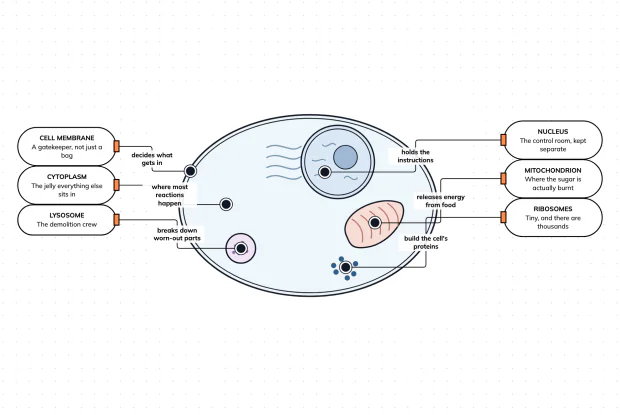
Every living thing is built from cells, and a cell is not a simple bag. Inside it, separate parts handle instructions, energy, building, demolition and what crosses the boundary. Match six parts to their jobs in an interactive playground.
Plant Cell or Animal Cell — What Tells Them Apart?
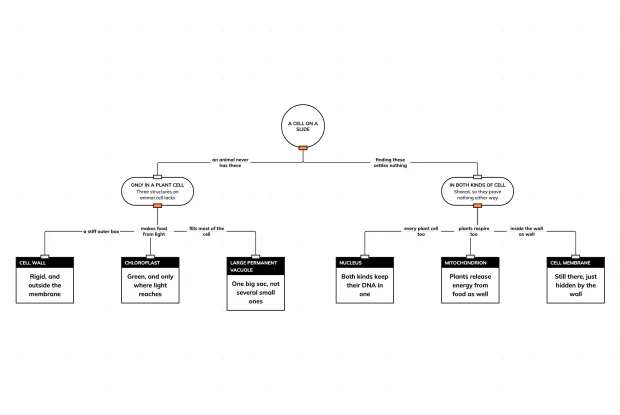
Plant and animal cells share almost everything. Only three structures are found in a plant cell and never in an animal one, and the shared parts settle nothing. Sort six structures in an interactive playground.
What Does the Cell Membrane Let Through?
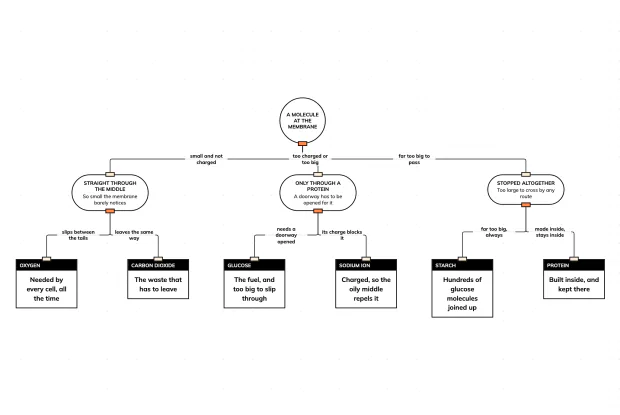
A cell membrane is a double layer of fat molecules with proteins set into it. Small uncharged molecules cross it freely, charged or larger ones need a protein doorway, and big ones never get through. Sort six molecules in an interactive playground.
What Does the Nucleus Actually Hold?
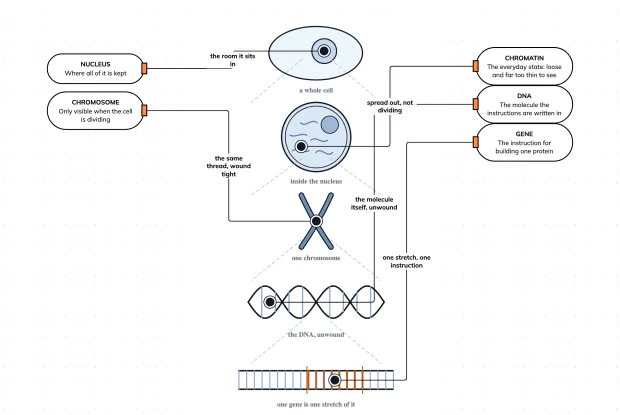
The nucleus holds DNA, but chromosome, chromatin and gene all describe that same material at different levels. Follow the zoom from a cell down to a single gene in an interactive playground.
Bacteria Have No Nucleus — So What Do They Have?
A bacterium has no nucleus and no membrane-bound organelles, yet it does everything a cell must do. Follow the two ways of organising a cell in an interactive playground.