What Does the Cell Membrane Let Through?
Root Concept
A cell membrane is an oily double layer that only small uncharged molecules cross unaided; everything else needs a protein or cannot pass.
CodePLU Goal
Upgrading Human Mental Models
Learn how to think in Workflows

Concept Development By codeplu.com
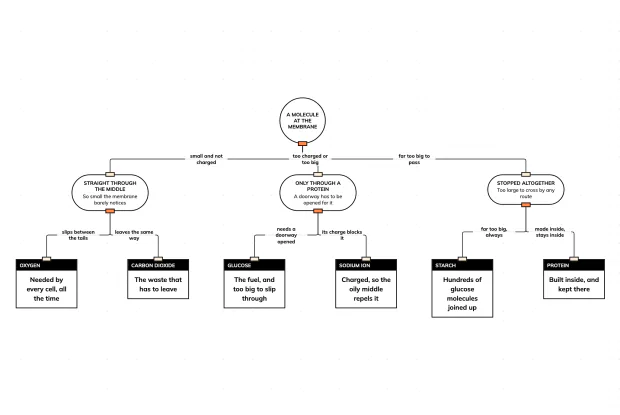
Each molecule joined to the route it has to take. Size and charge decide the route; nothing else does.
The Part That Decides What a Cell Is
The first tutorial in this track called the membrane a gatekeeper and left it there. The second showed that a plant cell wraps a rigid wall around it and still keeps the membrane underneath, because the wall does no gatekeeping at all. This tutorial finally asks the obvious question: what actually decides?
It matters more than it sounds. A cell is only alive because the inside of it is different from the outside — different concentrations of salts, sugars and proteins, held that way against everything in the surroundings trying to even them out. The only thing standing between those two worlds is a layer about seven nanometres thick, which is roughly a ten-thousandth of the width of a human hair.
That layer is not a sieve with holes in it, which is the picture most people start with. It is a double sheet of fat molecules, and what gets through depends on two properties of the traveller: how big it is, and whether it carries an electrical charge. Get those two right and you can predict the route for almost any substance in school biology. The playground below gives you six to sort.
What It Is Made Of, and Why That Decides Everything
What is the membrane actually made of?
Two layers of fat molecules, laid back to back. Each molecule has a head that mixes happily with water and two long tails that refuse to. Drop a great many of them into water and they arrange themselves without being told to: heads out towards the water on both sides, tails tucked into the middle away from it. The result is a double sheet — a bilayer — with a thin oily layer running through its core. Proper name for the molecules: phospholipids. Set into this sheet are proteins, some passing all the way through, and those proteins are what the second half of this tutorial is about. The sheet is not rigid; it behaves more like a film of oil than a wall, and its parts drift about within it.
Why does an oily middle block so much?
Because most of what a cell deals with is dissolved in water, and anything comfortable in water is uncomfortable in oil. A charged particle is the clearest case: a sodium ion is tiny, far smaller than a glucose molecule, and it still cannot cross, because its charge makes the oily core effectively a wall. That is worth pausing on, since it breaks the intuition that small things get through and big things do not. Size matters too, but charge matters more. The molecules that do cross unaided are the ones that are both small and uncharged — oxygen and carbon dioxide above all, which is why gas exchange needs no machinery anywhere in biology.
What are the proteins for?
They are the doorways for everything the bilayer refuses. Some are channels: a protein with a water-lined passage through its middle, shaped so that only one kind of particle fits, which is how a sodium ion crosses a barrier its charge should forbid. Others are carriers, which bind a molecule on one side, change shape, and release it on the other — the usual route for glucose, which is too large and too water-loving to slip between the tails. The important consequence is control. Because each doorway is specific, a cell can decide what to admit by choosing which proteins to build, and that is what selectively permeable actually means.
Why is being selective the whole point?
Because a boundary that let everything through would not be a boundary. If the membrane were simply porous, the concentrated soup inside a cell would leak out until inside and outside matched, and at that moment the cell would stop being alive in any useful sense. Everything a cell does depends on holding a difference across its edge: a nerve cell signals by briefly letting sodium in, a root hair draws water from soil by keeping its contents concentrated, and your gut lining absorbs glucose that would otherwise pass straight through you. All of it comes back to one oily sheet deciding what crosses and when. A membrane that was merely a bag would make none of that possible.
Real World Example
How Oxygen Gets From Air Into Blood
Every breath moves oxygen from air into blood and carbon dioxide the other way, and nothing pushes either of them across. They cross because of what they are.
Step 1
Two membranes and almost nothing else
At the end of the finest airways sit tiny air sacs, and wrapped around each is a blood vessel so narrow that red cells pass through in single file. Between the air and the blood lie just two cells, flattened until the whole barrier is well under a micrometre thick. Nothing in the body is built thinner. That extreme thinness is deliberate, because the rate at which anything crosses a membrane falls as the barrier gets thicker, and this is the one exchange the body cannot afford to slow down. Everything else about the lung is built around protecting a surface that has to stay this thin to work.
Step 2
Oxygen needs no help at all
An oxygen molecule is small and carries no charge, which puts it squarely in the first group on the board. It crosses the fatty middle of both membranes without a protein, without a pump and without the cell spending any energy, moving simply because there is more oxygen in the air sac than in the blood. Carbon dioxide does exactly the same in reverse for exactly the same reason. The entire exchange that keeps you alive runs on two molecules happening to be the right size and electrically neutral. Had oxygen carried a charge, breathing would need machinery in every cell it reached.
Step 3
What that design costs
A barrier that thin is also fragile, and one that passive cannot be sped up on demand. The body's answer is area rather than force: instead of one large surface it builds several hundred million microscopic sacs, giving tens of square metres of membrane folded into a chest cavity. When you breathe harder during exercise you are not making oxygen cross faster through any one patch; you are refreshing the air against that enormous surface more often. The membrane's rules are fixed, so the design works around them rather than trying to beat them, which is a pattern worth noticing across biology.
FAQs
Final Words
A cell membrane is a double sheet of fat molecules with an oily core, and that core is what does the deciding. Small uncharged molecules such as oxygen and carbon dioxide cross it without help or cost. Charged particles and larger molecules such as glucose need a protein doorway built into the sheet. Anything as large as starch or a protein does not cross at all.
The result is a boundary a cell can control, which is what lets the inside stay different from the outside — and a cell that lost that difference would stop working. You now have the structure of the boundary. The next tutorial turns inward instead and opens the one compartment the first tutorial passed over in a single line — the nucleus, and the four words people use for what is inside it.
Continue This Track
This concept is part 3 of What Everything Living Is Made Of.
What Is a Cell, and What Does Each Part Do?
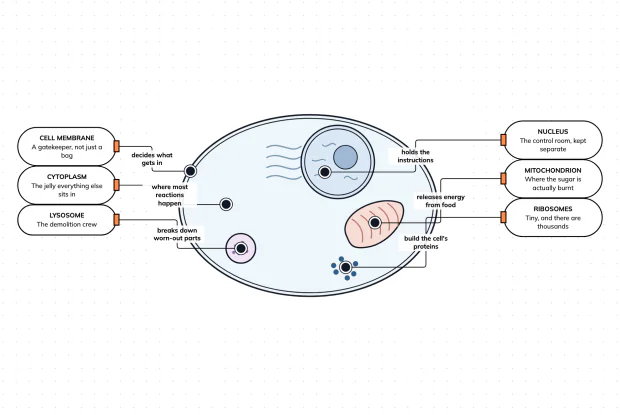
Every living thing is built from cells, and a cell is not a simple bag. Inside it, separate parts handle instructions, energy, building, demolition and what crosses the boundary. Match six parts to their jobs in an interactive playground.
Plant Cell or Animal Cell — What Tells Them Apart?
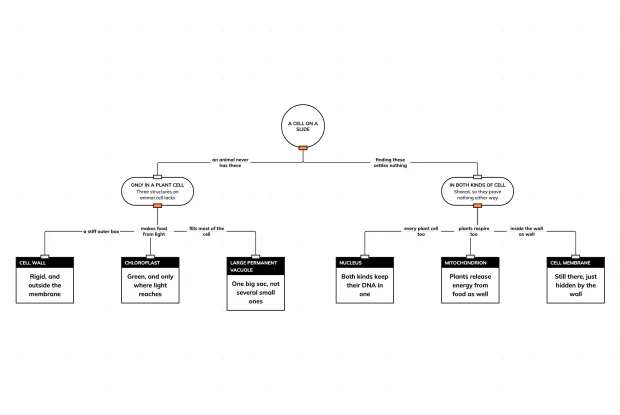
Plant and animal cells share almost everything. Only three structures are found in a plant cell and never in an animal one, and the shared parts settle nothing. Sort six structures in an interactive playground.
What Does the Cell Membrane Let Through?
A cell membrane is a double layer of fat molecules with proteins set into it. Small uncharged molecules cross it freely, charged or larger ones need a protein doorway, and big ones never get through. Sort six molecules in an interactive playground.
What Does the Nucleus Actually Hold?
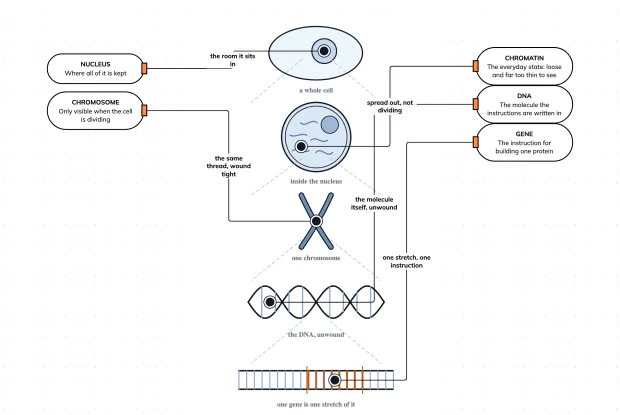
The nucleus holds DNA, but chromosome, chromatin and gene all describe that same material at different levels. Follow the zoom from a cell down to a single gene in an interactive playground.
Bacteria Have No Nucleus — So What Do They Have?
A bacterium has no nucleus and no membrane-bound organelles, yet it does everything a cell must do. Follow the two ways of organising a cell in an interactive playground.