What Everything Living Is Made Of
Zoom in far enough on anything alive and you reach a cell, the smallest thing that is still living. This track is about what is inside one and why it is arranged that way. The first idea is that a cell is organised rather than uniform: the reactions that keep it alive would ruin each other if they met, so each job gets its own compartment — instructions sealed in the nucleus, energy released in the mitochondria, proteins built on ribosomes, worn-out parts broken down inside lysosomes, and the cytoplasm around them all doing most of the ordinary chemistry. The second is that the boundary is the part that matters most, because a membrane that lets some things through and refuses others is what allows a cell to be different inside from out. From there the track asks what actually separates a plant cell from an animal one, which is a shorter list than most people expect, and what a bacterium does instead of having a nucleus at all.
CodePLU Goal
Upgrading Human Mental Models
Learn how to think in Workflows
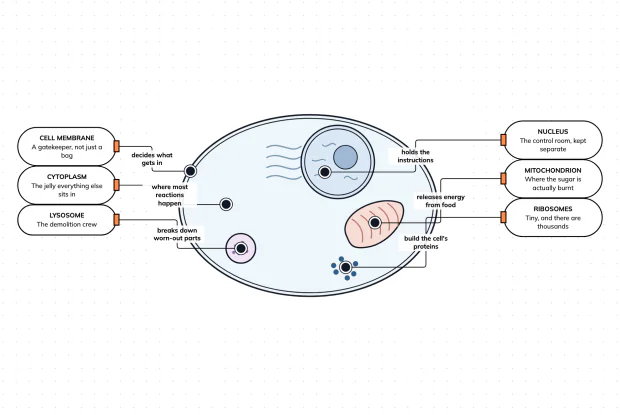
What Is a Cell, and What Does Each Part Do?
Every living thing is built from cells, and a cell is not a simple bag. Inside it, separate parts handle instructions, energy, building, demolition and what crosses the boundary. Match six parts to their jobs in an interactive playground.

Plant Cell or Animal Cell — What Tells Them Apart?
Plant and animal cells share almost everything. Only three structures are found in a plant cell and never in an animal one, and the shared parts settle nothing. Sort six structures in an interactive playground.
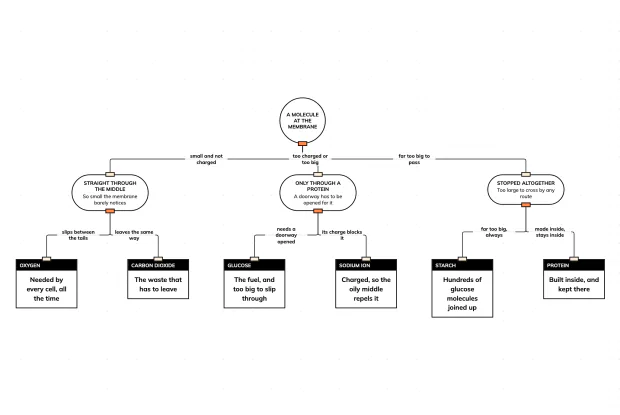
What Does the Cell Membrane Let Through?
A cell membrane is a double layer of fat molecules with proteins set into it. Small uncharged molecules cross it freely, charged or larger ones need a protein doorway, and big ones never get through. Sort six molecules in an interactive playground.
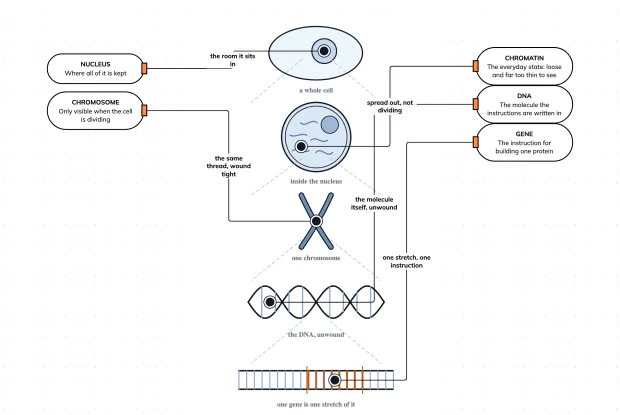
What Does the Nucleus Actually Hold?
The nucleus holds DNA, but chromosome, chromatin and gene all describe that same material at different levels. Follow the zoom from a cell down to a single gene in an interactive playground.
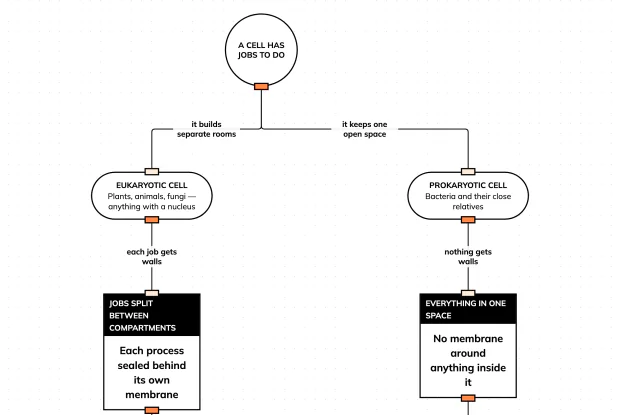
Bacteria Have No Nucleus — So What Do They Have?
A bacterium has no nucleus and no membrane-bound organelles, yet it does everything a cell must do. Follow the two ways of organising a cell in an interactive playground.