What Counts as a Microorganism? Not One Group
Root Concept
A microorganism is any organism too small to see without a microscope, which is a statement about size rather than about ancestry, so microbes are spread across several kingdoms and include viruses, which belong to none.
CodePLU Goal
Upgrading Human Mental Models
Learn how to think in Workflows

Concept Development By codeplu.com
Four microbes, four different answers. Being small is the only thing they have in common.
A Word About Size, Not About Family
The last track spent five tutorials establishing that a useful grouping follows ancestry rather than appearance, and that grouping by "lives in water" is useless because it puts a shark beside a whale and predicts nothing about either. This tutorial opens with a word that breaks that rule on purpose.
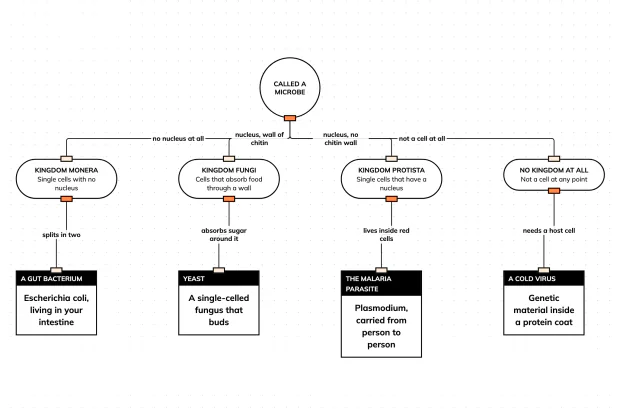
"Microorganism", or microbe, means any living thing too small to see without a microscope. That is a statement about size and nothing else. It says nothing about what the organism is made of, how it feeds, or what it is descended from. So when you follow the word back into the classification you built in Track 6, it does not land in one place. Bacteria are microbes and sit in Monera. Yeast is a microbe and sits in Fungi, alongside mushrooms you can see perfectly well. Amoeba and the malaria parasite are microbes and sit in Protista. Viruses are usually counted as microbes and sit in no kingdom at all, because they are not cells.
That makes "microbe" a genuinely different kind of word from "mammal". It is still a useful word, because organisms that small share real problems and real methods — they are studied with the same microscopes, grown in the same dishes, and killed by the same heat. But it is a working category, not a branch of the family tree, and knowing something is a microbe tells you almost nothing about its biology until you ask which kingdom it is in.
Taking the Word Apart
How small does something have to be?
The usual line is roughly a tenth of a millimetre: below that, the unaided eye cannot resolve an object as a shape. A typical bacterium is about two micrometres long, which is fifty times smaller than that limit, and a virus is smaller again by another factor of a hundred. But the boundary is soft, and that is the first clue that the category is practical rather than natural. Some protists are nearly a millimetre across and can just be seen as moving specks in pond water. Bread mould is called a microorganism even though the fuzzy patch on the bread is obvious from across a room, because what you see is a colony of millions and the individual threads are microscopic. A category whose edge depends on whether you are looking at one organism or a crowd of them is not a category nature drew.
Why are bacteria and yeast in different kingdoms?
Both are single cells, both are roughly round under a microscope, and both can be grown overnight in a warm flask of sugar solution. On every practical measure they behave alike, which is exactly why the word microbe covers both. But Track 3 established the deepest division in all of life: whether a cell keeps its DNA inside a nucleus. A bacterium does not, and its DNA sits as a single loop in the cytoplasm. Yeast does, along with mitochondria and every other organelle an animal cell has. Yeast is far more closely related to you than it is to the bacterium growing in the flask beside it. The two are neighbours in size and strangers in ancestry, and when those two facts disagree, ancestry is the one that predicts things.
Where do protists fit?
Protista is the kingdom for organisms that have a nucleus but are not plants, animals or fungi, and most of its members are single cells. Amoeba crawls by pushing out part of itself and flowing into it. Paramecium swims with rows of tiny beating hairs. Plasmodium, the cause of malaria, spends part of its life inside a mosquito and part inside human red blood cells. These organisms have little in common beyond being single cells with a nucleus, which is why the previous tutorial warned that Protista is less a group than a leftover tray. But every one of them is a microbe, and together they include some of the most important disease-causing organisms on Earth, so the tray cannot simply be ignored.
Should viruses be counted at all?
Honestly, it depends who is asking. A virus is far smaller than any bacterium and is studied in the same laboratories by the same people, so in practice microbiology includes it. But everything else about the word organism fails. A virus has no cell, no cytoplasm, no ribosomes and no chemistry of its own; outside a host it is an inert particle that can be crystallised like salt. If microbe means a small organism, then strictly a virus is not one. The sensible position is the one the previous track reached about whether a virus is alive: the awkwardness is real, it is not going to be resolved by arguing about the word, and the useful move is to state plainly what a virus has and has not got.
Real World Example
Four Things in One Drop of Pond Water
Put a drop of pond water under a school microscope and you will find organisms from several kingdoms sharing a space narrower than a full stop. Being equally small has brought them together; nothing else has.
Step 1
The swimming specks are protists
The first things anyone notices are the ones that move. A Paramecium glides across the field of view driven by rows of beating hairs, turning when it bumps into something. An Amoeba moves far more slowly, flowing forward as it pushes out a lobe of itself and pours the rest in behind. Both are single cells, both have a nucleus you can sometimes make out as a darker patch, and both hunt and swallow smaller things. They look like tiny animals and behave like tiny animals, which is precisely the trap. They are not animals, because an animal is multicellular. They are protists, and the resemblance to animals is about how they make a living rather than about where they came from.
Step 2
The green threads are plants and bacteria
Green strands in the same drop may be two completely different things. Some are filaments of algae, with chloroplasts visible as distinct green bodies arranged in a spiral or a ring inside each cell. Others are cyanobacteria, which are also green and also make food from light, but have no nucleus and no chloroplasts at all — the photosynthetic chemistry is spread through the cell instead of being packaged. Under a school microscope the two can look almost identical at low power. They sit either side of the deepest boundary in biology, and the only way to tell is to turn up the magnification and look for the organelles.
Step 3
What you cannot see is the biggest group
Most of what is in the drop never appears. Ordinary bacteria at two micrometres are at the very edge of what a school microscope resolves, and they show up at best as faint moving dots with no visible structure. Viruses are a hundred times smaller again and are completely invisible to any light microscope, since they are smaller than the wavelength of light itself and were only seen once electron microscopes arrived in the 1930s. So the drop contains, in rough order of abundance, viruses then bacteria then everything you actually looked at. The things easiest to see are the rarest, which is worth remembering before concluding that a sample is clean.
FAQs
Final Words
Microorganism is a word about size, and that is all it is. It gathers up bacteria from Monera, yeast and moulds from Fungi, amoebae and malaria parasites from Protista, some tiny algae from Plantae, and viruses from nowhere at all, on the single ground that none of them can be seen without a lens.
That makes it the exact opposite of the groupings the last track argued for. Knowing something is a mammal predicts a great deal; knowing something is a microbe predicts only that it is small and will need a microscope. The word still earns its keep, because organisms that small really do share problems and really are handled the same way in a laboratory. But the biology only becomes clear once you ask the next question, which is which kingdom it came from. The rest of this track takes them one group at a time, starting with how fast they multiply.
Continue This Track
This concept is part 1 of The World Too Small to See.
What Counts as a Microorganism? Not One Group
A microorganism is anything too small to see without a microscope, which turns out to span four kingdoms plus viruses. Sort four familiar microbes into the groups they really belong to in an interactive playground.
How Do Microbes Multiply So Fast? Follow the Doubling
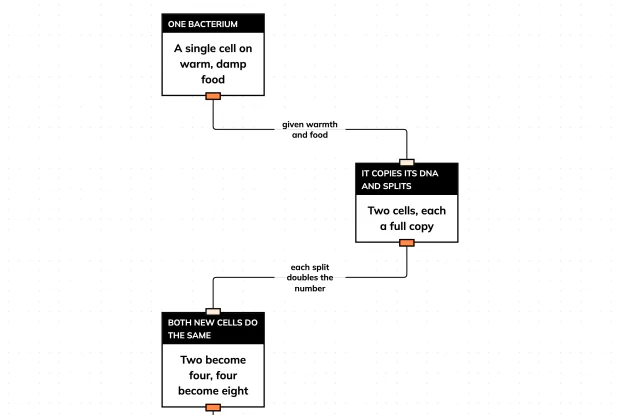
A bacterium does not grow a family — it splits in two, and both halves split again. Follow that doubling step by step in an interactive playground and see why warm food spoils so suddenly.
How Does a Mould Feed and Spread? Label the Parts
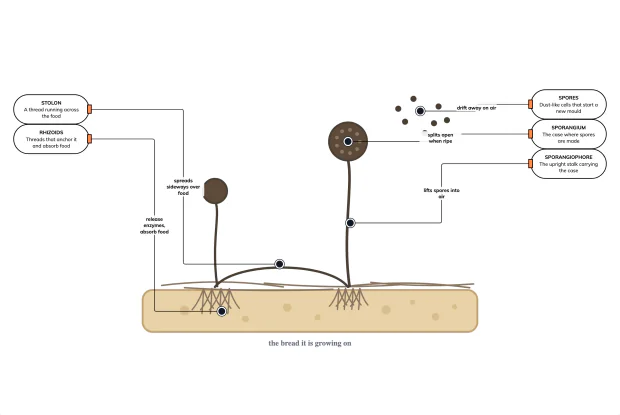
Bread mould has no mouth and never moves, yet it feeds on the loaf and reaches the next one. Label each part by the job it does in an interactive playground.
The Microbes We Could Not Live Without
Disease-causing microbes are a tiny minority. Sort four essential ones by the job each does — rotting, fixing nitrogen, fermenting food and living in your gut — in an interactive playground.
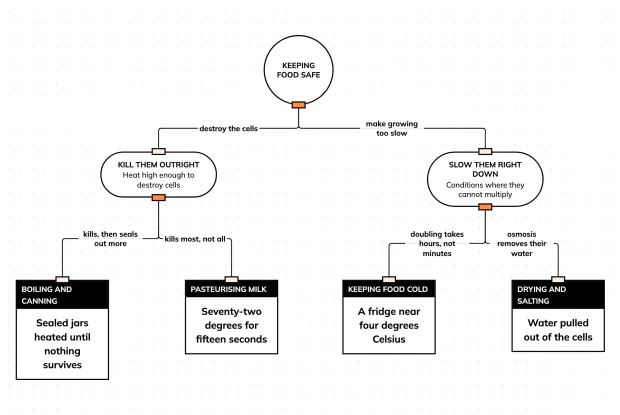
How Do We Stop Microbes Growing? Kill or Slow
Every method of preserving food either destroys microbes or makes conditions too poor for them to multiply, and the two are not the same. Sort four methods in an interactive playground.