How Do Microbes Multiply So Fast? Follow the Doubling
Root Concept
Bacteria reproduce by binary fission, in which one cell divides into two identical cells, so the population doubles each generation and grows exponentially rather than by adding a fixed number each time.
CodePLU Goal
Upgrading Human Mental Models
Learn how to think in Workflows

Concept Development By codeplu.com
Nothing in the chain is dramatic on its own. Doubling twenty-four times is what does the work.
Why Milk Is Fine, Then Suddenly Is Not
Milk left out of the fridge seems perfectly all right for hours, and then is obviously spoiled. Nothing happened suddenly at the end. What changed was that a number which had been doubling quietly finally became large enough to taste.
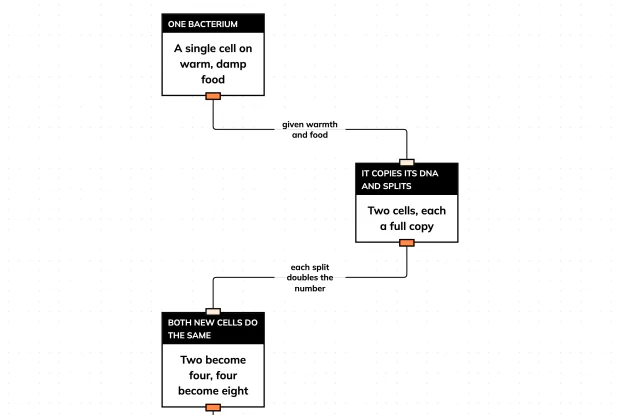
Bacteria do not reproduce the way familiar animals do. There is no pairing, no offspring that grow up alongside a parent, and no parent left over afterwards. A bacterium copies its single loop of DNA, pulls the two copies to opposite ends of itself, and pinches into two cells. This is called binary fission, and what matters about it is that it leaves behind two cells which are both ready to do it again. There is no slow juvenile stage and nothing that gets old and stops.
That one structural fact changes the arithmetic completely. Adding a fixed number each round gives you a line: one, three, five, seven. Doubling each round gives you one, two, four, eight — and after twenty-four rounds it gives you sixteen million. The early rounds look like almost nothing happening, which is exactly why spoilage feels sudden and why a wound can look fine for a day and be seriously infected on the next. The playground walks the chain one step at a time, and no single step is surprising. The end of it is.
Where the Numbers Come From
What actually happens when a bacterium divides?
The cell first copies its DNA. A bacterium has one circular chromosome rather than the paired chromosomes of your own cells, and copying starts at a single point and runs both ways round the loop until the two halves meet. The two copies then attach to the cell membrane at opposite ends, and as the cell lengthens they are pulled apart. A new wall then grows inward at the middle until the cell pinches into two. Each daughter cell has a complete chromosome and roughly half the cytoplasm, ribosomes and plasmids of the original. There is no parent cell remaining — the original has become both of the new ones, which is why bacteria are sometimes said not to die of old age.
Why does doubling get out of hand so quickly?
Because each round multiplies rather than adds. After ten doublings a single cell has become about a thousand, after twenty about a million, and after thirty about a billion. The crucial feature is that the increase in any one round is as large as everything that came before it put together: going from eight million to sixteen million adds more cells in twenty minutes than the previous seven and a half hours produced in total. This is why the growth feels like nothing and then like everything. Written as a formula it is simply the starting number multiplied by two raised to the number of doublings, and with twenty minutes per doubling, eight hours gives twenty-four of them.
Does this really go on forever?
No, and the reason it stops matters as much as the reason it starts. Twenty minutes per division is the best a well-fed Escherichia coli can manage at body temperature with everything it needs; most bacteria in most conditions are far slower, and the tuberculosis bacterium takes around a day. Even in ideal conditions the food runs out, waste products build up and the population levels off, which is why a flask of broth ends up cloudy rather than solid. Drawn on a graph the population rises steeply and then flattens into a plateau. The explosive phase is real but temporary, and the whole of food safety is about never letting it begin.
Do all microbes multiply this way?
Not quite. Binary fission is the bacterial method, and some protists divide similarly. Yeast does something slightly different called budding, where a small bulge grows out of the parent cell, receives a copy of the nucleus, and breaks away smaller than the cell it came from — so there is a recognisable parent left behind. Moulds spread by growing threads and release enormous numbers of spores rather than dividing in half. Viruses do not reproduce at all in any ordinary sense: they hijack a host cell, which assembles hundreds of new particles and usually bursts, so one infected cell releases a crowd rather than a pair. The numbers get large by different routes, but they all get large, and in every case the increase is a multiplication rather than an addition.
Real World Example
Chicken Left Out on a Summer Afternoon
Food safety rules sound fussy until the doubling is written out. The two-hour rule and the four-degree fridge are both answers to exactly the chain in the playground.
Step 1
The starting number is small
Cooked chicken coming out of the oven is essentially sterile on the surface, but it does not stay that way. Handling it, resting it on a board that held raw meat, or simply leaving it uncovered puts a modest number of bacterial cells onto it — perhaps a few hundred across the whole piece. At that point there is no detectable problem whatsoever. It looks right, smells right and would do nobody any harm. Every account of food poisoning begins at a moment exactly like this one, which is the part that makes the rules hard to follow: the dangerous state and the safe state look identical.
Step 2
Warmth starts the clock
A kitchen at twenty-five degrees sits inside what food safety guidance calls the danger zone, roughly five to sixty degrees, where bacteria multiply fastest. The chicken is moist, full of protein and at a comfortable temperature, which is close to ideal growing conditions. Doubling begins. After an hour the few hundred cells have become a few thousand, which is still nothing you could detect by looking, smelling or tasting. This is the stretch during which it genuinely seems that leaving the plate out is causing no harm, because by every sense available to you it is not.
Step 3
The last hour does most of the damage
By four hours the same doubling has carried the count into the millions, and more than half of that total arrived during the final forty minutes. For many food poisoning bacteria that is the region where an infectious dose begins. The chicken may still look and smell completely normal, because the cells are microscopic and some species produce no obvious spoilage until far later. This is why the advice is a clock rather than a sniff test, and why refrigeration matters so much: at four degrees the doubling time stretches from twenty minutes to many hours, and the chain in the playground simply never gets going.
FAQs
Final Words
One cell becomes two, two become four, and the only thing that makes the end of the chain surprising is that the beginning of it is so dull. Binary fission leaves behind no parent and no juvenile — just two cells both ready to divide again — and that is what turns addition into multiplication.
The practical consequences follow directly. Food left in the warm is safe and then is not, with no visible moment in between. Refrigeration works by stretching the doubling time rather than by killing anything. A small number of resistant cells in a large population can take it over in hours. Every one of those facts is the same arithmetic seen from a different angle. The next tutorial turns from bacteria to a microbe you can actually watch spread: the mould on a slice of bread.
Continue This Track
This concept is part 2 of The World Too Small to See.
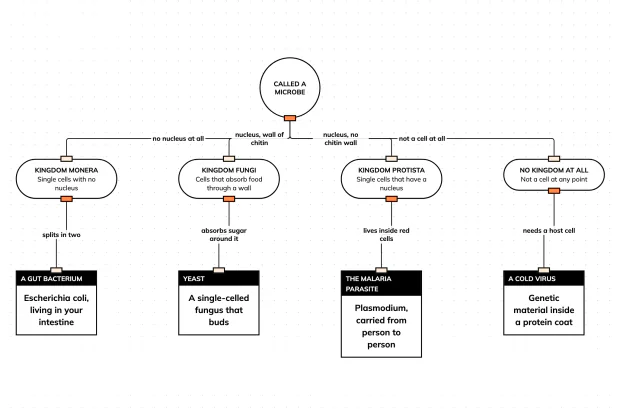
What Counts as a Microorganism? Not One Group
A microorganism is anything too small to see without a microscope, which turns out to span four kingdoms plus viruses. Sort four familiar microbes into the groups they really belong to in an interactive playground.
How Do Microbes Multiply So Fast? Follow the Doubling
A bacterium does not grow a family — it splits in two, and both halves split again. Follow that doubling step by step in an interactive playground and see why warm food spoils so suddenly.
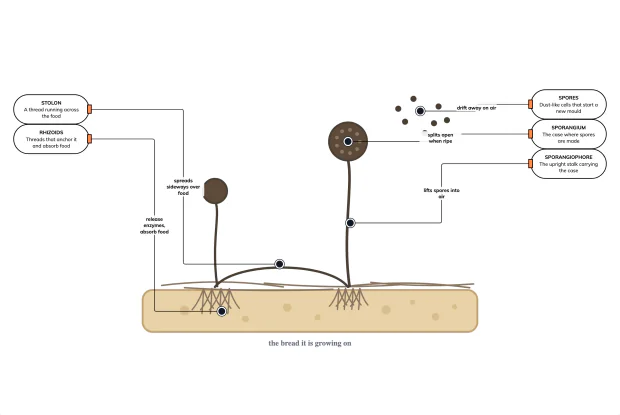
How Does a Mould Feed and Spread? Label the Parts
Bread mould has no mouth and never moves, yet it feeds on the loaf and reaches the next one. Label each part by the job it does in an interactive playground.
The Microbes We Could Not Live Without
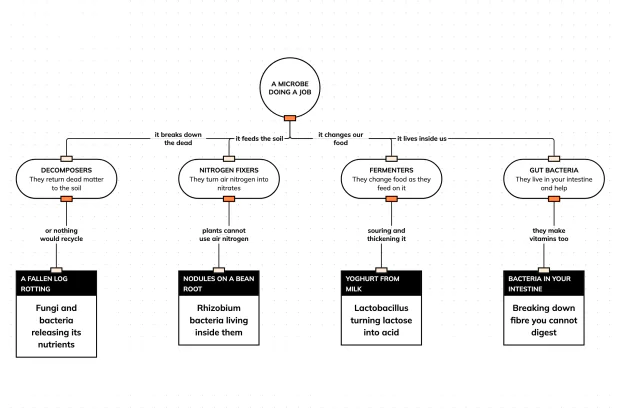
Disease-causing microbes are a tiny minority. Sort four essential ones by the job each does — rotting, fixing nitrogen, fermenting food and living in your gut — in an interactive playground.
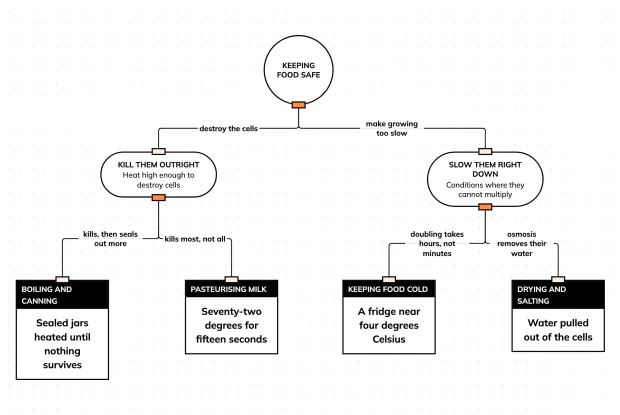
How Do We Stop Microbes Growing? Kill or Slow
Every method of preserving food either destroys microbes or makes conditions too poor for them to multiply, and the two are not the same. Sort four methods in an interactive playground.