The Microbes We Could Not Live Without
Root Concept
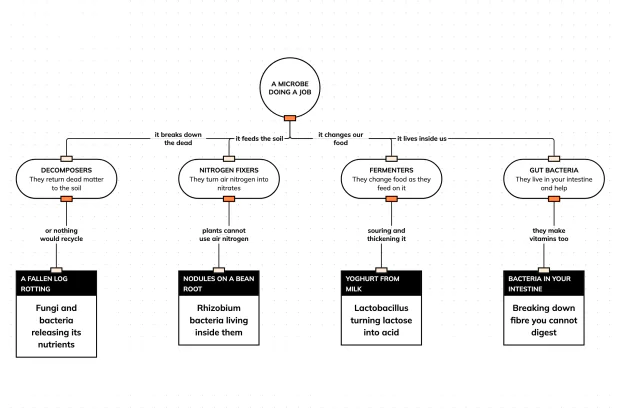
Most microorganisms are harmless or essential rather than harmful, and they sustain life by decomposing dead material, fixing nitrogen into forms plants can use, fermenting food, and living in the digestive systems of animals.
CodePLU Goal
Upgrading Human Mental Models
Learn how to think in Workflows

Concept Development By codeplu.com
Four jobs, none of them optional. Remove any one and something large stops working.
The Minority That Gets All the Attention
Ask anyone what microbes do and the answer will be about disease. That is understandable, because the ones that cause illness matter enormously to us, and the history of medicine is largely the history of finding them. But as a description of what microbes do in the world it is badly wrong. The great majority are harmless to humans, and a substantial number are not merely harmless but essential.
The clearest way to see this is to ask what would happen if they stopped. If every decomposing microbe vanished tonight, nothing dead would ever rot. Leaves would pile up where they fell and stay there; the nutrients locked inside every dead plant and animal would never return to the soil, and within a few seasons plants would be starving on top of a mountain of their own unrecycled remains. If nitrogen-fixing bacteria stopped, the air would still be four-fifths nitrogen and no plant could touch any of it.
Those are not small contributions at the edge of an ecosystem. They are two of the load-bearing processes the whole thing rests on, and both are carried out entirely by organisms too small to see. The playground sorts four of these jobs. None of the four is optional, and only one of them has anything to do with us directly.
The Four Jobs
What happens when something rots?
Rotting is feeding. Bacteria and fungi land on dead material, release enzymes onto it exactly as the bread mould did, and absorb what dissolves. What they leave behind are the simple substances the dead material was built from: carbon dioxide into the air, and nitrates, phosphates and other minerals into the soil. Those are precisely the substances plant roots take up, so a decomposer is the step that connects the end of one life to the start of the next. Track 1 drew food chains with energy flowing one way and stopping; the matter does not stop, and decomposers are the reason it comes back round. Nothing else does this job. Scavenging animals break material into smaller pieces, but only microbes take it apart to the molecules.
Why do plants need bacteria for nitrogen?
Proteins and DNA both contain nitrogen, so no organism can build itself without a supply. The atmosphere is about seventy-eight per cent nitrogen gas, which sounds like an unlimited supply and is almost entirely useless: the two atoms in a nitrogen molecule are held together so tightly that plants cannot break them apart. What plants can absorb is nitrate dissolved in soil water. Certain bacteria can do the conversion, and some of them live inside swellings called nodules on the roots of peas, beans and clover, trading nitrogen compounds for sugars from the plant. This is why farmers rotate a legume crop through a field and why clover is sown into pasture: the bacteria fertilise the soil from the air.
How do microbes change food?
Fermentation is what certain microbes do when they break down sugars without using oxygen, and the useful part is the waste they leave. Lactobacillus feeding on the lactose in milk produces lactic acid, which sours the milk and makes its proteins clump — that is yoghurt, and with further steps, cheese. Yeast feeding on sugar in dough produces carbon dioxide, which is trapped as bubbles and makes bread rise, and ethanol, which bakes off. Every one of these foods is the by-product of a microbe making a living. The practice is far older than any understanding of it: bread, cheese, yoghurt and beer were all being made thousands of years before anyone knew a microbe existed.
What are the bacteria in your gut doing?
Your large intestine holds an enormous population of bacteria, roughly comparable in number to your own body cells, and they are not merely passengers. They break down fibre that your own enzymes cannot touch, releasing substances your gut lining can absorb and use. They manufacture vitamin K and several B vitamins. And by occupying the space and consuming the food, they make it harder for harmful bacteria to establish themselves, which is part of why a course of antibiotics can be followed by digestive upset — the treatment does not distinguish between the bacteria causing the problem and the ones already doing a job. The population is also remarkably varied, with hundreds of species present in one person and a noticeably different mixture in the next, shaped partly by what that person habitually eats.
Real World Example
A Field Left to Itself for One Year
Nothing in an ordinary field looks like it is being maintained, and yet it continues year after year without anything being added. Three microbial jobs are the reason.
Step 1
Last year's growth disappears
Grass that died back in autumn is gone by the following summer, and nobody removed it. Fungi and bacteria in the soil have digested it where it lay, breaking the cellulose and protein down into simple substances. The carbon in it has gone back to the air as carbon dioxide; the nitrogen, phosphorus and minerals have gone into the soil as dissolved salts. Without this the field would be buried in its own dead material within a decade, and every nutrient the soil started with would be locked up in a layer of undecayed stems nothing could reach.
Step 2
The clover quietly fertilises the field
Scattered through the grass are clover plants, and on their roots are small pink nodules packed with Rhizobium bacteria. Those bacteria are converting nitrogen gas from air in the soil into compounds the clover can use, in exchange for sugars the clover supplies. When the clover dies and decomposes, that nitrogen enters the soil where the surrounding grass can take it up. This is why a pasture with clover in it stays green without fertiliser while a pure grass sward slowly runs down, and why clover was central to farming for centuries before artificial fertiliser existed.
Step 3
The animals could not digest grass alone
A cow grazing the field cannot digest cellulose, which is most of what grass is made of, because no mammal produces an enzyme that breaks it down. What a cow has instead is a rumen: a large chamber holding a dense population of bacteria and protists that can digest cellulose, fermenting it into substances the cow absorbs. The cow is not really living on grass at all — it is living on the products of a microbial culture it keeps fed. Remove the microbes and an animal built entirely for eating grass would starve on a full stomach.
FAQs
Final Words
Four jobs, none of them optional. Decomposers take dead material apart to the molecules so the matter in it can be used again. Nitrogen fixers convert a gas that makes up most of the air into something a root can absorb. Fermenters turn milk into yoghurt and dough into bread. Gut bacteria break down fibre, make vitamins and crowd out worse neighbours.
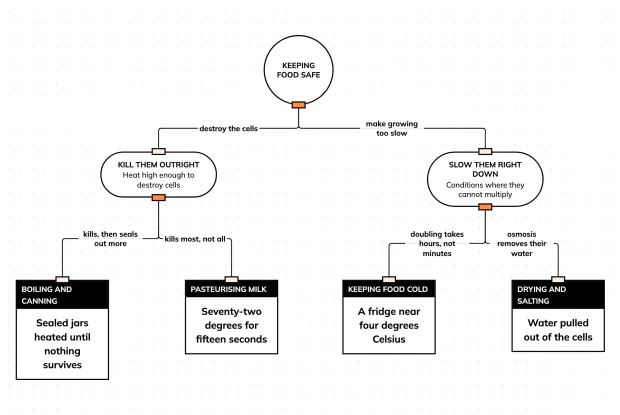
Set against those, the disease-causing microbes are a small and unrepresentative minority which happens to be the one we notice. That minority is still worth understanding, and worth controlling, which is where this track ends. The last tutorial asks how microbial growth is stopped — and which methods kill, which merely slow things down, and why that difference decides how long food keeps.
Continue This Track
This concept is part 4 of The World Too Small to See.
What Counts as a Microorganism? Not One Group
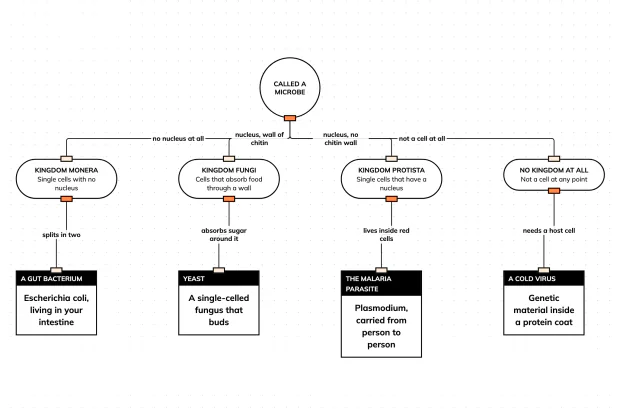
A microorganism is anything too small to see without a microscope, which turns out to span four kingdoms plus viruses. Sort four familiar microbes into the groups they really belong to in an interactive playground.
How Do Microbes Multiply So Fast? Follow the Doubling
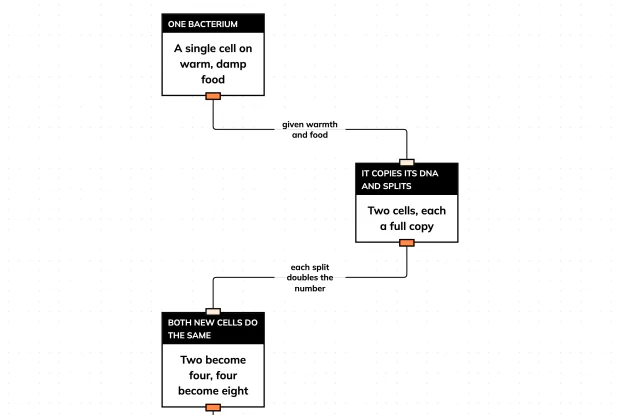
A bacterium does not grow a family — it splits in two, and both halves split again. Follow that doubling step by step in an interactive playground and see why warm food spoils so suddenly.
How Does a Mould Feed and Spread? Label the Parts
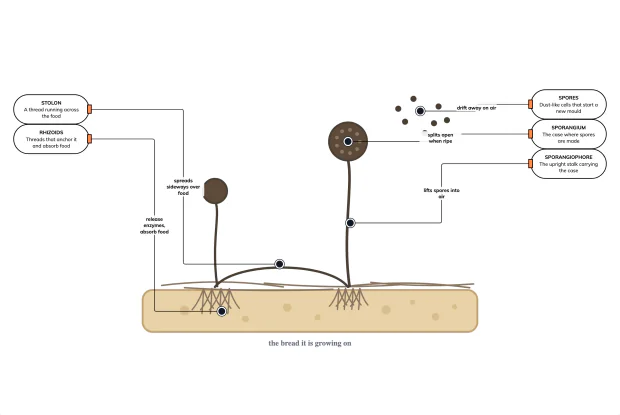
Bread mould has no mouth and never moves, yet it feeds on the loaf and reaches the next one. Label each part by the job it does in an interactive playground.
The Microbes We Could Not Live Without
Disease-causing microbes are a tiny minority. Sort four essential ones by the job each does — rotting, fixing nitrogen, fermenting food and living in your gut — in an interactive playground.
How Do We Stop Microbes Growing? Kill or Slow
Every method of preserving food either destroys microbes or makes conditions too poor for them to multiply, and the two are not the same. Sort four methods in an interactive playground.