How Does a Mould Feed and Spread? Label the Parts
Root Concept
A mould is a fungus made of threads called hyphae, which digest food outside themselves by releasing enzymes and then absorb the products, and which spread by releasing spores from cases raised above the food on upright stalks.
CodePLU Goal
Upgrading Human Mental Models
Learn how to think in Workflows

Concept Development By codeplu.com
Every part answers a job. The threads get the food in; the stalk gets the spores out.
The Fuzzy Patch Is Not One Thing
Bread mould is the easiest microorganism to study because you need no equipment to find it and only a hand lens to see how it is built. Leave a damp slice in a warm place for a few days and a grey-green patch appears, which under magnification turns out not to be a patch at all but a forest of threads with round black heads standing up from it.
Those threads are the fungus. Each one is called a hypha, and the whole tangled network is the mycelium. There is no body in the sense an animal has one — no inside and outside, no organs, no mouth. The fungus is a mesh spreading through its food, and because it is a mesh, every part of it is in contact with the bread at once. That turns out to be the key to how it feeds.
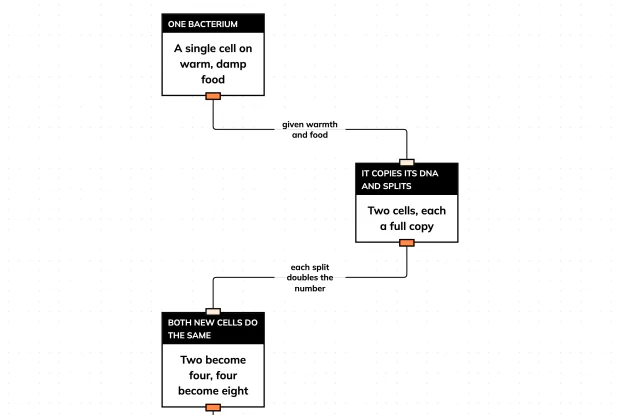
The parts in the playground divide neatly into two jobs. Some of them are about getting food in: the rhizoids digging down into the slice and the stolon running sideways to reach fresh bread. The rest are about getting out: the upright stalk, the case on top of it, and the spores that leave. A fungus that only solved the first problem would eat one slice and die with it. Everything above the surface exists so that something survives the slice running out.
Reading the Parts Off the Figure
How does a mould eat without a mouth?
It digests the food first and absorbs it afterwards, which is the exact reverse of what you do. You take bread into your body and release enzymes onto it inside your gut. A mould releases its enzymes outward, through the walls of the threads, straight onto the bread it is sitting on. Those enzymes break the starch and protein of the loaf into small soluble molecules, and the threads then absorb the solution directly through their surfaces. This is called extracellular digestion, and it is the defining feature of the whole fungal kingdom. It explains why the bread beneath a mould patch goes soft and discoloured before the mould itself has visibly spread: the digestion reaches further than the fungus does.
What do the rhizoids and the stolon do?
They are both hyphae, but pointed in different directions and doing different work. Rhizoids are short branching threads that grow downward into the bread. They anchor the fungus so it is not brushed off, and they are where most of the enzyme release and absorption happens, because they are the parts buried in the food. A stolon is a thicker thread that arches across the surface from one anchored point to another, like a strawberry runner. Where it touches down, a new clump of rhizoids grows and a new upright stalk goes up. That is how the colony crosses a slice: not by anything moving, but by growing outward from wherever it already is.
Why does the spore case sit on a stalk?
Because spores that fall onto the bread the fungus is already eating are wasted. The sporangiophore raises the sporangium a few millimetres into the air, which does not sound like much but puts the spores into moving air rather than into the still layer against the surface. When the case ripens its wall breaks down and thousands of spores are released, light enough to stay airborne for a long time and tough enough to survive drying. Each one that lands somewhere damp and warm can grow a new hypha and start the whole thing again. The height of the stalk is a dispersal mechanism, and it is why mould appears on a fresh loaf in a bin that held a mouldy one.
Is a mould one organism or many?
This is harder to answer than it looks, and the honest answer is that the question does not fit the organism well. A patch grown from one spore is a single connected mycelium, so it is one individual in the sense that matters. But the threads are often not divided into separate cells at all: in bread mould the hyphae are continuous tubes with many nuclei sharing one stretch of cytoplasm, with no walls between them. There is no cell count to give. Fungi are usually called multicellular, and in many species that is clearly right, but bread mould sits awkwardly across the boundary, in much the same way that viruses sit awkwardly across the boundary of being alive.
Real World Example
Growing Mould on Purpose in a Jar
The sequence is predictable enough to be used as a school practical, and watching it in order makes the point that the feeding structures come first and the spreading structures only once feeding is established.
Step 1
A spore lands and sends out threads
Put a slightly damp piece of bread in a sealed jar in a warm cupboard and you do not need to add anything — mould spores are already on the surface and in the air of the room. For the first day or two nothing is visible. A spore that has landed somewhere damp enough is swelling and pushing out its first hypha, which branches as it goes and begins releasing enzymes into the bread around it. The slice may start to look slightly damp or darkened in one spot before any fungus can be seen, because the digestion is running ahead of the visible threads.
Step 2
A white mat spreads across the surface
By about the third day there is an obvious white or pale grey fuzz, and a hand lens shows it to be a mat of fine threads rather than a powder. Stolons arch across the surface and anchor down in new places, so the patch widens outward in a roughly circular shape from wherever the original spore landed. This circular spread is worth noticing: it is the signature of something growing outward at an even rate from a point, and the same shape shows up in fungal rings in grass, which are the same process running for years instead of days.
Step 3
Black pinheads appear and the patch turns grey
Around the fourth or fifth day the colour changes, which is the step that gives black bread mould its name. Upright stalks rise from the mat and each develops a round sporangium at its tip, pale at first and then darkening as the spores inside mature. Seen with a lens they are unmistakable black pinheads on clear stalks. From this point the jar should stay closed, because opening it releases large numbers of spores into the room. That is also the lesson: the organism has moved from feeding to spreading, and everything built in this stage exists to leave.
FAQs
Final Words
Two jobs, five parts. The rhizoids dig into the bread, release enzymes and absorb what those enzymes dissolve. The stolon arches sideways so the colony reaches food it has not used yet. The sporangiophore stands up, the sporangium ripens on top of it, and the spores leave on the air.
The feeding method is what places the organism in its kingdom. Digesting outside the body and absorbing the results is what every fungus does, from this patch on a slice to a mushroom in a wood to the yeast in a bread dough, and it is why Track 6 separated fungi from plants despite both standing still. The next tutorial takes that further and asks what the world would be like if nothing fed this way at all.
Continue This Track
This concept is part 3 of The World Too Small to See.
What Counts as a Microorganism? Not One Group
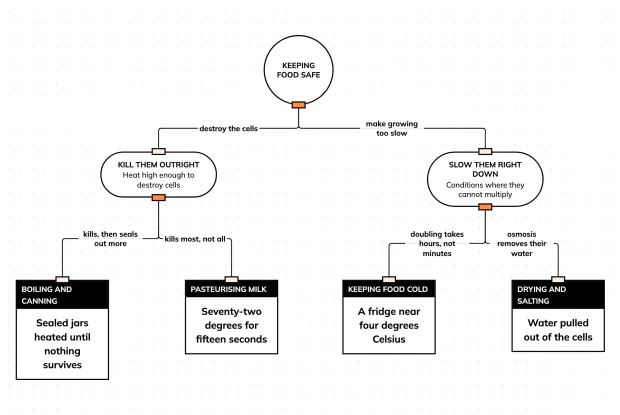
A microorganism is anything too small to see without a microscope, which turns out to span four kingdoms plus viruses. Sort four familiar microbes into the groups they really belong to in an interactive playground.
How Do Microbes Multiply So Fast? Follow the Doubling
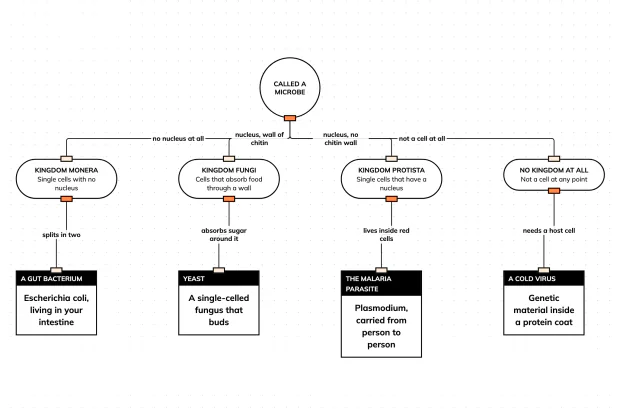
A bacterium does not grow a family — it splits in two, and both halves split again. Follow that doubling step by step in an interactive playground and see why warm food spoils so suddenly.
How Does a Mould Feed and Spread? Label the Parts
Bread mould has no mouth and never moves, yet it feeds on the loaf and reaches the next one. Label each part by the job it does in an interactive playground.
The Microbes We Could Not Live Without
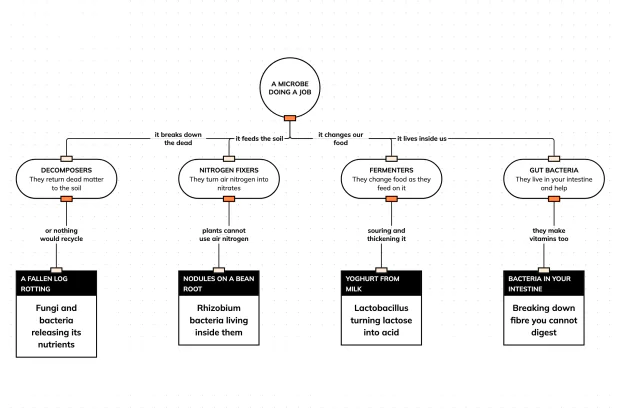
Disease-causing microbes are a tiny minority. Sort four essential ones by the job each does — rotting, fixing nitrogen, fermenting food and living in your gut — in an interactive playground.
How Do We Stop Microbes Growing? Kill or Slow
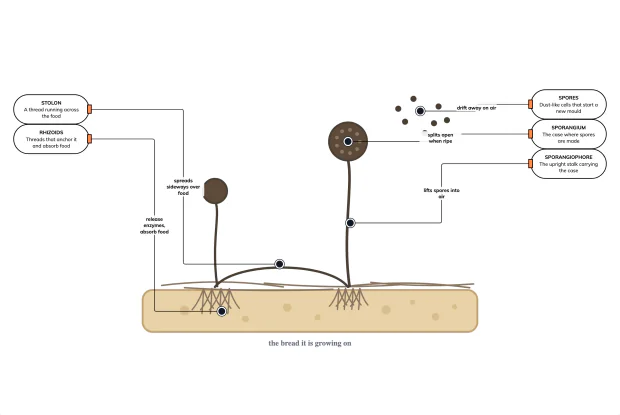
Every method of preserving food either destroys microbes or makes conditions too poor for them to multiply, and the two are not the same. Sort four methods in an interactive playground.