The World Too Small to See
Microorganism is the one grouping in this subject that deliberately breaks the rule the previous track spent five tutorials establishing. It is a statement about size and nothing else, so following it back into the classification lands in Monera, Fungi and Protista at once, and then in viruses, which belong to no kingdom at all. The track starts by taking the word apart, then turns to the arithmetic that makes microbes so hard to keep up with: binary fission leaves two cells where there was one, with no parent and no juvenile, so a count doubles rather than adding, and twenty-four doublings turn one cell into sixteen million. Bread mould then supplies a microbe you can watch, with every part answering a job — threads that digest the loaf from outside and absorb what dissolves, and a stalk whose only purpose is to lift spores clear of the food. The last two tutorials take the practical consequences in both directions: the four microbial jobs the living world could not continue without, and the two ways of stopping microbial growth, where killing is permanent and slowing lasts only as long as the conditions do.
CodePLU Goal
Upgrading Human Mental Models
Learn how to think in Workflows
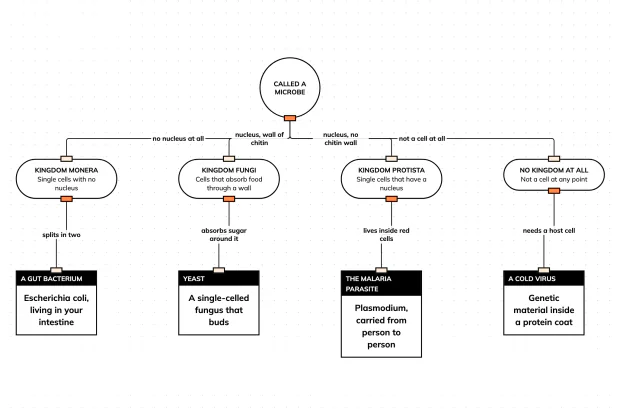
What Counts as a Microorganism? Not One Group
A microorganism is anything too small to see without a microscope, which turns out to span four kingdoms plus viruses. Sort four familiar microbes into the groups they really belong to in an interactive playground.
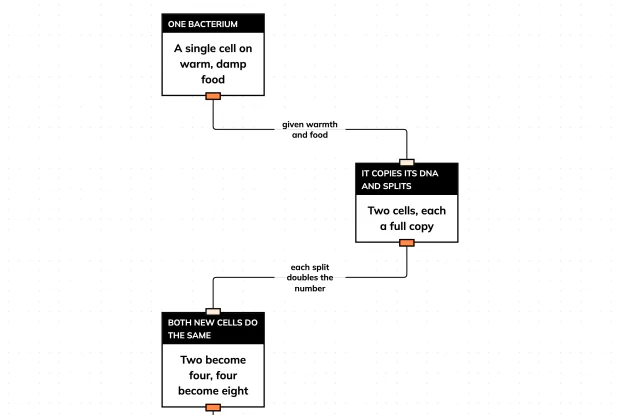
How Do Microbes Multiply So Fast? Follow the Doubling
A bacterium does not grow a family — it splits in two, and both halves split again. Follow that doubling step by step in an interactive playground and see why warm food spoils so suddenly.
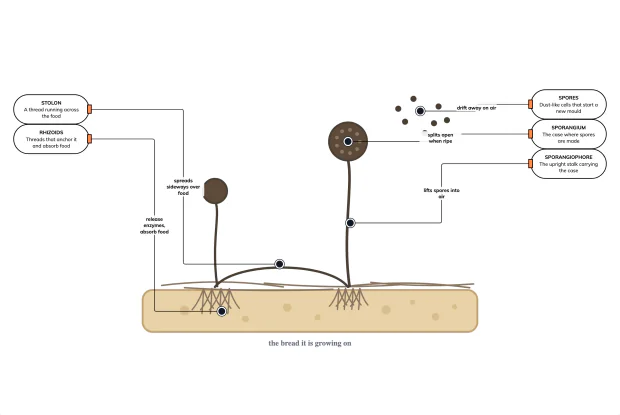
How Does a Mould Feed and Spread? Label the Parts
Bread mould has no mouth and never moves, yet it feeds on the loaf and reaches the next one. Label each part by the job it does in an interactive playground.
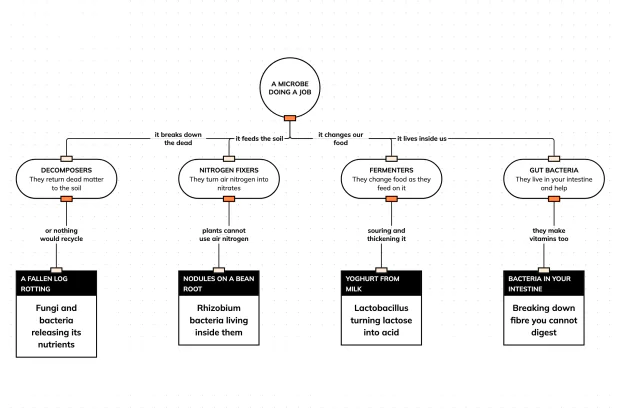
The Microbes We Could Not Live Without
Disease-causing microbes are a tiny minority. Sort four essential ones by the job each does — rotting, fixing nitrogen, fermenting food and living in your gut — in an interactive playground.
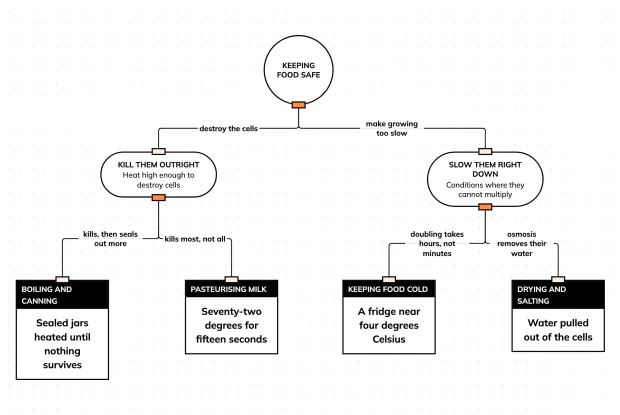
How Do We Stop Microbes Growing? Kill or Slow
Every method of preserving food either destroys microbes or makes conditions too poor for them to multiply, and the two are not the same. Sort four methods in an interactive playground.