How Do We Stop Microbes Growing? Kill or Slow
Root Concept
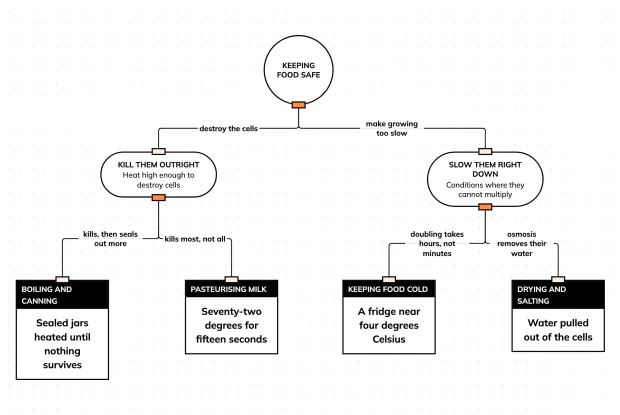
Food preservation works either by destroying microorganisms outright, usually with heat, or by creating conditions in which they cannot multiply, such as low temperature or the absence of available water, and only the first of these is permanent.
CodePLU Goal
Upgrading Human Mental Models
Learn how to think in Workflows

Concept Development By codeplu.com
Only one column is permanent. The other is a pause that ends when the conditions do.
A Fridge Does Not Make Food Safe
Every way of keeping food — heating it, chilling it, drying it, salting it, sealing it, pickling it — comes down to one of two strategies, and confusing them is how people get ill.
The first strategy is to kill the microbes that are there. Heat is the usual tool, because the proteins a cell depends on change shape permanently when they get hot enough and the cell cannot recover. Once the microbes are dead they stay dead, so the only remaining job is to stop new ones getting in, which is what a sealed tin or jar does. The second strategy is to leave the microbes alive but put them somewhere they cannot multiply. A fridge does not kill anything; it slows the chemistry of life down so far that the doubling from the earlier tutorial, which took twenty minutes in a warm kitchen, now takes many hours.
The difference matters because the second strategy only lasts as long as the conditions do. Take food out of the fridge and the clock starts again from wherever it had got to, with every cell that was there still present and now warming up. That is why thawed food cannot be treated as fresh, and why a tin lasts years on a shelf while the same food in the fridge lasts days. The playground sorts four methods into the two columns.
What Each Method Actually Does
Why does heat kill a microbe?
Because of what it does to proteins. Every enzyme in a cell is a protein folded into a particular shape, and the shape is what makes it work. Heat it enough and the folding comes apart, which is called denaturation, and it is not reversible — a boiled egg does not go back to being raw when it cools. A cell whose enzymes have been denatured cannot do its chemistry and is dead. How much heat is needed depends on the organism and on how long it is applied, which is why food safety guidance always gives a temperature and a time together rather than a temperature alone. Some bacteria also form extremely tough spores that survive boiling, and killing those is why canning uses pressure vessels that reach well above a hundred degrees.
What is pasteurisation and why does it not sterilise?
Pasteurisation heats a liquid enough to kill the organisms likely to cause disease, while deliberately leaving it short of sterile. Milk is commonly held at about seventy-two degrees for fifteen seconds. That is a compromise, and it is a deliberate one: heating milk until absolutely nothing survives changes the taste considerably and damages some of the nutrients. So the process targets the dangerous organisms and accepts that some harmless survivors remain, which is exactly why pasteurised milk still has to be refrigerated and still goes sour after a week or so. It is a killing method and a slowing method used together, with neither doing the whole job, and the name records the man who worked out in the 1860s that spoilage was caused by living organisms at all.
How do salting and drying work?
Both of them take water away from the microbes, and salting does it by the mechanism from Track 4. Packing meat or fish in salt makes the solution outside the microbial cells far more concentrated than the inside, so water leaves those cells by osmosis and they shrink and cannot function. Drying achieves the same end by simply removing the water from the food, so nothing can dissolve and no chemistry can happen. Sugar does it too, which is why jam keeps. These methods do kill a proportion of the microbes present, but their real work is making the food uninhabitable, and if the food is rewetted the survivors start again — which is why dried food must be kept dry rather than merely having been dried once.
What about pickling and sealing?
Pickling makes the food too acidic for most microbes, since enzymes work only within a narrow range of acidity and vinegar pushes conditions well outside it. That is a slowing method in the same family as salting: the conditions are hostile rather than lethal. Sealing is different again, because on its own it stops nothing — a sealed jar of untreated food spoils perfectly well using the microbes already inside it, and in some cases the lack of oxygen makes matters considerably worse. Sealing is what keeps new microbes out after a killing step has dealt with the old ones, which is why canning is always heat and a seal together and never a seal alone.
Real World Example
One Litre of Milk, Four Different Futures
Milk is the clearest example because it is sold in several preserved forms at once, and the shelf life of each one reads straight off which strategy was used.
Step 1
Raw milk lasts a day or two
Milk straight from an animal already contains a substantial microbial population, and it is close to an ideal growing medium: warm, wet, and full of sugar, fat and protein. Nothing has been killed and no conditions have been made hostile, so the doubling from the earlier tutorial runs at close to full speed. At room temperature raw milk sours within hours, and even chilled it keeps only a couple of days. This is the baseline against which every other treatment should be read: it is what happens when neither strategy is applied at all, and it is why milk was historically turned into cheese or butter rather than kept.
Step 2
Pasteurised and chilled lasts about a week
Heating to seventy-two degrees for fifteen seconds kills the organisms that cause disease and the great majority of the rest, which is a killing step. But it is not sterilisation, so survivors remain, and the milk is then refrigerated to slow those survivors down, which is a slowing step. Both strategies are in use at once, and the result is a week or so rather than a day. Notice that the date on the carton assumes the fridge: left out, pasteurised milk sours in a day, because the slowing half of the arrangement has been removed.
Step 3
UHT and powdered milk last months
UHT milk is heated to around a hundred and forty degrees for a few seconds, which is hot enough to kill essentially everything including the tough spores, and it is then sealed into a sterile carton. Nothing is alive and nothing can get in, so it keeps for months unrefrigerated — and goes off within days once opened, because opening it ends the seal. Powdered milk takes the other route entirely: remove the water and no microbe can grow whatever survived the drying. Both last far longer than the fridge can manage, by different strategies.
FAQs
Final Words
Two columns, and the sorting is the whole lesson. Heating kills, and once the microbes are dead a seal keeps new ones out, which is why a tin sits on a shelf for years. Chilling, drying, salting and pickling do not kill: they make conditions in which the doubling cannot get going, and they hold only for as long as the conditions do.
That one distinction explains most of the rules people are given about food without ever being told why. Thawed food is not fresh, because nothing died. An opened tin behaves like ordinary food, because the seal was doing the work. Pasteurised milk needs a fridge, because the heating was a compromise. This track began with a word that turned out to mean only "small", and ends with the practical consequence of everything that word covers.
Continue This Track
This concept is part 5 of The World Too Small to See.
What Counts as a Microorganism? Not One Group
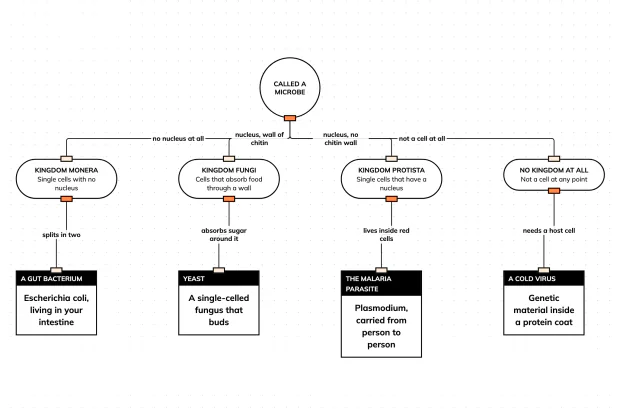
A microorganism is anything too small to see without a microscope, which turns out to span four kingdoms plus viruses. Sort four familiar microbes into the groups they really belong to in an interactive playground.
How Do Microbes Multiply So Fast? Follow the Doubling
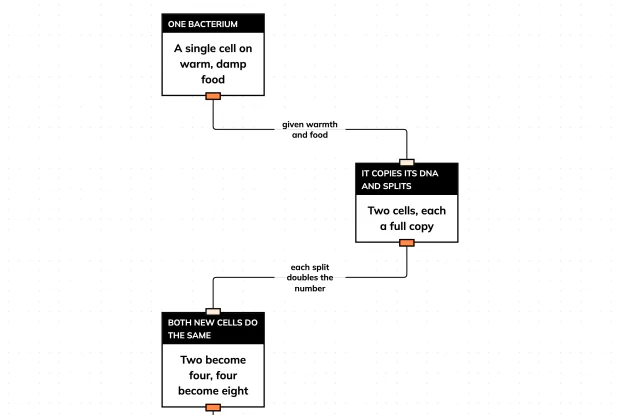
A bacterium does not grow a family — it splits in two, and both halves split again. Follow that doubling step by step in an interactive playground and see why warm food spoils so suddenly.
How Does a Mould Feed and Spread? Label the Parts
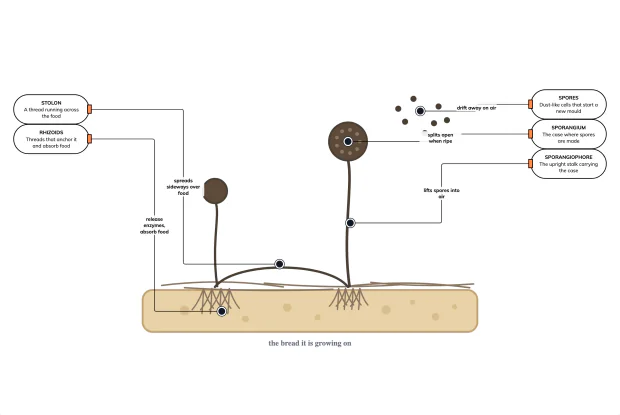
Bread mould has no mouth and never moves, yet it feeds on the loaf and reaches the next one. Label each part by the job it does in an interactive playground.
The Microbes We Could Not Live Without
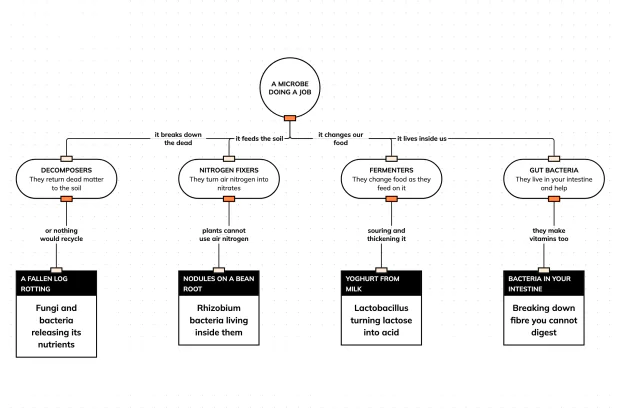
Disease-causing microbes are a tiny minority. Sort four essential ones by the job each does — rotting, fixing nitrogen, fermenting food and living in your gut — in an interactive playground.
How Do We Stop Microbes Growing? Kill or Slow
Every method of preserving food either destroys microbes or makes conditions too poor for them to multiply, and the two are not the same. Sort four methods in an interactive playground.