What Are a Trapezium and a Kite?
Root Concept
A trapezium keeps one pair of parallel sides; a kite keeps equal sides but moves them next to each other instead of opposite.
CodePLU Goal
Upgrading Human Mental Models
Learn how to think in Workflows

Concept Development By codeplu.com
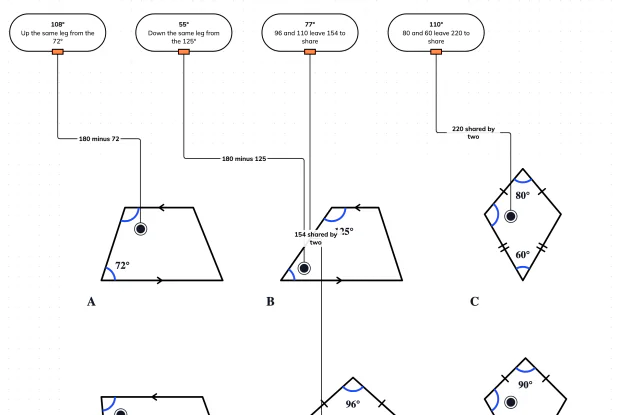
On a trapezium look along a leg, because the two angles there sit between parallel lines. On a kite look across the axis of symmetry.
What Happens If You Drop a Condition?
The last three tutorials built shapes by adding conditions to a parallelogram. This one goes the other way and looks at what survives when a condition is taken away. A trapezium has one pair of parallel sides rather than two. A kite keeps two pairs of equal sides but moves them so that equal sides sit next to each other instead of opposite.
Neither is a parallelogram, and most parallelogram properties disappear with the condition that produced them. A trapezium's opposite sides are not equal, its opposite angles are not equal, and its diagonals do not bisect each other. A kite's opposite angles are mostly not equal either, and only one of its diagonals is bisected.
What each keeps is worth knowing, because it is what the questions are about. A trapezium keeps the parallel-lines angle rule on its two legs: the angles at either end of a leg are co-interior and add to 180°. A kite keeps a line of symmetry down one diagonal, which forces the two angles either side of that axis to be equal. Those two facts are the whole playground.
Each Shape's One Useful Rule
What Exactly Is a Trapezium?
A quadrilateral with at least one pair of parallel sides. The parallel pair are called the bases and the other two are the legs, and the legs may be any lengths and at any angles. Beware the naming: in British usage a trapezium has a parallel pair and a trapezoid has none, while in American usage the two words mean the opposite way round. A trapezium whose two legs are equal in length is called isosceles, and that special case does have extra properties — equal base angles and equal diagonals — but an ordinary trapezium has neither. The definition being at least one pair also means every parallelogram technically counts as a trapezium, though most school courses treat the two as separate.
Why Do a Trapezium's Leg Angles Total 180°?
Because a leg is a transversal crossing two parallel lines, which is exactly the situation from Track 4. The two bases are parallel and the leg runs from one to the other, so the angle at the bottom of that leg and the angle at the top of it are co-interior angles and must add to 180°. The same holds independently for the other leg. That gives two pairs totalling 180° each, which accounts neatly for the 360° a quadrilateral must have. The important word is leg: the rule links the two angles at either end of the same leg, not any two angles you like. Pairing an angle with the one diagonally opposite it gives nothing at all.
What Exactly Is a Kite?
A quadrilateral with two pairs of equal sides where the equal sides are adjacent rather than opposite. That single change from the parallelogram arrangement produces a completely different shape with a line of symmetry down the long diagonal. Fold along that diagonal and the two halves match exactly, which is why the two angles either side of it — the ones between the unequal sides — are equal to each other. The other two angles, the ones the axis passes through, are generally different from each other and from everything else. A kite's diagonals do cross at right angles, as a rhombus's do, but only one of them is bisected: the axis cuts the other in half, and is not cut in half itself.
How Do You Find a Kite's Missing Angles?
Use the symmetry and the 360° total together. The two angles on the axis are usually given, since they are the odd ones out. Add them, subtract from 360°, and halve what is left, because the remaining two angles are equal. With angles of 96° and 110° on the axis, that is 360 − 206 = 154° to share, giving 77° each. The step people forget is the halving, and the answer that results is exactly twice too big, which is worth recognising. If instead you are given one of the equal pair, double it, add the known axis double it, add the known axis angle, and subtract from 360° to find the other. Either way the check is the same: the four angles you end up with must total 360° and two of them must match.
Real World Example
Why Is a Kite the Shape It Is?
The shape is not arbitrary: the symmetry and the crossed spars are what make the thing fly straight.
Two spars, crossed
One long, one short
A traditional kite is built from two spars: a long one running from nose to tail, and a shorter one across it. Those are the diagonals of the shape, and they cross at right angles. The long spar is the axis of symmetry, and the short one is fixed across it at some point that is usually nearer the nose than the tail. That single decision — where along the long spar the crossbar sits — is what makes the shape a kite rather than a rhombus, because it makes the four sides fall into two unequal pairs instead of four equal ones.
The sail
Two pairs of equal edges
The covering is stretched between the four ends of the spars, giving four straight edges. The two edges near the nose are equal to each other, and the two near the tail are equal to each other, but the two pairs differ — which is exactly the definition of a kite. The shape is therefore symmetrical about the long spar and about nothing else. That single line of symmetry is the point: air flowing over the sail is deflected identically on both sides, so there is no sideways force to make the kite wander off to one side.
What the angles have to do
Equal on both sides
Because of the symmetry, the two angles where the crossbar meets the sail edges are equal to each other, whatever the maker chooses for the nose and tail angles. A kite with a 96° nose and a 110° tail has 77° at each of the other two corners: 360 − 206 = 154, shared equally. If those two came out different, the kite would not be symmetrical and would pull to one side in flight. This is why a damaged crossbar makes a kite unflyable rather than merely untidy — it breaks the one property the design depends on.
FAQs
Final Words
A trapezium keeps one pair of parallel sides and with it one rule: the two angles at either end of a leg are co-interior and total 180°. A kite keeps equal sides but places them next to each other, giving a single line of symmetry down one diagonal, which forces the two angles either side of that axis to be equal.
Neither shape is a parallelogram, and most parallelogram properties do not survive the change. That leaves a family of five shapes with overlapping properties and a real risk of muddling them, which is what the last tutorial in this track sorts out — by asking what each one's diagonals do.
Continue This Track
This concept is part 4 of What Makes Each Quadrilateral Different.
What Makes a Parallelogram a Parallelogram?
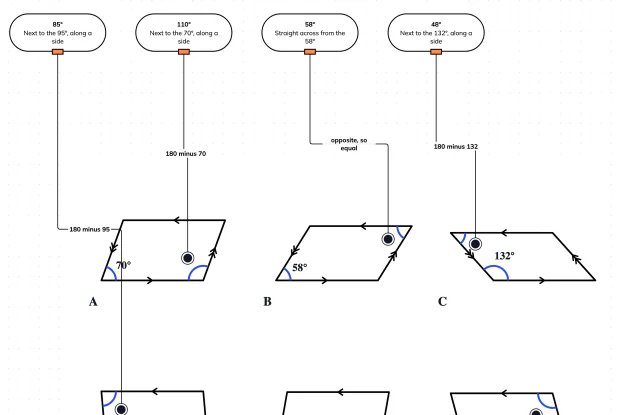
A parallelogram is defined by one thing only: both pairs of opposite sides are parallel. Equal opposite sides, equal opposite angles, supplementary neighbours and bisecting diagonals all follow from it rather than being separate rules. Work the angles out in an interactive playground.
What Is Special About a Rhombus's Diagonals?
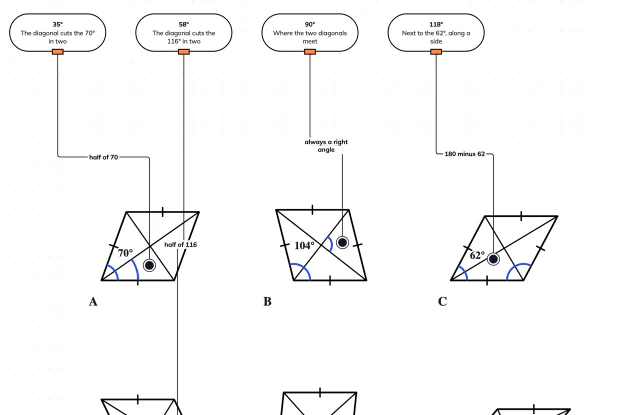
A rhombus is a parallelogram with all four sides equal, so it inherits everything a parallelogram has. What it adds is about the diagonals: they meet at right angles and each one bisects the two corners it runs between. Use both facts in an interactive playground.
What Does a Rectangle Inherit from a Parallelogram?
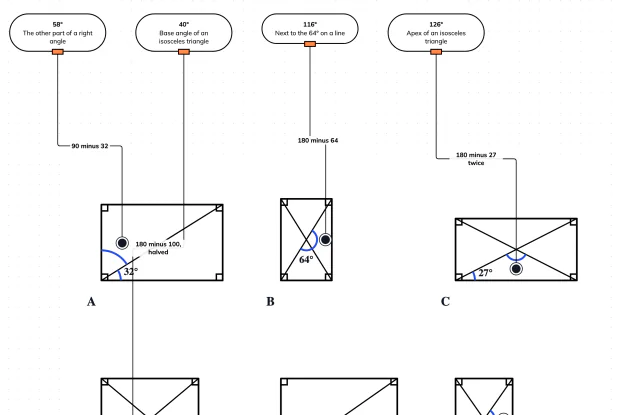
A rectangle is a parallelogram with a right angle, so it inherits equal opposite sides and bisecting diagonals without asking. What it adds is that the two diagonals are the same length, which turns the shape into four isosceles triangles. Use that in an interactive playground.
What Are a Trapezium and a Kite?
A trapezium has one pair of parallel sides instead of two; a kite has two pairs of equal sides that sit next to each other rather than opposite. Each keeps part of what a parallelogram offers and loses the rest, and each has its own angle rule. Use both in an interactive playground.
How Does the Quadrilateral Family Fit Together?
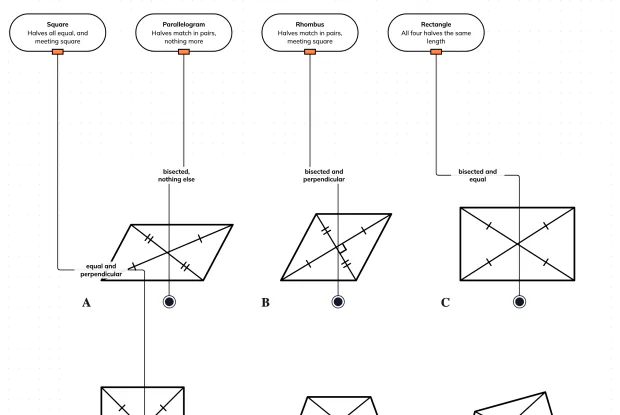
Parallelogram, rhombus, rectangle and square are not four separate shapes but one family, each adding a condition to the one before. The clearest way to tell them apart is to ignore the outline and look at what the diagonals do. Name them from the diagonals alone in an interactive playground.