What Makes Each Quadrilateral Different
Four-sided shapes are usually taught as a list of names to memorise. This track treats them as one family instead, where each shape is the previous one with a single extra condition. It starts with the parallelogram, which assumes only that opposite sides are parallel and gets equal sides, equal opposite angles and bisecting diagonals for nothing — all of it falling out of the parallel-line angle work from earlier in the chapter. Adding equal sides gives a rhombus, whose diagonals cross at right angles and cut its corners in half; adding right angles instead gives a rectangle, whose diagonals become equal and turn the shape into four isosceles triangles. The trapezium and the kite then show what happens when a condition is dropped rather than added. The last tutorial ties it together by asking the only question that separates all four cleanly: what do the diagonals do?
CodePLU Goal
Upgrading Human Mental Models
Learn how to think in Workflows
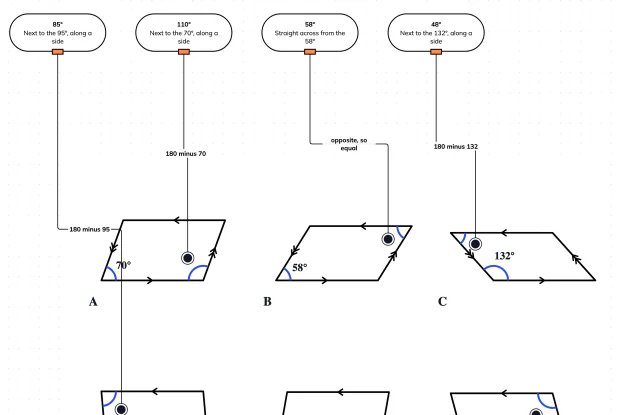
What Makes a Parallelogram a Parallelogram?
A parallelogram is defined by one thing only: both pairs of opposite sides are parallel. Equal opposite sides, equal opposite angles, supplementary neighbours and bisecting diagonals all follow from it rather than being separate rules. Work the angles out in an interactive playground.
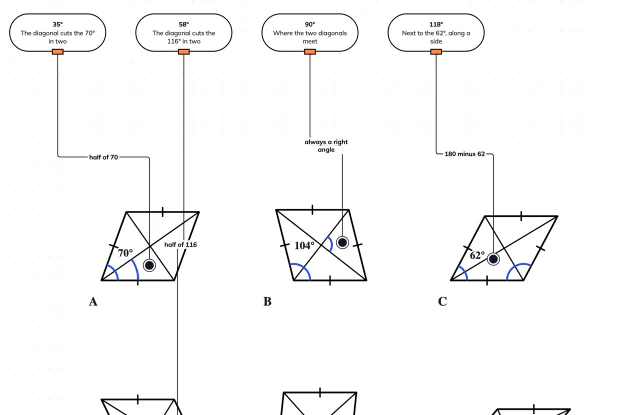
What Is Special About a Rhombus's Diagonals?
A rhombus is a parallelogram with all four sides equal, so it inherits everything a parallelogram has. What it adds is about the diagonals: they meet at right angles and each one bisects the two corners it runs between. Use both facts in an interactive playground.
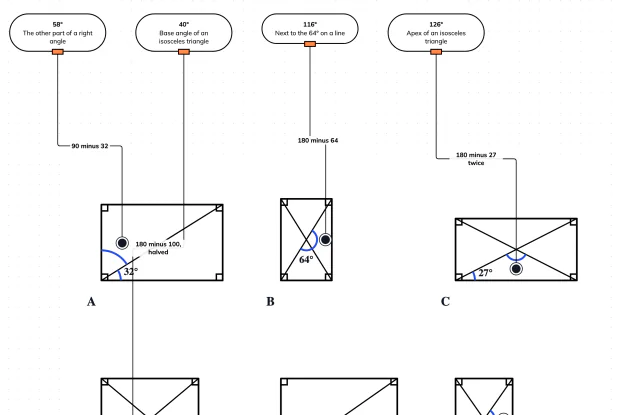
What Does a Rectangle Inherit from a Parallelogram?
A rectangle is a parallelogram with a right angle, so it inherits equal opposite sides and bisecting diagonals without asking. What it adds is that the two diagonals are the same length, which turns the shape into four isosceles triangles. Use that in an interactive playground.
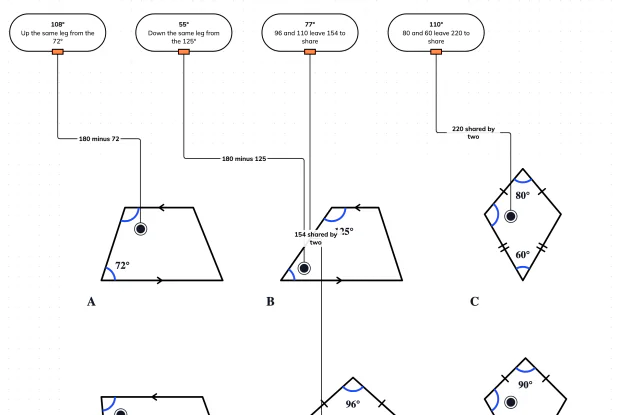
What Are a Trapezium and a Kite?
A trapezium has one pair of parallel sides instead of two; a kite has two pairs of equal sides that sit next to each other rather than opposite. Each keeps part of what a parallelogram offers and loses the rest, and each has its own angle rule. Use both in an interactive playground.
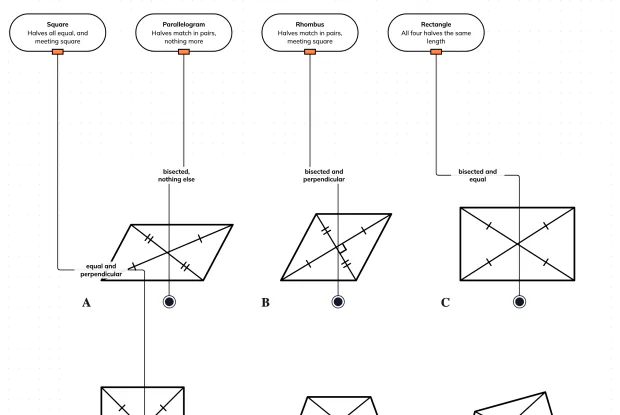
How Does the Quadrilateral Family Fit Together?
Parallelogram, rhombus, rectangle and square are not four separate shapes but one family, each adding a condition to the one before. The clearest way to tell them apart is to ignore the outline and look at what the diagonals do. Name them from the diagonals alone in an interactive playground.