What Does a Rectangle Inherit from a Parallelogram?
Root Concept
A rectangle's diagonals are equal as well as bisecting, so the four triangles they make are all isosceles.
CodePLU Goal
Upgrading Human Mental Models
Learn how to think in Workflows

Concept Development By codeplu.com
Equal diagonals that bisect each other means all four half-diagonals match, which is what makes every triangle at the centre isosceles.
What Is a Rectangle, Strictly Speaking?
A rectangle is a parallelogram with a right angle. That sounds like too little — surely all four corners have to be right angles? They do, but only one needs to be stated. A parallelogram's neighbouring angles total 180°, so one right angle forces the next to be 90° too, and round it goes. One condition, four right angles.
Because it is a parallelogram, a rectangle inherits the lot: opposite sides equal and parallel, opposite angles equal, diagonals bisecting each other. None of that has to be proved again. What the right angles add is a single new fact, and it concerns the diagonals: in a rectangle the two diagonals are the same length.
That one addition has a consequence worth more than the fact itself. Equal diagonals that also bisect each other means all four half-diagonals are the same length, so the four triangles formed at the centre are all isosceles. That is what the playground below is built on, and it is why an angle at one corner of a rectangle propagates all the way across it.
The Extra Property and What It Forces
Why Are the Diagonals Equal?
Take the two triangles formed by the bottom side of the rectangle together with each diagonal in turn. Each has the bottom side, one vertical side, and a diagonal as its hypotenuse. The two vertical sides are equal, because opposite sides of a rectangle match; the bottom side is shared; and both triangles contain a right angle where the vertical meets the bottom. That is two sides and the included angle, which is SAS from Track 5, so the triangles are congruent and their third sides — the two diagonals — must be equal. Alternatively, use Pythagoras: each diagonal is √(length² + width²), and both use the same two numbers.
Why Does That Make Four Isosceles Triangles?
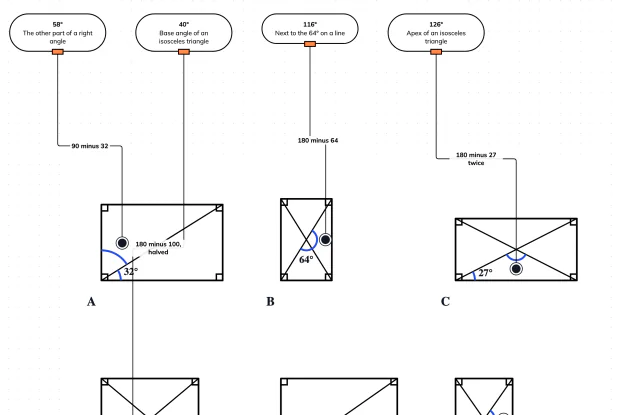
The diagonals bisect each other because a rectangle is a parallelogram, and they are equal because it is a rectangle. Put those together and all four half-diagonals are the same length. Each of the four triangles at the centre has two of those half-diagonals as its sides, so each is isosceles, with a side of the rectangle as its base. That means the two base angles of each triangle are equal, which is the fact the playground leans on: an angle of 27° between a diagonal and the base tells you the angle at the far end of that base is also 27°, so the angle at the centre is 180 − 54 = 126°. One measurement propagates through the whole figure.
What Does This Let You Calculate?
It ties the corner angles and the centre angles together. A diagonal makes some angle with the long side and the complement of that with the short side, because the corner it sits in is a right angle: 32° against the base means 58° against the side. At the centre the angles come in a supplementary pair, since they sit on a straight diagonal, so 64° one way means 116° the other. And the isosceles triangles link the two: the centre angle facing a side is 180° minus twice the corner angle at that side. Between them these three relationships let any single angle in the figure produce every other one, which is what most exam questions on rectangles are testing.
Where Does the Square Fit In?
A square is a rectangle with equal sides, or equally a rhombus with right angles — both descriptions are correct and they are the two routes into it. It therefore has every property from both branches: opposite sides parallel and all sides equal, all angles right angles, and diagonals that bisect each other, are equal, cross at right angles and bisect the corners. That is the maximum any quadrilateral can have. It also means a square answers yes to every test in this track, which trips people up when a question asks whether a square is a rhombus: it is, and it is a rectangle, and it is a parallelogram.
Real World Example
How Does a Joiner Check a Frame Is Rectangular?
A frame can have four equal-looking corners and still be a parallelogram. The diagonals are what settle it.
Four sides is not enough
A leaning frame still fits
A joiner assembling a cabinet carcass cuts the sides to length in pairs, so opposite sides already match. That makes the frame a parallelogram the moment it is screwed together, but a parallelogram can lean: push one corner and the whole thing racks over into a diamond while every side stays exactly the length it was cut to. Measuring the sides again proves nothing, because they have not changed. What has changed is the angles, and those are awkward to measure accurately across a big carcass with a small square, and a degree out at the corner is several millimetres out at the far edge.
Measuring both diagonals
Equal means square
Instead the joiner measures corner to corner, both ways. A rectangle's diagonals are equal, and a leaning parallelogram's are not — racking the frame lengthens one diagonal and shortens the other. So if the two measurements agree, the frame is a rectangle and the corners are right angles; if one reads 1204 mm and the other 1198 mm, it is out of square and needs pushing. This is the converse of the property in this tutorial, and it is probably the most widely used piece of quadrilateral geometry there is, reached for daily by people who have never called it that.
Which way to push
Shorten the longer one
The measurement also says what to do about it. The frame has to be pushed along the longer diagonal, which shortens it and lengthens the other until the two meet in the middle. A sash clamp across the long diagonal does the job, and the joiner re-measures until the two agree before the glue goes off. It is worth noticing how much work one property is doing here: before the glue goes off. It is worth noticing how much work one property is doing here: two tape measurements replace four awkward angle measurements, and they give a clear instruction as well as a verdict.
FAQs
Final Words
A rectangle is a parallelogram with a right angle, which turns out to force all four. It inherits every parallelogram property and adds exactly one: its two diagonals are the same length. Combined with the inherited bisecting, that makes all four half-diagonals equal and every triangle at the centre isosceles, which is what lets one angle spread across the figure.
That property read backwards is one of the most used results in this chapter: a frame whose diagonals measure the same is square. The next tutorial steps outside the parallelogram family entirely, to the two shapes that keep only part of what a parallelogram has — the trapezium and the kite.
Continue This Track
This concept is part 3 of What Makes Each Quadrilateral Different.
What Makes a Parallelogram a Parallelogram?
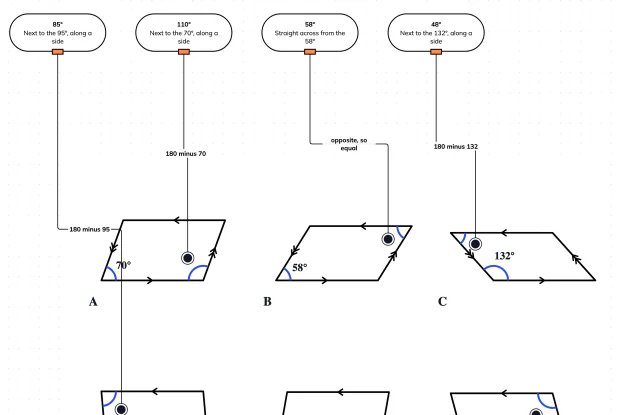
A parallelogram is defined by one thing only: both pairs of opposite sides are parallel. Equal opposite sides, equal opposite angles, supplementary neighbours and bisecting diagonals all follow from it rather than being separate rules. Work the angles out in an interactive playground.
What Is Special About a Rhombus's Diagonals?
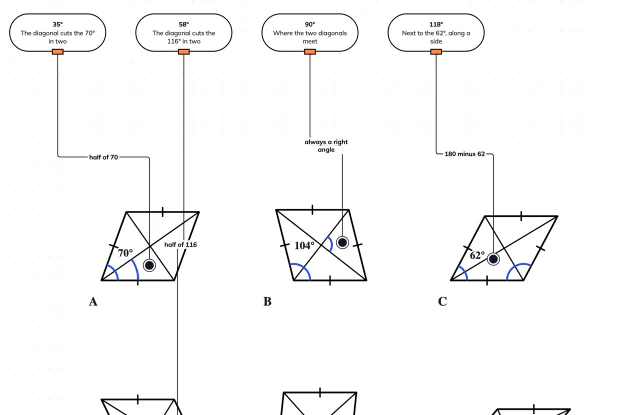
A rhombus is a parallelogram with all four sides equal, so it inherits everything a parallelogram has. What it adds is about the diagonals: they meet at right angles and each one bisects the two corners it runs between. Use both facts in an interactive playground.
What Does a Rectangle Inherit from a Parallelogram?
A rectangle is a parallelogram with a right angle, so it inherits equal opposite sides and bisecting diagonals without asking. What it adds is that the two diagonals are the same length, which turns the shape into four isosceles triangles. Use that in an interactive playground.
What Are a Trapezium and a Kite?
A trapezium has one pair of parallel sides instead of two; a kite has two pairs of equal sides that sit next to each other rather than opposite. Each keeps part of what a parallelogram offers and loses the rest, and each has its own angle rule. Use both in an interactive playground.
How Does the Quadrilateral Family Fit Together?
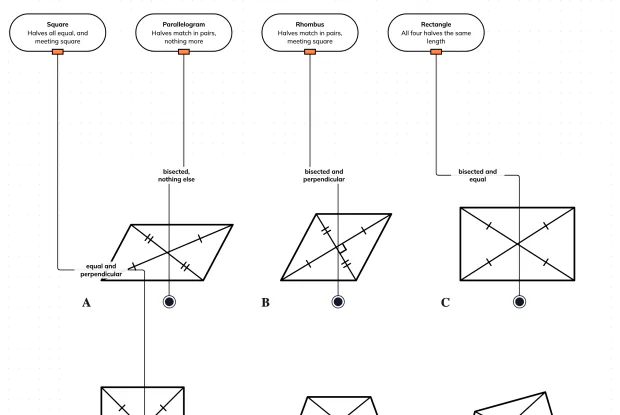
Parallelogram, rhombus, rectangle and square are not four separate shapes but one family, each adding a condition to the one before. The clearest way to tell them apart is to ignore the outline and look at what the diagonals do. Name them from the diagonals alone in an interactive playground.