What Makes a Parallelogram a Parallelogram?
Root Concept
Both pairs of opposite sides parallel is the only assumption; every other parallelogram property is a consequence of it.
CodePLU Goal
Upgrading Human Mental Models
Learn how to think in Workflows

Concept Development By codeplu.com
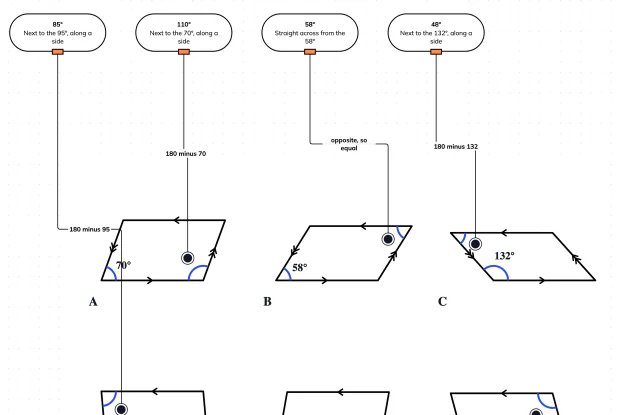
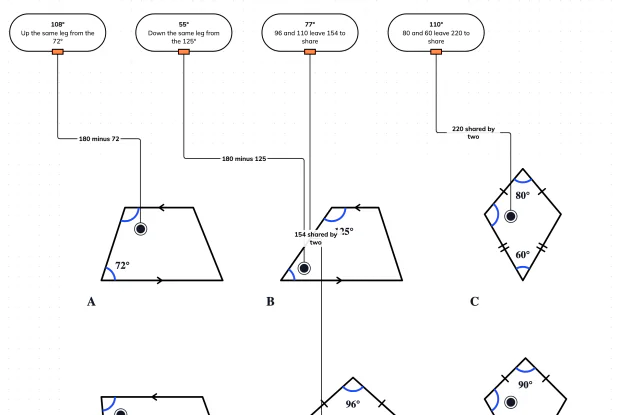
Across the shape the angles are equal; along a side they are co-interior angles between parallel lines, so they total 180°.
How Much Comes From One Condition?
A parallelogram is a quadrilateral whose opposite sides are parallel — both pairs. That is the whole definition, and nothing is said about lengths, angles or diagonals. What makes the shape worth a tutorial is how much follows from that one condition without being asked for.
Opposite sides turn out to be equal in length. Opposite angles turn out to be equal in size. Angles next to each other along a side add to 180°. The two diagonals cut each other exactly in half. Four separate-looking facts, and every one of them is forced by the parallel sides rather than being an extra requirement.
The angle facts are the ones this playground drills, and they are the ones you already have the tools for: a side of a parallelogram is a transversal crossing two parallel lines, so the angle results from Track 4 apply directly. That is why neighbouring angles are supplementary — they are co-interior angles — and it is worth seeing the connection rather than learning the parallelogram rules as a fresh list.
What Follows, and Why
Why Are Neighbouring Angles Supplementary?
Because they are co-interior angles between two parallel lines. Take the bottom side and the top side of a parallelogram: they are parallel by definition. The left-hand side runs from one to the other, so it is a transversal cutting them both. The angle at the bottom-left corner and the angle at the top-left corner are therefore interior angles on the same side of that transversal, which from Track 4 means they add to 180°. Nothing about parallelograms specifically was needed; the result came entirely from the parallel lines. That is why a 70° corner forces the corner above it to be 110°, and why the same reasoning works at every corner in turn.
Why Are Opposite Angles Equal?
It follows in one more step. Going round the shape, each neighbouring pair adds to 180°. So if the bottom-left corner is 70°, the top-left is 110°; and the top-left and top-right are also neighbours, so the top-right is 180 − 110 = 70°. That is the same as the bottom-left, and those two are opposite each other. Every parallelogram therefore has two angles of one size and two of another, arranged so that equal ones face each other. It also means one angle is enough to know all four, which is what the playground is built on. If all four happen to be equal, each must be 90°, and the parallelogram is a rectangle.
Why Are Opposite Sides Equal?
Draw a diagonal and the parallelogram splits into two triangles. Those two triangles share the diagonal, and the alternate angle rule gives them two more pairs of equal angles: the diagonal is a transversal across each pair of parallel sides in turn. Two angles and the side between them is ASA, the congruence rule from Track 5, so the two triangles are congruent. Congruent triangles have matching sides, and the sides that match are exactly the opposite sides of the parallelogram. So the lengths were never assumed — they were forced. The same argument, run with the other diagonal, is how you show that the diagonals cut each other in half.
How Do You Prove a Shape Is a Parallelogram?
Every one of these properties also works backwards, which is more useful than it sounds. A quadrilateral is a parallelogram if both pairs of opposite sides are parallel, or if both pairs of opposite sides are equal, or if both pairs of opposite angles are equal, or if the diagonals bisect each other, or if one pair of sides is both parallel and equal. Any single one of those is enough on its own. That last one is the most commonly used in proofs and the most commonly misremembered: one pair, but it must be both parallel and equal. One pair merely parallel gives a trapezium, and one pair merely equal gives nothing at all.
Real World Example
Why Does a Scissor Lift Stay Level?
The platform stays horizontal at every height, and that is a consequence of the linkage's geometry rather than of any control system.
One cell of the frame
Opposite sides parallel
A scissor lift is built from pairs of arms pinned together, and each cell of the resulting frame is a parallelogram: the arm on one side is parallel to the arm opposite it, and the same for the other pair. That is designed in rather than checked afterwards, because the pins are placed at matching distances along each arm. Everything the lift does mechanically follows from that single geometric condition, which is exactly the pattern of this tutorial — one thing assumed, and several more forced whether anyone wanted them or not, with no extra parts and no adjustment needed.
Raising it
70° becomes 40°
As the lift rises, the arms swing and every angle in the frame changes. A corner that measured 70° when the platform was low might read 40° near the top. The shape is still a parallelogram throughout, so the angle next to it changes in step, from 110° to 140°, keeping the pair at 180°. Nothing holds those two numbers together except the parallel sides, and they are welded in. This is why a scissor lift has one degree of freedom: fix any single angle anywhere in the frame and every other angle in it is decided.
Why the platform stays flat
Opposite sides stay parallel
The platform sits on the top side of the topmost cell, and the base sits on the bottom side. Those two sides are opposite sides of a parallelogram, so they are parallel at every height, whatever the arms are doing in between. A platform parallel to a level base is a level platform. No sensor, motor or feedback loop is involved — the linkage cannot tilt the platform without ceasing to be a parallelogram, which would mean bending the steel. The same idea holds a drawing board flat, keeps a desk lamp's head pointing the same way as it is moved, and levels the bucket on a loader.
FAQs
Final Words
A parallelogram assumes one thing — both pairs of opposite sides parallel — and gets four more for nothing: equal opposite sides, equal opposite angles, neighbouring angles totalling 180°, and diagonals that bisect each other. The angle results are just the parallel-lines work from earlier in the chapter, applied with each side acting as a transversal.
Every one of those properties also runs backwards as a test for whether a shape is a parallelogram, which is how they usually earn their keep in proofs. The next three tutorials take the shapes that add one more condition on top — the rhombus, the rectangle and then the trapezium and kite, which sit outside the parallelogram family altogether.
Continue This Track
This concept is part 1 of What Makes Each Quadrilateral Different.
What Makes a Parallelogram a Parallelogram?
A parallelogram is defined by one thing only: both pairs of opposite sides are parallel. Equal opposite sides, equal opposite angles, supplementary neighbours and bisecting diagonals all follow from it rather than being separate rules. Work the angles out in an interactive playground.
What Is Special About a Rhombus's Diagonals?
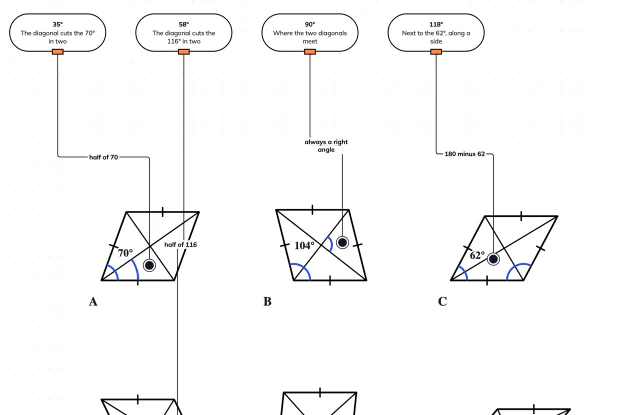
A rhombus is a parallelogram with all four sides equal, so it inherits everything a parallelogram has. What it adds is about the diagonals: they meet at right angles and each one bisects the two corners it runs between. Use both facts in an interactive playground.
What Does a Rectangle Inherit from a Parallelogram?
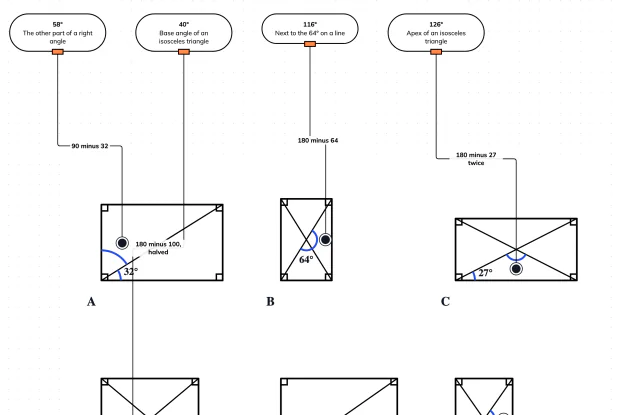
A rectangle is a parallelogram with a right angle, so it inherits equal opposite sides and bisecting diagonals without asking. What it adds is that the two diagonals are the same length, which turns the shape into four isosceles triangles. Use that in an interactive playground.
What Are a Trapezium and a Kite?
A trapezium has one pair of parallel sides instead of two; a kite has two pairs of equal sides that sit next to each other rather than opposite. Each keeps part of what a parallelogram offers and loses the rest, and each has its own angle rule. Use both in an interactive playground.
How Does the Quadrilateral Family Fit Together?
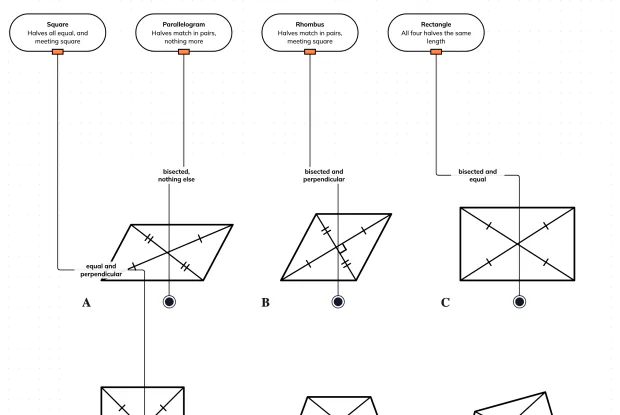
Parallelogram, rhombus, rectangle and square are not four separate shapes but one family, each adding a condition to the one before. The clearest way to tell them apart is to ignore the outline and look at what the diagonals do. Name them from the diagonals alone in an interactive playground.