How Does the Quadrilateral Family Fit Together?
Root Concept
Each shape in the family inherits everything above it and adds one condition, and the diagonals are where that condition shows.
CodePLU Goal
Upgrading Human Mental Models
Learn how to think in Workflows

Concept Development By codeplu.com
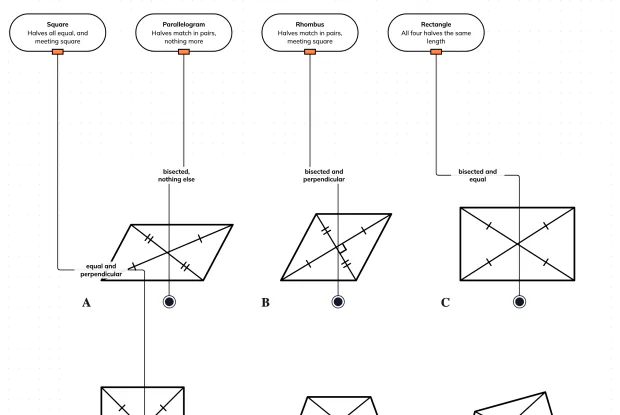
Bisecting says parallelogram. Add perpendicular for a rhombus, add equal for a rectangle, add both for a square.
Why Treat Them as a Family?
It is tempting to learn parallelograms, rhombuses, rectangles and squares as four separate shapes with four separate lists of properties. That is four times the work and it hides what is actually going on, which is that each one is the previous shape with a single extra condition attached.
Start with a quadrilateral and require both pairs of opposite sides parallel: that is a parallelogram, and it brings equal opposite sides, equal opposite angles and diagonals that bisect each other. Now add all sides equal and you have a rhombus; add right angles instead and you have a rectangle; add both and you have a square. Everything from higher up is inherited and never needs restating.
The diagonals are the cleanest place to see the structure, because each level leaves a distinct mark there. Bisecting each other comes from the parallelogram. Crossing at right angles is what the rhombus adds. Being equal in length is what the rectangle adds. A square, sitting under both, has all three. That is what the playground asks you to read.
Reading the Family From the Diagonals
What Does Each Level Add?
A parallelogram's diagonals bisect each other, so each one is cut into two equal halves — but the two diagonals are different lengths and they meet at no particular angle. A rhombus adds equal sides, and the consequence is that the diagonals now meet at right angles and bisect the corner angles as well. A rectangle instead adds right-angled corners, and its consequence is that the two diagonals become equal in length, though they still meet at no particular angle. A square sits beneath both branches and therefore has the lot: bisecting, perpendicular and equal. Notice that each shape adds one condition to the shape and gets a different diagonal property in return, which is why the diagonals identify the shape uniquely.
Why Is a Square Both a Rhombus and a Rectangle?
Because it satisfies both definitions at once. A square has four equal sides, which is the definition of a rhombus, and it is a parallelogram with a right angle, which is the definition of a rectangle. Nothing in either definition excludes the other, so a square is genuinely both, and it is also a parallelogram, a kite and a trapezium. Exam questions like asking whether a square is a rectangle, and the answer is always yes. The reverse is what fails: most rectangles are not squares. This is the same logic as every other family relationship in maths — every square number is an integer, but not the other way round — and the direction of the claim is what matters.
Where Do the Trapezium and Kite Sit?
Outside the main line, because they keep only part of what a parallelogram requires. A trapezium has one pair of parallel sides instead of two, so it never joins the family proper, though under the usual definition every parallelogram counts as a trapezium. A kite has two pairs of equal sides but adjacent rather than opposite, which gives it one line of symmetry and perpendicular diagonals but nothing else. The rhombus is where the kite branch and the parallelogram branch meet, because a rhombus is both, and the square is where every branch meets. Drawing the family as a tree with the square at the bottom makes these overlaps much easier to keep straight than a list.
How Do You Answer a Classification Question?
Work from the conditions rather than from what the drawing looks like. Ask in order: are both pairs of opposite sides parallel? If not, it is at most a trapezium or a kite. If yes, it is at least a parallelogram, so then ask whether all sides are equal and whether the angles are right angles. Equal sides only gives a rhombus, right angles only a rectangle, both a square. When a question gives you diagonals rather than sides, use the reverse readings: diagonals that bisect each other prove a parallelogram, and adding perpendicular or equal upgrades it. The most common error is reading a property off the picture instead of the marks, so always check what the figure actually claims.
Real World Example
Why Does a Sorting Question Catch People Out?
The trouble is almost never the shapes themselves but the direction of the claim being made about them.
The question
Is a square a rectangle?
Asked whether a square is a rectangle, most people hesitate, and many answer no. The instinct comes from everyday language, where calling something a rectangle implies it is not a square — in the same way that calling someone a parent implies they have children rather than merely could. Mathematics does not work that way. A rectangle is defined as a parallelogram with a right angle, and a square satisfies that definition completely, so a square is a rectangle. It is also a rhombus, a parallelogram, a kite and a trapezium, all at once and without contradiction.
The direction that fails
Not every rectangle is a square
The reverse claim is the one that is false, and keeping the two apart is the whole skill. Every square is a rectangle, but a rectangle three metres by one is nowhere near a square. The same asymmetry runs through the family: every rhombus is a kite, but most kites are not rhombuses; every parallelogram is a trapezium under the usual definition, but most trapeziums are not parallelograms. When a question feels ambiguous, write down which way round the claim is going before answering, because the answer usually flips with the direction rather than depending on the shapes at all.
What actually settles it
The definition, not the picture
The reliable method is to go back to the definition and check the conditions one at a time, rather than to compare the shape with a mental picture of a typical rectangle. Typical is not a mathematical idea. A rectangle needs a parallelogram and a right angle, and that is the entire test; nothing in it says the sides must differ. The same discipline settles whether a particular figure is a kite, a rhombus or both, and it is why the playground above deliberately asks you to read the diagonal marks rather than to recognise the outline.
FAQs
Final Words
The four main quadrilaterals form a single line rather than four separate shapes. A parallelogram requires opposite sides parallel; a rhombus adds equal sides; a rectangle adds right angles; a square adds both. Everything from higher in the family is inherited, so there is only ever one new condition to remember at each step.
The diagonals record that structure exactly: bisecting for a parallelogram, and then perpendicular, equal, or both. That completes the quadrilateral chapter — you can now name any of these shapes from its properties rather than its appearance, and say which claims about the family hold in which direction.
Continue This Track
This concept is part 5 of What Makes Each Quadrilateral Different.
What Makes a Parallelogram a Parallelogram?
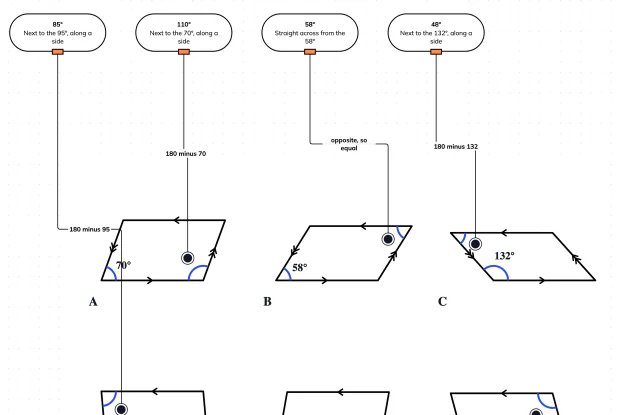
A parallelogram is defined by one thing only: both pairs of opposite sides are parallel. Equal opposite sides, equal opposite angles, supplementary neighbours and bisecting diagonals all follow from it rather than being separate rules. Work the angles out in an interactive playground.
What Is Special About a Rhombus's Diagonals?
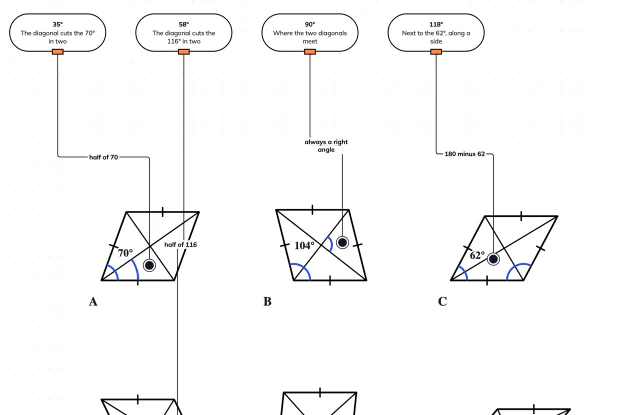
A rhombus is a parallelogram with all four sides equal, so it inherits everything a parallelogram has. What it adds is about the diagonals: they meet at right angles and each one bisects the two corners it runs between. Use both facts in an interactive playground.
What Does a Rectangle Inherit from a Parallelogram?
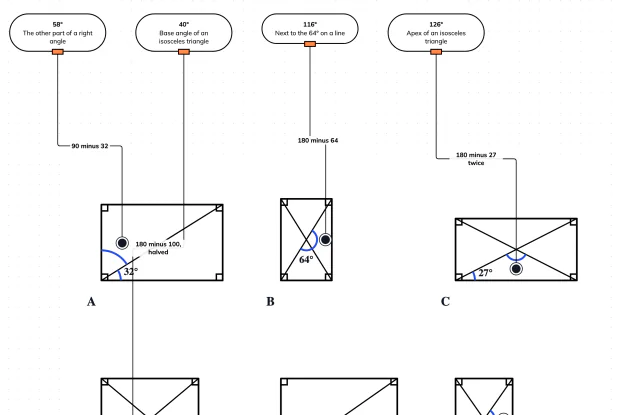
A rectangle is a parallelogram with a right angle, so it inherits equal opposite sides and bisecting diagonals without asking. What it adds is that the two diagonals are the same length, which turns the shape into four isosceles triangles. Use that in an interactive playground.
What Are a Trapezium and a Kite?
A trapezium has one pair of parallel sides instead of two; a kite has two pairs of equal sides that sit next to each other rather than opposite. Each keeps part of what a parallelogram offers and loses the rest, and each has its own angle rule. Use both in an interactive playground.
How Does the Quadrilateral Family Fit Together?
Parallelogram, rhombus, rectangle and square are not four separate shapes but one family, each adding a condition to the one before. The clearest way to tell them apart is to ignore the outline and look at what the diagonals do. Name them from the diagonals alone in an interactive playground.