What Is Special About a Rhombus's Diagonals?
Root Concept
Equal sides make each diagonal a line of symmetry, which is why it bisects two corners and meets the other diagonal squarely.
CodePLU Goal
Upgrading Human Mental Models
Learn how to think in Workflows

Concept Development By codeplu.com
A rhombus keeps every parallelogram property and adds two: perpendicular diagonals, and diagonals that bisect the corners.
What Does Adding Equal Sides Buy You?
A rhombus is a parallelogram with one extra condition: all four sides are the same length. Because it is still a parallelogram, everything from the last tutorial carries over unchanged — opposite angles equal, neighbouring angles totalling 180°, diagonals bisecting each other. None of that needs to be learned again.
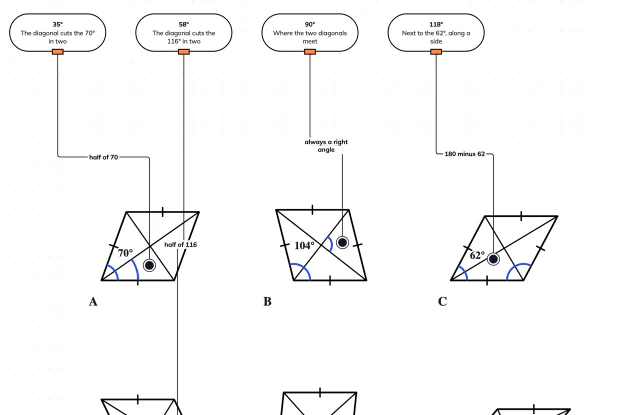
What the equal sides add is entirely about the diagonals, and there are two new facts. The diagonals cross at right angles, which no ordinary parallelogram guarantees. And each diagonal bisects the two corners it runs between, so a 70° corner is cut into two 35° angles.
Both come from the same source: a rhombus is made of four identical triangles, or, put another way, each diagonal is a line of symmetry. Fold a rhombus along a diagonal and the two halves land on each other exactly, which is not true of a general parallelogram. The playground mixes the two new facts with the inherited ones, so the first decision each time is which kind of angle is being asked for.
Where the Two Extra Properties Come From
Why Does Each Diagonal Bisect Two Corners?
Draw one diagonal and the rhombus splits into two triangles. Each of those triangles has two sides of the rhombus and the diagonal, and because all four sides of a rhombus are equal, each triangle is isosceles with the diagonal as its base. From Track 5, an isosceles triangle's base angles are equal — and the line from the apex to the middle of the base, which here is the diagonal itself, splits the apex angle exactly in half. So the diagonal cuts the corner it starts from into two equal pieces, and the same at the far end. This is why a 116° corner becomes two 58° angles, and why knowing one corner of a rhombus tells you eight angles rather than four.
Why Do the Diagonals Meet at Right Angles?
Look at the four small triangles the two diagonals cut the rhombus into. All four have a full side of the rhombus as one edge, and the other two edges are half-diagonals, which match up because the diagonals bisect each other. Three matching sides means the four triangles are congruent by SSS. The four angles they make at the centre are therefore all equal, and they fill a complete turn of 360°, so each one is 90°. That is the whole argument, and it leans on two results you already have: the diagonals of a parallelogram bisect each other, and SSS proves congruence. Nothing about the rhombus needed to be assumed beyond its equal sides.
How Do You Use These in a Question?
Start by identifying what kind of angle is marked. A corner angle behaves exactly as in a parallelogram: opposite ones are equal, neighbours total 180°. Half a corner means a diagonal is involved, so halve the corner. An angle at the centre is 90° without any calculation at all. The most useful consequence is that the four small triangles are right angled, which lets Pythagoras loose on the half-diagonals — that is how the side length of a rhombus is found from its two diagonals, and how its area comes out as half the product of them. A rhombus with diagonals of 6 and 8 has half-diagonals of 3 and 4, so its sides are 5.
How Do You Prove a Shape Is a Rhombus?
Any one of several tests will do, and they mirror the properties. A quadrilateral is a rhombus if all four sides are equal, or if it is a parallelogram with two adjacent sides equal, or if it is a parallelogram whose diagonals cross at right angles, or if it is a parallelogram whose diagonals bisect its angles. The second one catches people out: for a parallelogram, two adjacent sides being equal is enough, because opposite sides already match. Note also that perpendicular diagonals on their own are not enough — a kite has them too and is not a rhombus, which is exactly the distinction the last tutorial in this track turns on.
Real World Example
Why Does a Diamond Trellis Fold Flat?
Every cell of the trellis is a rhombus, and the way it opens, closes and stays square to itself is a direct consequence of that.
Equal slats, equal spacing
Four equal sides
An expanding trellis is made of flat slats crossed over each other and pinned where they meet. Because the pins are set at equal intervals along every slat, each cell of the mesh has four sides of exactly the same length, which makes it a rhombus rather than just a parallelogram. That is a manufacturing decision with geometric consequences: it costs nothing extra to drill the holes evenly, and it is what gives the trellis the behaviour described below. A version with unequal spacings would still expand, but the cells would be ordinary parallelograms and the diamonds would not stay symmetrical.
Opening it out
70° cut into two 35°
Open the trellis and every cell changes shape together, from tall thin diamonds to wide flat ones. At any moment the slats running through a cell lie along its diagonals, and each diagonal bisects the corners it passes through: a cell with a 70° corner has the slat cutting it into two 35° angles. This is why the pattern always looks symmetrical no matter how far it is opened, and why a single measurement anywhere on the trellis describes the whole thing — every cell is at the same stage as every other, so measuring one corner anywhere tells you the shape of the entire panel.
Why the crossings stay square
Always 90° at the pins
The most useful property is the one that never changes. Wherever two slats cross, the angle between them is the angle between the diagonals of a rhombus, and that is 90° at every position of the trellis, from fully folded to fully open. The pins therefore always carry load square to both slats rather than at a varying angle, which is why a simple pin works and nothing binds or wears unevenly. The same geometry appears in lazy-tongs grabbers, expanding gates and scissor barriers, all of which rely on the crossing staying square while everything else about the shape changes.
FAQs
Final Words
A rhombus keeps everything a parallelogram has and adds two facts about its diagonals: they cross at right angles, and each one cuts the two corners it runs between exactly in half. Both follow from the equal sides, through the isosceles triangles a diagonal creates and the four congruent triangles the pair of them create.
The perpendicular crossing is the more useful of the two, because it turns the shape into four right-angled triangles and lets Pythagoras find sides from diagonals. The next tutorial takes the other branch of the family: a rectangle, which adds right-angled corners instead of equal sides, and gets a completely different extra property as a result.
Continue This Track
This concept is part 2 of What Makes Each Quadrilateral Different.
What Makes a Parallelogram a Parallelogram?
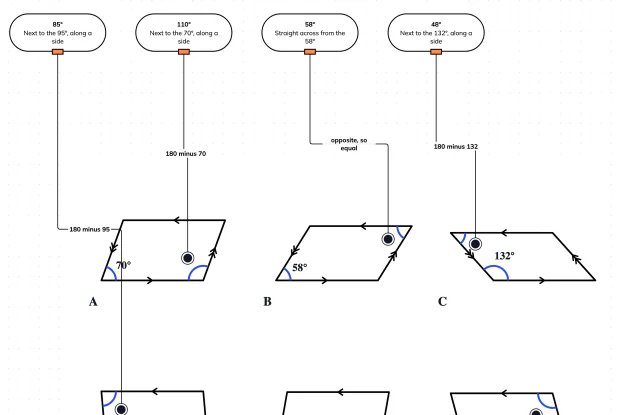
A parallelogram is defined by one thing only: both pairs of opposite sides are parallel. Equal opposite sides, equal opposite angles, supplementary neighbours and bisecting diagonals all follow from it rather than being separate rules. Work the angles out in an interactive playground.
What Is Special About a Rhombus's Diagonals?
A rhombus is a parallelogram with all four sides equal, so it inherits everything a parallelogram has. What it adds is about the diagonals: they meet at right angles and each one bisects the two corners it runs between. Use both facts in an interactive playground.
What Does a Rectangle Inherit from a Parallelogram?
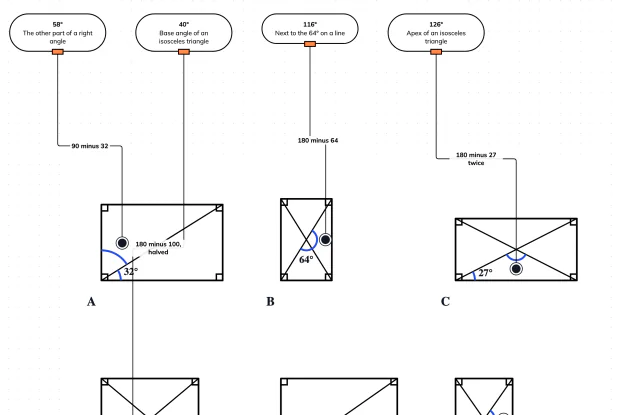
A rectangle is a parallelogram with a right angle, so it inherits equal opposite sides and bisecting diagonals without asking. What it adds is that the two diagonals are the same length, which turns the shape into four isosceles triangles. Use that in an interactive playground.
What Are a Trapezium and a Kite?
A trapezium has one pair of parallel sides instead of two; a kite has two pairs of equal sides that sit next to each other rather than opposite. Each keeps part of what a parallelogram offers and loses the rest, and each has its own angle rule. Use both in an interactive playground.
How Does the Quadrilateral Family Fit Together?
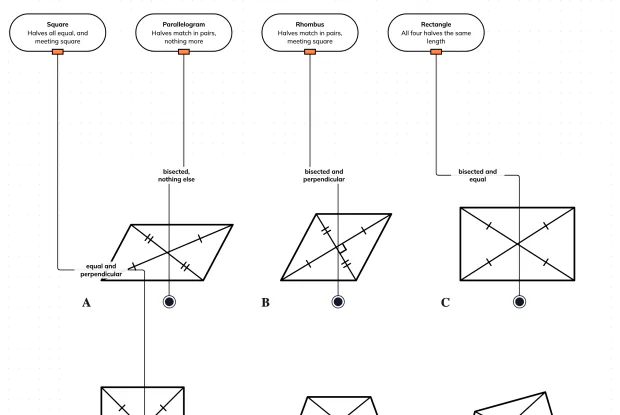
Parallelogram, rhombus, rectangle and square are not four separate shapes but one family, each adding a condition to the one before. The clearest way to tell them apart is to ignore the outline and look at what the diagonals do. Name them from the diagonals alone in an interactive playground.