What Are the Eight Planets, in Order From the Sun?
Root Concept
The eight planets sit in a fixed order outwards from the Sun, and each one has a single giveaway — a colour, a ring, a storm, or a tilt.
CodePLU Goal
Upgrading Human Mental Models
Learn how to think in Workflows

Concept Development By codeplu.com
The eight planets in order, each joined to the feature that gives it away
Why Should You Be Able to Name the Planets?
This tutorial has an unusually plain goal: by the end of it you should be able to look at a diagram of the Solar System with nothing written on it and name all eight planets, in order, without hesitating. That is a memory job, and it is worth saying so out loud rather than pretending otherwise.
Memory jobs like this one are not the opposite of understanding — they are the floor it stands on. Every later idea about space is phrased in these names. You cannot follow why Mars is a target for landers, why Venus is a warning about greenhouse gases, or why Jupiter matters to the asteroid belt, if the names are still a fog. The same is true everywhere: a medical student learns the bones before the fracture, a musician the notes before the key change.
But nobody remembers eight arbitrary words in a row for long. What sticks is a reason, so this tutorial gives you a **tell** for each planet — one feature that identifies it and nothing else: a colour, a ring, a storm, a tilt. Then the playground takes the picture, gives you only the names, and asks you to place them. That is not a shortcut past thinking. It is a test of what you actually kept.
How Do You Tell One Planet From Another?
Why is the order always the same?
Because the order is simply distance from the Sun, and orbits are stable over enormous stretches of time. Nothing swaps places. The four closest in are small and made of rock and metal; the four farthest out are huge and made mostly of gas and ice. That split is not a coincidence either — close to the young Sun it was too hot for ice to survive, so only rock and metal were left to build with, while further out ice lasted, cores grew large, and their gravity captured enormous amounts of gas. So the arrangement you are memorising has a reason underneath it, and the reason makes the list much easier to hold: small ones first, giants after.
What gives away each of the four inner planets?
**Mercury** is the smallest and the plainest — grey, pockmarked with craters, no atmosphere left to smooth anything over. It is named after the fast messenger of the gods, and it does orbit fastest, which is a useful hook. **Venus** is wrapped in unbroken pale cloud, so it shows no surface at all; it is named after the goddess of beauty because it is the brightest planet in our sky. **Earth** is the blue one, and the only one anywhere with liquid water on its surface. **Mars** is unmistakably rust-coloured, and the reason is literal: its dust is rich in iron oxide, which is rust. It is named after the god of war for exactly that colour.
What gives away each of the four giants?
**Jupiter** is the biggest by a wide margin, striped with cloud bands, and carries the Great Red Spot — a storm that has been raging since before anyone reading this was born. **Saturn** has rings so wide and bright that a small telescope shows them, which makes it the easiest planet of all to identify. **Uranus** is a pale blue-green, and its giveaway is bizarre: it is tipped almost completely onto its side, so its rings appear to stand upright rather than lie flat. **Neptune** is the deepest blue, the farthest out, and has the fastest winds in the Solar System — over 2,000 kilometres per hour. Four giants, four separate tells, none of which is its size.
Which planets get confused, and how do you separate them?
Three pairs cause nearly all the mistakes, so learn the tell for each. **Uranus and Neptune** are both blueish: Uranus is the paler, greener one with upright rings, Neptune the deep blue one at the very end. **Mercury and Mars** are both small and dim: Mars is red, Mercury is grey. And the one that catches almost everybody: **Venus is hotter than Mercury**, even though Mercury is closer to the Sun. Mercury has no atmosphere, so its heat escapes to space every night; Venus is smothered in thick carbon dioxide that traps heat like a closed car in summer. Closer to the fire does not always mean hotter — what matters is whether anything holds the heat in.
Why is every picture of the Solar System wrong?
Because no single page can be honest about size and distance at the same time, and the diagram above is no exception — its planets are in the right size order but nothing like the right ratios, and the gaps are pure invention. Try the real numbers. Shrink the Sun to a beach ball on your doorstep: Earth becomes a peppercorn about 26 metres down the street, and Neptune is a small bead most of a kilometre away. Every planet is a speck, and almost all of the Solar System is empty space. That is worth sitting with, because it is the one thing about the Solar System you cannot memorise from a picture — the picture is the very thing hiding it.
Real World Example
Which of These Can You Actually See From Your Garden?
You do not need equipment to start using what you have just learned. On any clear evening the Solar System is partly visible from a pavement, and what you can and cannot see follows directly from the features above:
Venus, with nothing at all
Brightest thing after the Moon
That unreasonably bright star low in the sky just after sunset or before sunrise is Venus, and it is bright for the reason you now know — it is close to us, and it is wrapped in unbroken cloud that throws sunlight straight back. Nothing else in the night sky except the Moon comes near it. Venus also never strays far from the Sun as we see it, because its orbit sits inside Earth's, so it is always caught near sunrise or sunset and never rides high at midnight. That is why it picked up two names, the evening star and the morning star, long before anyone realised both were the same planet.
Jupiter's moons, with binoculars
The four Galileo saw
Steady a pair of binoculars against a wall and Jupiter stops being a point of light: it becomes a small disc with up to four pinpricks strung out in a line beside it. Those are its largest moons, and watching them over a few nights shows them shift position from one evening to the next. That is exactly what Galileo saw in 1610, and it mattered enormously — here were objects plainly going round something that was not the Earth, at a time when everything was supposed to circle us. It is the most consequential observation anyone has ever made with equipment this modest, and you can repeat it from a back garden.
Uranus and Neptune, effectively never
Too far away, too dim
Uranus sits just at the edge of what an unaided eye can catch, and only from genuinely dark skies by somebody who already knows exactly where to look. Neptune is beyond reach entirely. So the features these two are famous for — the sideways tilt, the deep blue — are not things anyone has ever noticed by looking up. They come from spacecraft and large telescopes, and Voyager 2 remains the only probe to have visited either. That gap is worth noticing in itself: the planets people can describe most confidently are not always the ones they could find, and almost everything we know about the outer two arrived in a single flyby.
FAQs
Final Words
Eight names, one fixed order, and a tell for each: Mercury grey and airless, Venus smothered and hottest, Earth blue and wet, Mars rusty, Jupiter biggest and storm-scarred, Saturn ringed, Uranus tipped over, Neptune deepest blue and windiest. Learn them by their giveaways rather than as a list and they stop slipping away, because each name is now attached to something you can actually look for.
And keep the last section in mind, because it is the part the diagram cannot teach you. The picture you just labelled is a useful lie about distance — a real map of the Solar System is almost entirely empty, with eight specks in it. Knowing the names is the floor. Knowing what the picture is hiding is the next storey up.
Related Concepts
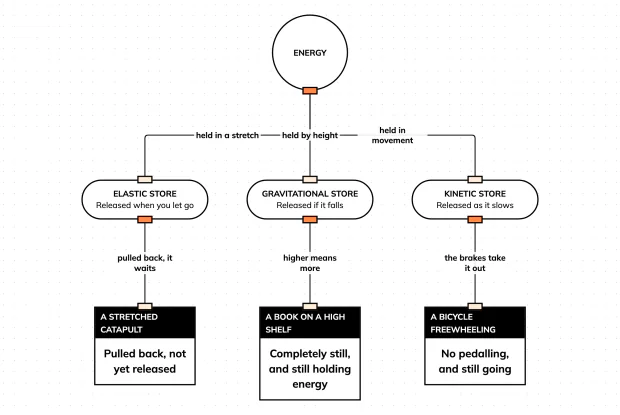
What Are the Different Ways Energy Is Stored?
Energy is not a substance with types — it is a quantity held in stores. Learn the main stores and build energy down into each one in an interactive playground.
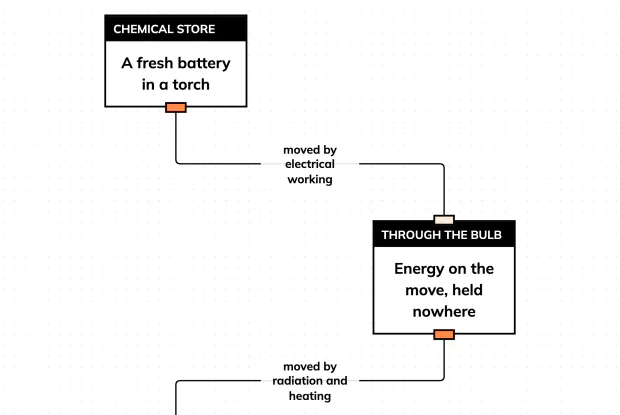
Where Does Energy Go When It Runs Out?
Energy is never used up — it spreads out until it is too thin to be useful. Follow one battery worth of energy all the way to the end.
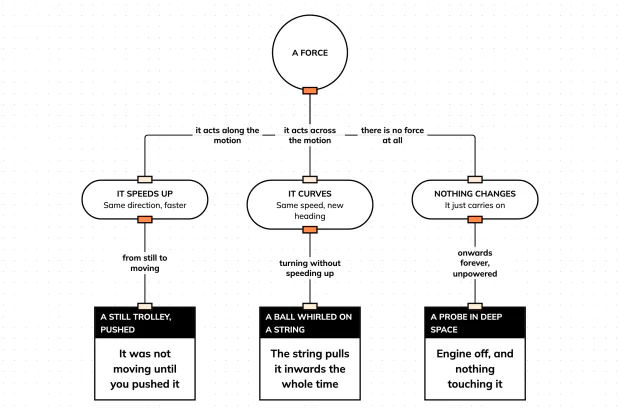
What Does a Force Actually Do?
A force does not keep things moving; it changes how they move. Learn what that difference means, and build a force down to what it changes in an interactive playground.
Why Does a Falling Object Stop Speeding Up?
A skydiver does not accelerate all the way down. Learn how growing drag brings forces into balance, and build the four stages.
Why Must an Electric Circuit Be a Complete Loop?
A bulb lights only when charge has an unbroken path back to the battery. Build that loop yourself and find out exactly what one small break does.
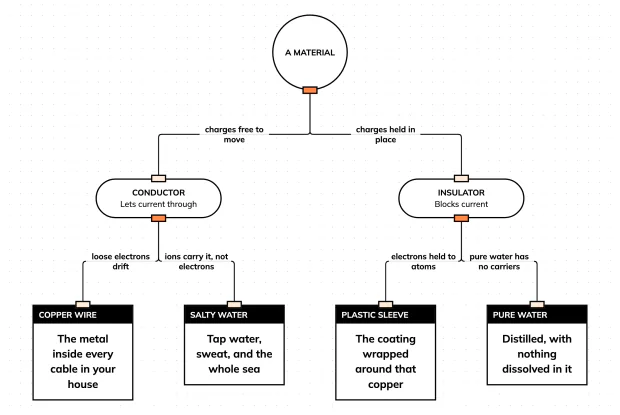
What Lets Electricity Through, and What Blocks It?
Conductors and insulators are not about what a material is made of but about whether anything inside it is free to move. Sort four materials by that test.