Where Does Energy Go When It Runs Out?
Root Concept
Energy is always conserved, so running out means it has dissipated into the surroundings where it is too spread out to do anything useful.
CodePLU Goal
Upgrading Human Mental Models
Learn how to think in Workflows

Concept Development By codeplu.com
One battery's energy traced from a concentrated store to a spread-out one
If Energy Can't Be Destroyed, Why Do Batteries Go Flat?
One of the firmest rules in physics is that energy cannot be created or destroyed. The total in a closed system stays exactly the same, always, with no known exceptions. Which raises an obvious objection: batteries go flat, phones die, cars run out of fuel. If nothing is destroyed, what exactly has happened?
Nothing has been lost. It has been spread out. The energy that was concentrated in the battery's chemical store is now distributed thinly through the room as a very slightly raised temperature — every joule accounted for, and not one of them usefully recoverable. That process is called dissipation, and it is what running out actually means.
This is worth getting straight because it changes what an energy problem is. We never consume energy; we degrade it, taking it from a concentrated store where it can do work and leaving it as warmth spread across a huge number of particles. An energy crisis is not a shortage of energy — the same amount exists before and after — it is a shortage of energy that is still concentrated enough to be useful. In the playground below you will follow one battery's worth from start to finish and see exactly where it ends up.
How Does Energy Move and Degrade?
What does conservation of energy actually claim?
That in any closed system, the total energy before equals the total energy after. Add up every store at the start, add up every store at the end, and the two numbers match. This is one of the most thoroughly tested statements in science and no exception has ever been found, which is why it functions as a tool rather than a belief — if your accounting does not balance, you have missed a store rather than found a violation. The catch is the word closed. Almost nothing you deal with is genuinely closed; energy leaks in and out constantly, mostly as warmth. So when a bouncing ball rises less each time, the energy did not vanish from the universe, it left your accounting because your accounting stopped at the ball.
Why does energy always end up as warmth?
Because every real process has friction and drag, and both move energy into thermal stores. Rub your hands and they warm; a brake pad heats when it stops a wheel; air resistance warms both the aircraft and the air. There is nothing wrong or wasteful happening in a moral sense — it is simply that thermal stores are extremely easy to reach and extremely hard to leave. Energy spread across billions of particles as slightly faster random motion has no direction and no concentration, so there is no straightforward way to gather it back up. This is why every device ever built eventually delivers all its energy to the surroundings as warmth. A torch, a car, a laptop and a kettle differ in what they do on the way, not in where the energy finishes.
What does efficiency really measure?
The fraction of energy that goes where you wanted it, rather than the fraction that was not wasted. An old filament bulb sent about five per cent of its energy out as light and the rest straight into heating the room, making it roughly five per cent efficient — as a lamp. Its energy accounting was perfect; it just was not doing the job you bought it for. An LED delivers a much larger share as light, which is why it needs far less energy to be equally bright. Notice what this means: nothing is ever more than one hundred per cent efficient, because that would require creating energy. And a heater is close to a hundred per cent efficient at heating, since heating is the destination everything reaches anyway — which is a genuinely odd consequence of the rule.
So what is an energy crisis, if energy is conserved?
A shortage of concentrated stores, not of energy. The energy in a barrel of oil does not disappear when it is burned; it ends up warming the atmosphere, in exactly the same quantity. What is gone is the concentration — the property that made it useful. So the real resource is not energy but low-entropy energy, meaning energy that is still gathered up in one place. This also explains why the Sun matters so much: it is a colossal external supply of concentrated energy arriving continuously, and photosynthesis, wind and hydro are all ways of catching some before it dissipates. Rephrasing energy problems as concentration problems makes a lot of otherwise confusing claims easier to evaluate.
Real World Example
Where Does the Energy Go When a Car Brakes?
Braking is dissipation you can feel, and it is also where the difference between wasting energy and recovering it becomes very concrete:
Ordinary brakes
A moving car holds a large kinetic store. Press the brake and friction between pad and disc moves that energy into thermal stores — the discs get genuinely hot, hot enough to glow on a racing car. From there it spreads into the air. The car has stopped, the energy is entirely accounted for, and none of it is coming back.
Regenerative braking
An electric car can do something cleverer. Instead of using friction, it runs its motor backwards as a generator, so slowing the car pushes energy along an electrical pathway into the battery's chemical store rather than into hot brake discs. The same kinetic store empties, but into somewhere concentrated enough to use again.
Why it is never all recovered
Regenerative braking recovers a useful fraction, not everything. Some energy still becomes heat in the motor, the wires and the battery, and air resistance is taking its share throughout. That is the rule in action: you can choose where energy goes and you cannot avoid some of it dissipating. Efficiency is about steering the flow, never about stopping the leak entirely.
FAQs
Final Words
Energy is never created or destroyed, so running out always means spreading out. A flat battery's energy is entirely present in the room around it, distributed so thinly that nothing can be done with it. That is dissipation, and it is where every device's energy eventually arrives no matter what it does on the way.
Once energy is seen as something we degrade rather than consume, efficiency becomes a question of steering the flow, and an energy crisis becomes a shortage of concentration rather than of energy. The next two concepts turn to forces — what actually makes something start moving, and what makes it stop.
Continue This Track
This concept is part 2 of Energy, Forces and What They Really Do.
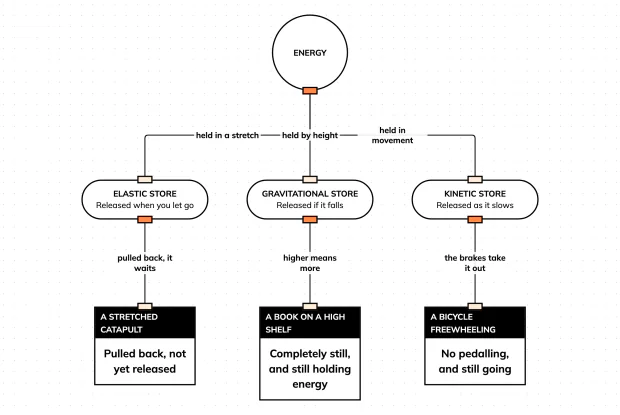
What Are the Different Ways Energy Is Stored?
Energy is not a substance with types — it is a quantity held in stores. Learn the main stores and build energy down into each one in an interactive playground.
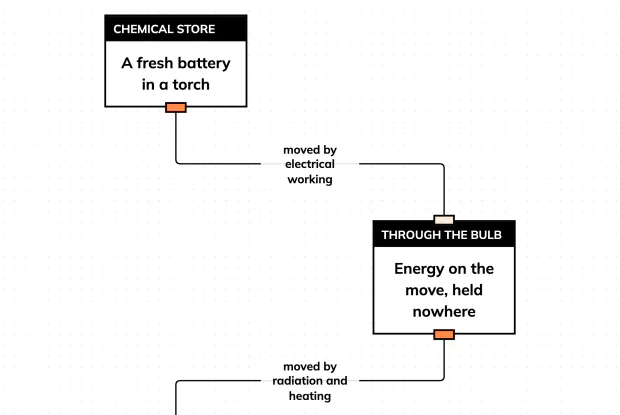
Where Does Energy Go When It Runs Out?
Energy is never used up — it spreads out until it is too thin to be useful. Follow one battery worth of energy all the way to the end.
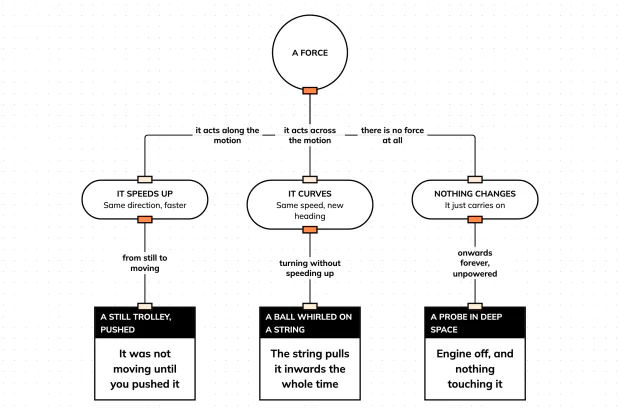
What Does a Force Actually Do?
A force does not keep things moving; it changes how they move. Learn what that difference means, and build a force down to what it changes in an interactive playground.
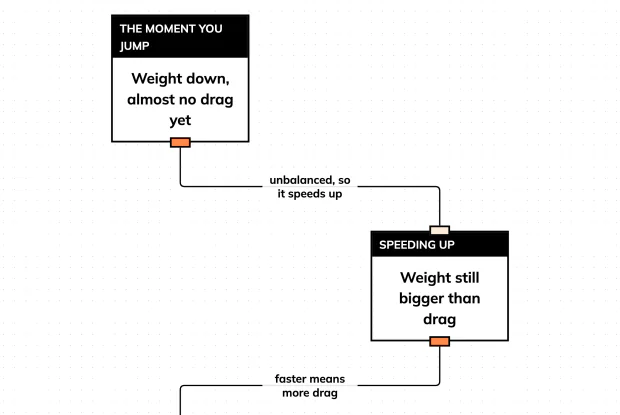
Why Does a Falling Object Stop Speeding Up?
A skydiver does not accelerate all the way down. Learn how growing drag brings forces into balance, and build the four stages.