Why Does a Falling Object Stop Speeding Up?
Root Concept
Balanced forces mean no change in motion, not no motion — which is why a falling object reaches a steady terminal velocity instead of accelerating forever.
CodePLU Goal
Upgrading Human Mental Models
Learn how to think in Workflows

Concept Development By codeplu.com
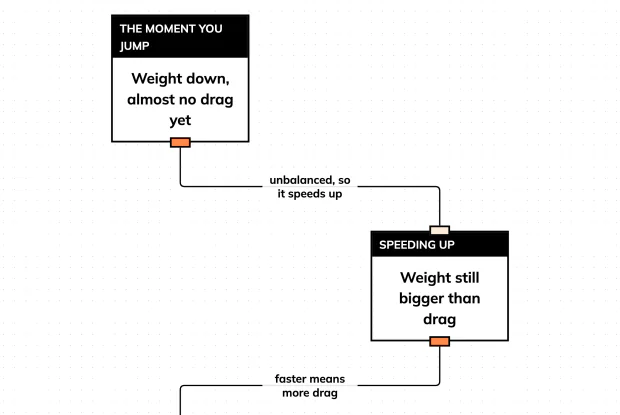
One fall in four stages, from unbalanced forces to balanced ones
Why Doesn't a Skydiver Just Keep Getting Faster?
Gravity pulls a skydiver down for the whole fall and never lets up, so you might reasonably expect them to keep accelerating until they hit the ground at a catastrophic speed. They do not. After a while they settle at a steady speed — very fast, around 190 kilometres per hour in a typical belly-down position, but no longer increasing.
The reason is that gravity is not the only force acting. Air resistance pushes upwards, and crucially it grows as you go faster: more speed means more air being shoved out of the way every second. So the fall has a self-limiting quality built into it. Weight stays constant while drag climbs, the gap between them shrinks, and the acceleration therefore fades away.
When drag has grown until it exactly equals weight, the forces are balanced — and here is the idea that trips people up. Balanced forces do not mean stationary. They mean no change in motion. So a skydiver with balanced forces is not hovering; they are falling at a constant speed, which is called terminal velocity. In the playground below you will build that whole sequence, from the moment of jumping to the moment the forces even out.
What Happens When Forces Are Balanced?
What does the resultant force tell you?
When several forces act on something, what matters is the single overall force you get by combining them, called the resultant. If someone pushes a box with 10 newtons one way and friction pushes back with 4 newtons, the resultant is 6 newtons in the direction of the push. If the two are equal, they cancel and the resultant is zero. That single number is what determines the motion: a resultant of zero means no change in motion, and any non-zero resultant means the object speeds up, slows down or turns. Notice that this makes the two rules from the previous concept one rule. Nothing acting and everything cancelling out have identical consequences, because in both cases the resultant force is zero, and the object simply continues as it was.
Why doesn't balanced mean stationary?
Because zero resultant force means unchanging motion, and unchanging motion includes moving at a steady speed. A car cruising at seventy on a level motorway has balanced forces: the engine's driving force exactly matches drag and friction, which is why the speed holds. A parachutist drifting down at a constant five metres per second has balanced forces. A stationary book on a table has balanced forces too, with its weight matched by the table pushing up. All three are the same physical situation, and the difference between them is only their starting speed. This is the most common misconception in the whole topic — balanced is read as still, when it actually means whatever you were doing, keep doing it.
How does drag grow, and why does that create a limit?
Air resistance depends on how fast you are travelling, how large an area you present, and the shape you make. Go faster and you collide with more air per second, so the force rises — quite sharply, since drag roughly follows the square of speed at everyday scales. That relationship is what makes a limit inevitable rather than coincidental. Weight does not change during a fall, so as drag climbs it must eventually reach the same value, and at that point the resultant becomes zero and speeding up stops. A skydiver can change their terminal velocity at will by changing shape: spread out to present a large area and drag grows sooner, giving a slower terminal velocity; dive head-first and it can more than double. Opening a parachute is the same trick taken to its extreme, hugely increasing area so terminal velocity drops to something survivable.
Do heavier things fall faster?
In air, often yes — but not for the reason people assume, and the difference matters. Drop a hammer and a feather on Earth and the hammer wins, because the feather has a large area for very little weight and so reaches its low terminal velocity almost at once. Remove the air and the effect disappears entirely: Apollo 15 astronaut David Scott dropped a hammer and a falcon feather on the Moon in 1971 and they hit the surface together, which is worth watching if you have not. So mass does not determine how fast something falls. What determines it is the balance between weight and drag, which is why a heavy dense object and a light fluffy one behave so differently in air and identically in a vacuum. Air resistance is doing all the work in the everyday version of this question.
Real World Example
What Actually Changes When a Parachute Opens?
A parachute is a device for manipulating one side of a force balance, and following it through explains both the jolt and the safe landing:
Before the parachute
Falling belly-down, the skydiver has reached terminal velocity at roughly 190 kilometres per hour. Weight down and drag up are equal, the resultant force is zero, and the speed is steady. This is balanced forces while travelling extremely fast, which is the whole counter-intuitive point.
The instant it opens
The canopy multiplies the area presented to the air, so drag increases enormously and immediately — while weight is unchanged. Suddenly the upward force is far larger than the downward one, so the resultant points upwards and the skydiver slows sharply. That deceleration is the jolt you feel, and it is a genuine change in motion caused by an unbalanced force.
The new balance
As speed drops, drag falls again, because drag depends on speed. It keeps falling until it once more equals weight — but now that happens at around 20 kilometres per hour instead of 190, because the area is so much greater. Forces are balanced again, the speed is constant again, and it is a speed you can land on. The parachute did not reduce weight; it changed the speed at which the balance occurs.
FAQs
Final Words
What governs motion is the resultant force — everything combined into one. Zero resultant means motion does not change, and that covers a stationary book, a cruising car and a parachutist descending steadily. Balanced never means still; it means carry on as you were.
A falling object reaches terminal velocity because drag grows with speed while weight does not, so a balance is inevitable. Change the area and you change where that balance lands, which is all a parachute does. Together with energy stores and dissipation, that gives you the core of this category: what holds energy, where it goes, and what forces do with it.
Continue This Track
This concept is part 4 of Energy, Forces and What They Really Do.
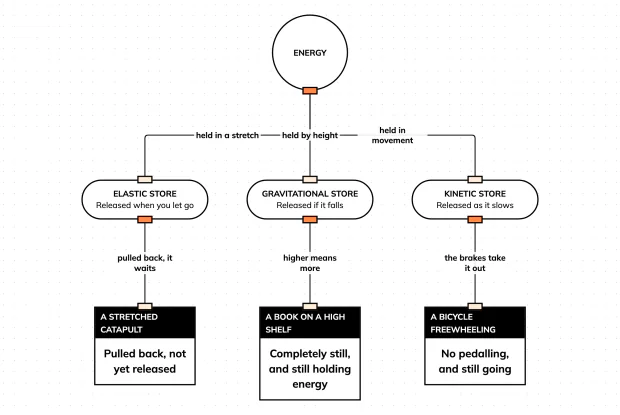
What Are the Different Ways Energy Is Stored?
Energy is not a substance with types — it is a quantity held in stores. Learn the main stores and build energy down into each one in an interactive playground.
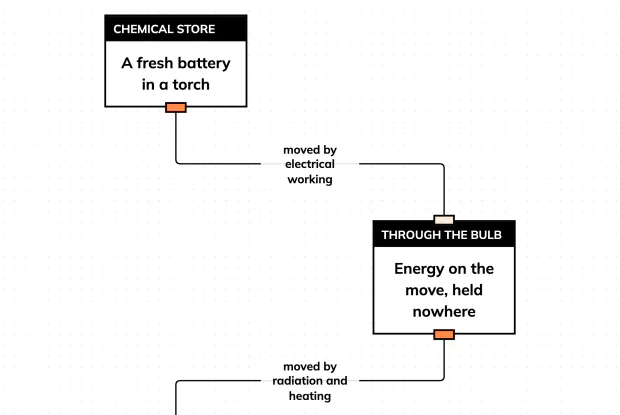
Where Does Energy Go When It Runs Out?
Energy is never used up — it spreads out until it is too thin to be useful. Follow one battery worth of energy all the way to the end.
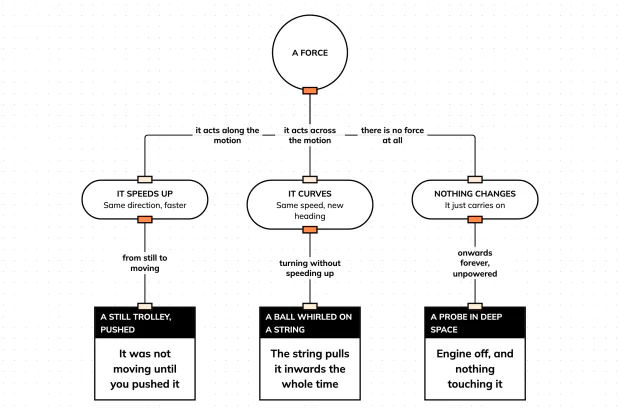
What Does a Force Actually Do?
A force does not keep things moving; it changes how they move. Learn what that difference means, and build a force down to what it changes in an interactive playground.
Why Does a Falling Object Stop Speeding Up?
A skydiver does not accelerate all the way down. Learn how growing drag brings forces into balance, and build the four stages.