What Does a Force Actually Do?
Root Concept
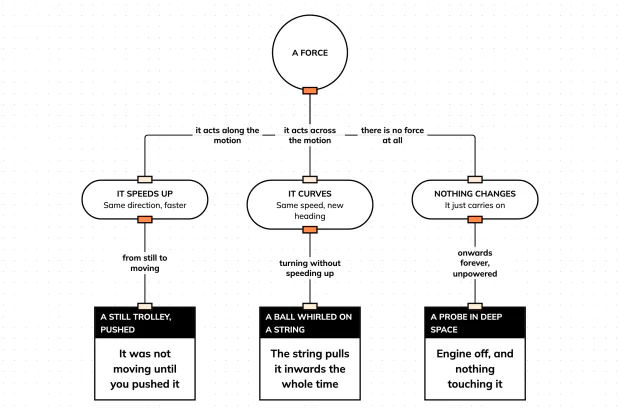
A force changes an object's speed or direction; with no force at all, motion simply continues unchanged forever.
CodePLU Goal
Upgrading Human Mental Models
Learn how to think in Workflows

Concept Development By codeplu.com
Three situations showing that forces change motion rather than sustain it
Do Moving Things Need a Force to Keep Moving?
Almost everyone's instinct says yes. Stop pedalling and the bike slows. Stop pushing the trolley and it stops. Take your foot off the accelerator and the car loses speed. The pattern seems obvious: motion requires a continuous push, and when the push stops, so does the movement.
That instinct is wrong, and it was wrong for around two thousand years of recorded thinking before anyone worked out why. A force does not keep something moving. A force changes how something moves — its speed, its direction, or both. Left completely alone, a moving object simply carries on at the same speed in the same direction, indefinitely.
The reason this is so hard to believe is that nothing on Earth is ever left alone. Friction and air resistance act on everything, all the time, and they are forces. So the bike slowing down is not the absence of a force revealing itself; it is the presence of a force you were not counting. Send a probe into deep space with its engines off and it does not slow at all — it keeps going for millions of years. In the playground below you will build a force down to what it changes, including the branch where no force acts at all.
How Do Forces Change Motion?
What is a force, and what can it change?
A force is a push or a pull, measured in newtons, and it always has a direction — which is why it matters not just how hard you push but which way. What a force can do is change an object's motion: make it speed up, make it slow down, or make it change direction. Any of those three counts as acceleration in the physics sense, which is broader than everyday usage. A car going round a roundabout at a steady thirty is accelerating, because its direction is changing even though the speedometer is constant. What a force cannot do is maintain motion, because maintaining requires no force at all. Getting this straight resolves a surprising number of puzzles, because most confusion about forces comes from expecting them to be responsible for movement rather than for changes in movement.
Why does everything on Earth seem to need pushing?
Because friction and air resistance never stop acting. Stop pedalling and you are not in a force-free situation — you are in a situation where the only remaining horizontal forces are friction in the bearings and drag from the air, both pointing backwards. Those slow you down, exactly as forces should, by changing your motion. The reason this deceives people so effectively is that the resisting forces are invisible and always present, so their absence has never been experienced. Ice offers a hint: a puck slides an extraordinary distance because friction has been nearly removed, and space offers the full version. The moment you count friction as a force rather than as the natural tendency of things to stop, the whole picture becomes consistent.
How is direction change also a force at work?
Whirl a ball on a string and its speed can be perfectly constant while its direction changes continuously. That change requires a force, which is the string pulling inwards the whole time. Let go and the force vanishes — and notice what the ball then does: it does not fly outwards from the centre, it travels off in a straight line along the direction it was heading at that instant. That is a good test of whether the idea has landed. The same logic explains why a car needs grip to corner: turning is a change of motion, so something must supply a sideways force, and on ice nothing can, so the car continues straight regardless of where the wheels point. Skidding is not a failure of steering; it is motion continuing exactly as physics says it should when the force is missing.
What happens when forces act in pairs?
Forces always come in pairs acting on different objects: push a wall and the wall pushes back on you with equal strength in the opposite direction. This is easy to state and easy to misapply, so the crucial detail is that the two forces act on different things and therefore never cancel each other out. When you walk, your foot pushes backwards on the ground and the ground pushes forwards on you — and it is that forward push on you which moves you. This is exactly why walking on ice is difficult and why a rocket works in the vacuum of space: the rocket pushes gas out backwards, the gas pushes the rocket forwards, and no air is required for the pair to exist. The common objection that a rocket has nothing to push against misunderstands which two objects are involved.
Real World Example
Why Do You Lurch Forward When a Bus Brakes?
The everyday experience that feels most like a mysterious force is actually the clearest demonstration that no force is needed to keep moving:
What it feels like
The bus brakes sharply and you are thrown forward. It genuinely feels as though something shoved you towards the front, and people reasonably describe it that way. But nothing touched you, and there is no forward force anywhere in the situation.
What is actually happening
You were travelling at the same speed as the bus. The brakes applied a backwards force to the bus, so the bus slowed. No comparable force was applied to you, so you carried on at your original speed — which is precisely what an object does when no force acts. You did not move forward; the bus slowed underneath you.
Which is what a seatbelt is for
A seatbelt exists to apply the force you were otherwise missing, slowing you at roughly the same rate as the vehicle. In a crash the difference is enormous: without one, you continue at full speed until something rigid stops you very suddenly. A seatbelt is not restraint for its own sake — it is the force that makes you decelerate with the car instead of independently of it.
FAQs
Final Words
A force changes motion; it does not sustain it. Push something and it speeds up, pull it sideways and it turns, leave it entirely alone and it carries on exactly as it was, forever. Everything on Earth seems to need pushing only because friction and air resistance are forces that never stop acting.
Forces also come in pairs on different objects, which is why walking works and why a rocket needs nothing to push against. The remaining question is what happens when several forces act at once — because when they cancel out exactly, the result is not stillness, and that is what the final concept in this category is about.
Continue This Track
This concept is part 3 of Energy, Forces and What They Really Do.
What Are the Different Ways Energy Is Stored?
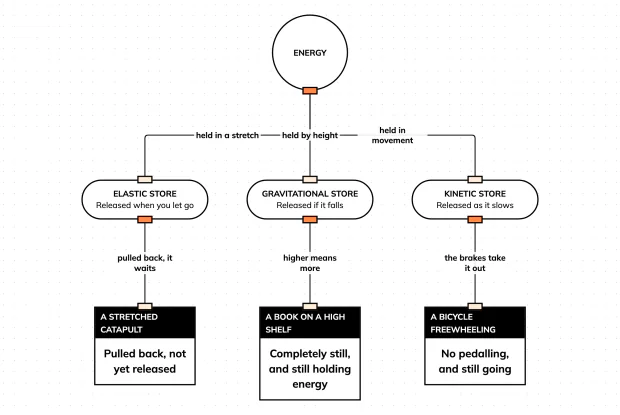
Energy is not a substance with types — it is a quantity held in stores. Learn the main stores and build energy down into each one in an interactive playground.
Where Does Energy Go When It Runs Out?
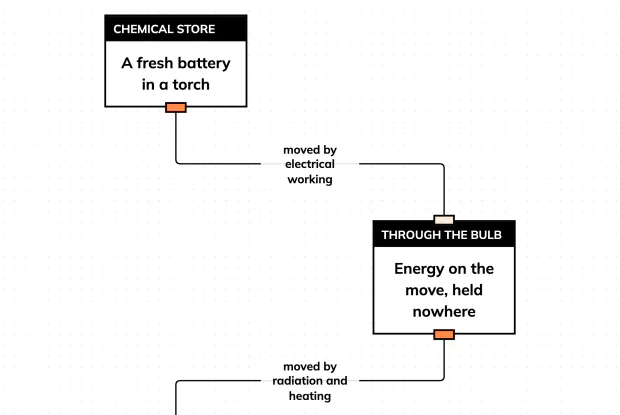
Energy is never used up — it spreads out until it is too thin to be useful. Follow one battery worth of energy all the way to the end.
What Does a Force Actually Do?
A force does not keep things moving; it changes how they move. Learn what that difference means, and build a force down to what it changes in an interactive playground.
Why Does a Falling Object Stop Speeding Up?
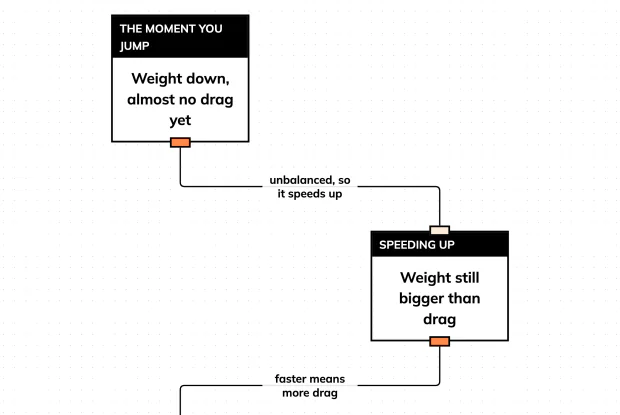
A skydiver does not accelerate all the way down. Learn how growing drag brings forces into balance, and build the four stages.