Why Must an Electric Circuit Be a Complete Loop?
Root Concept
A circuit works only when charge has an unbroken path out of the battery and back into it — the bulb transfers energy out of the circuit, but the charge itself is never used up.
CodePLU Goal
Upgrading Human Mental Models
Learn how to think in Workflows

Concept Development By codeplu.com
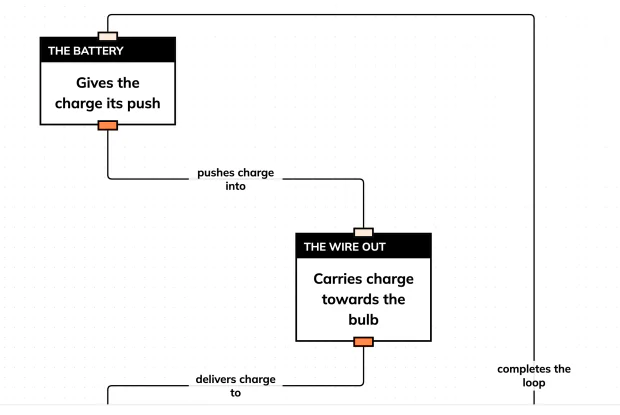
One unbroken loop: the charge that leaves the battery is the charge that comes back to it
What Has to Be True Before Anything Lights Up?
Connect a wire from one end of a battery to a bulb and nothing happens. Add a second wire from the other side of the bulb back to the other end of the battery, and the bulb lights. Nothing changed about the battery or the bulb. What changed is that the path became a loop.
That is the first rule of every electrical thing you own, and it is stricter than most people expect. There is no such thing as a circuit that works most of the way round. Charge needs a continuous path out of the battery, through whatever you want to run, and back into the battery again. Break that path at any single point — the far side of the bulb, a switch, one loose connection at the very end — and everything stops at once. Not dimly. Completely.
The word circuit is doing the work here: it means a circle, and it was chosen for exactly this reason. In the playground below you will connect the four stages of that circle yourself, including the return journey people usually forget. If you build it as a line from the battery to the bulb and stop there, the loop will not close, and the validation will tell you what a real bulb would tell you.
How Does a Circuit Actually Work?
Why does the loop have to close?
A battery does not fire charge out into the world; it pushes charge round a path. Pushing only works if there is somewhere for the charge to go and somewhere for it to arrive, which means the path has to come back. Think of water in a central heating system: the pump does not squirt water out of the boiler, it drives water round a closed pipe and back. Cut the pipe anywhere and the pump can push all it likes — nothing circulates. Many beginners picture electricity as something that leaves the battery and gets delivered, like a parcel, so a single wire ought to be enough. It never is. The commonest wrong version of this is imagining charge coming out of both ends of the battery and meeting at the bulb to create the light. That is not what happens. Charge travels one way around the loop, in the same direction all the way, and the bulb sits in that one-directional flow.
If the charge comes back, what does the bulb actually use?
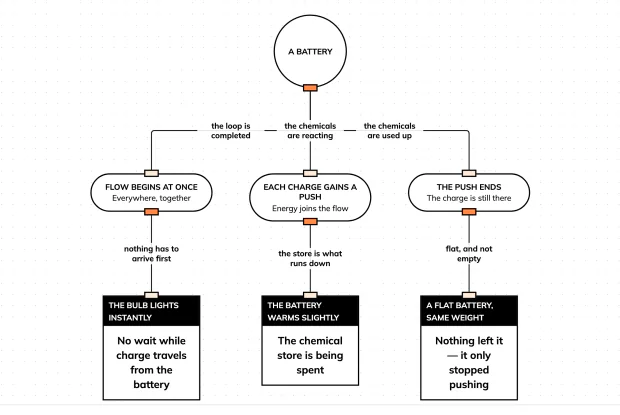
Energy, not charge. Exactly the same amount of charge returns to the battery as left it, and that is not an approximation — charge is conserved. What the bulb takes is energy: the charge arrives with a push behind it and leaves with less of one, and the difference comes out of the bulb as light and heat. This is the energy stores idea from earlier in this track doing real work. The battery holds a chemical store; the circuit is an electrical working pathway that carries energy from that store to the bulb; the bulb turns it into a light-and-heat output that spreads into the room. Nothing anywhere in that sentence holds a store of electricity, which is why the question "how much electricity is left in the wire?" has no answer. The wire holds no electricity. It carries a flow, in the same way a road holds no journeys.
What happens the instant you break the circuit?
Everything stops, everywhere, effectively at once. That is worth sitting with, because it is surprising: flick a switch at the wall and a bulb three metres away goes out with no delay you could ever measure. If charge had to travel from the switch to the bulb to deliver the news, there would be a visible lag. There isn't, because the whole loop stops flowing together — the push disappears throughout the circuit almost instantly. Here is the detail that makes this concrete, and it catches nearly everyone out: the individual charged particles in a wire drift astonishingly slowly, often less than a millimetre per second. The effect travels at close to the speed of light; the particles crawl. So the bulb is not lit by particles that have just arrived from the battery. It is lit by particles that were already sitting in the filament, being pushed.
Real World Example
Why Does One Loose Bulb Kill a Whole String of Fairy Lights?
Everyone has met this, usually in December, usually while standing on a chair. A hundred bulbs, all dark, because of one:
One bulb works loose
The loop now has a gap in it a fraction of a millimetre wide.
Every other bulb goes out
Not just the ones after the gap — all of them, including the ones nearer the plug. There is only one loop, and it is broken.
Nothing is damaged
No bulb has failed and no energy has been lost. The path is simply not closed, so no charge moves anywhere in it.
Push it back in and all hundred light
Instantly, and together. The loop closed, so the flow resumed everywhere at the same moment.
FAQs
Final Words
A circuit is a circle, and the name is the lesson. Charge leaves the battery with a push, travels one way round, gives up energy at the bulb, and arrives back at the battery having lost none of itself. Break the loop at any single point and the flow stops everywhere in it at once — which is why a loose bulb at the far end of a string kills every bulb before it too.
Once you are picturing a loop rather than a delivery, the rest of electricity gets much easier. The next two parts of this track ask what the loop has to be made of, and what the battery is really doing when it pushes. Both answers turn out to be simpler than the words around them suggest.
Continue This Track
This concept is part 1 of What Makes a Circuit Work.
Why Must an Electric Circuit Be a Complete Loop?
A bulb lights only when charge has an unbroken path back to the battery. Build that loop yourself and find out exactly what one small break does.
What Lets Electricity Through, and What Blocks It?
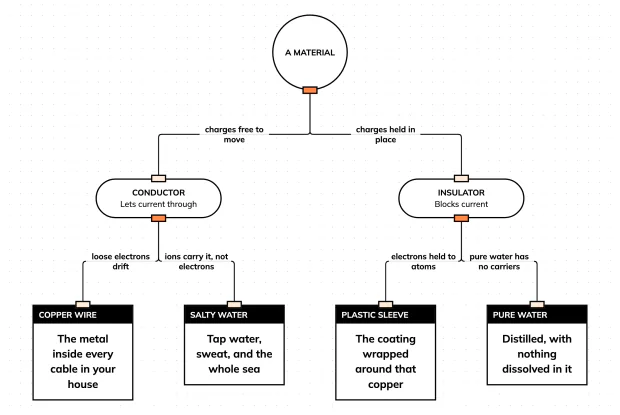
Conductors and insulators are not about what a material is made of but about whether anything inside it is free to move. Sort four materials by that test.
What Does a Battery Actually Do?
A battery does not store electricity waiting to be used up. It holds chemicals, and it pushes. Build a battery down to what it does at each moment.