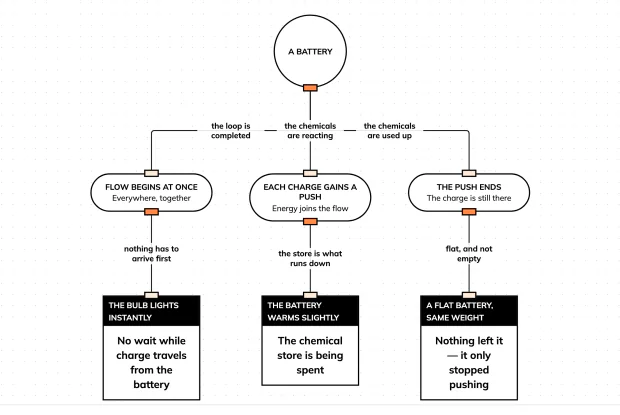
What Lets Electricity Through, and What Blocks It?
Root Concept
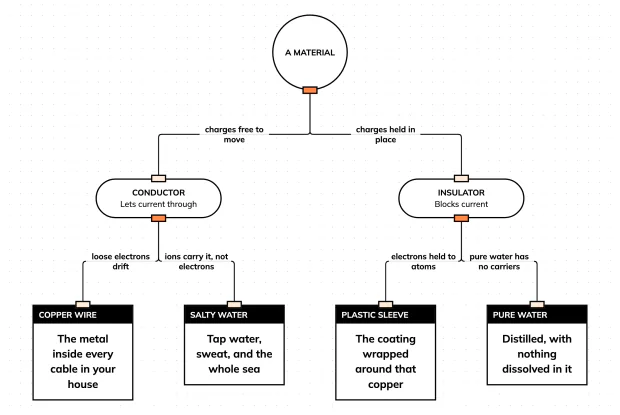
A material conducts if it contains charged particles that are free to move, and insulates if it does not — which is why pure water insulates and salty water conducts.
CodePLU Goal
Upgrading Human Mental Models
Learn how to think in Workflows

Concept Development By codeplu.com
The same test applied four times: is anything charged inside this material free to move?
What Actually Separates a Conductor From an Insulator?
Copper conducts. Plastic does not. Almost everyone knows that much, and almost everyone explains it wrongly — usually as though metals contain electricity and plastics do not. Neither contains electricity. What separates them is one thing only: whether the material holds charged particles that are free to move.
In copper, some electrons are not tied to any particular atom. They drift about the metal already, and when a battery pushes, they shift along together. In plastic, every electron is held tightly to its own atom. Push as hard as you like and nothing travels, because there is nothing loose to travel. That single test — is anything charged free to move? — decides the behaviour of every material there is.
It also produces an answer most people find surprising, which is why it is in the playground below. Pure water is an insulator. Genuinely, measurably, a poor conductor. What makes the water in your kitchen dangerous is not the water.
How Does the Free-to-Move Test Work?
What makes a metal let charge through so easily?
Metals have an unusual arrangement: their outer electrons are shared out across the whole lump of metal rather than belonging to individual atoms. Picture a fixed grid of atoms sitting in a sea of loose electrons that already wander freely. Nothing has to be broken or forced for those electrons to move — they are moving anyway, just randomly. All a battery does is bias that random drifting so slightly more of it goes one way than the other, and that bias is the current. This is why metals conduct heat well too, for the same reason and by the same particles, and why a metal spoon in hot soup becomes unpleasant while a wooden one does not. The misconception to drop is that a conductor is a material that contains electricity. It contains loose electrons, which is a different claim: they are there whether or not anything is switched on.
Why does pure water insulate when tap water conducts?
Because water molecules themselves are not charged and are not free to carry current. What carries charge through water is dissolved ions — atoms that have gained or lost an electron and are therefore charged, and floating about loose. Distil water so nothing is dissolved in it and there is almost nothing to do the carrying: pure water is a genuinely poor conductor. Now add a pinch of salt, and it dissolves into charged particles that drift when pushed, and the same water conducts well. Tap water already contains dissolved minerals, sweat contains dissolved salts, and sea water is full of them. So the rule people carry — water conducts electricity — has the cause wrong in a way that matters. Water is dangerous around electricity because of what is always dissolved in it, and because it spreads, soaks and makes good contact with skin. Knowing the real reason is what stops the rule collapsing when a physics question mentions distilled water.
Is the line between them as sharp as it sounds?
No — it is a spectrum, and the two words are just the useful ends of it. Every material resists the flow of charge to some degree; copper resists very little, plastic resists so much that for practical purposes nothing gets through. In between sit materials that are middling, and one group in the middle turned out to matter enormously: semiconductors, which conduct only under certain conditions. That controllability is what makes a transistor possible, and transistors are what every computer is built from — so the interesting materials were never the good conductors or the good insulators, but the ones in the gap. Even the ends of the spectrum are not absolute. Push hard enough with a high enough voltage and an insulator will give way, which is exactly what lightning is: air is an excellent insulator right up until it isn't.
Real World Example
Why Is a Cable Made of Both at Once?
A power cable is not one material doing a job. It is two, chosen for opposite reasons and assembled together:
Copper in the middle
Free electrons, so charge flows along the cable with very little resistance — and very little waste heat.
Plastic around the outside
Locked electrons, so charge cannot leave sideways. It stays in the copper because there is no other route it can take.
Why both are essential
A bare copper wire would work perfectly well — until it touched another wire, a pipe, or you. The insulator does not help the electricity; it controls where it is allowed to be.
The engineering choice underneath
Silver conducts slightly better than copper, and is used where that matters. Copper wins almost everywhere else because it is far cheaper and nearly as good.
FAQs
Final Words
Conductors and insulators sound like two categories of material, but they are really one question asked of every material: is anything charged in here free to move? Copper answers yes because its outer electrons are loose. Plastic answers no because its are locked down. Salty water answers yes because of the ions dissolved in it, and pure water answers barely, because almost nothing is.
That reframing is worth more than the two labels, because it survives the awkward cases the labels cannot. It explains why distilled water behaves unlike tap water, why the interesting materials for computing sit in the middle of the range, and why air insulates faithfully until a storm proves otherwise. The last part of this track asks what the battery is doing to push all those free particles in the first place.
Continue This Track
This concept is part 2 of What Makes a Circuit Work.
Why Must an Electric Circuit Be a Complete Loop?
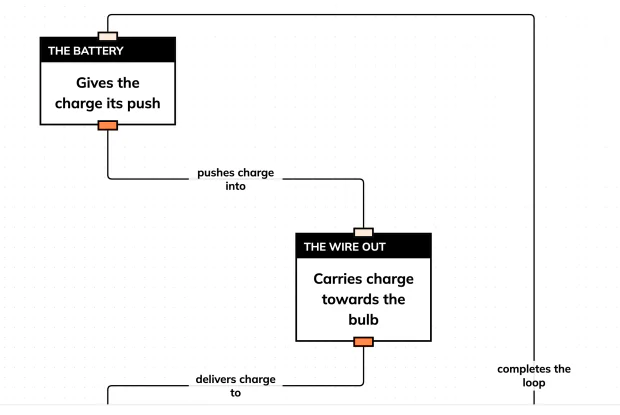
A bulb lights only when charge has an unbroken path back to the battery. Build that loop yourself and find out exactly what one small break does.
What Lets Electricity Through, and What Blocks It?
Conductors and insulators are not about what a material is made of but about whether anything inside it is free to move. Sort four materials by that test.
What Does a Battery Actually Do?
A battery does not store electricity waiting to be used up. It holds chemicals, and it pushes. Build a battery down to what it does at each moment.