What Are the Different Ways Energy Is Stored?
Root Concept
Energy is held in stores — kinetic, gravitational, chemical, elastic, thermal — and things like electricity and light are how it moves between them, not stores themselves.
CodePLU Goal
Upgrading Human Mental Models
Learn how to think in Workflows

Concept Development By codeplu.com
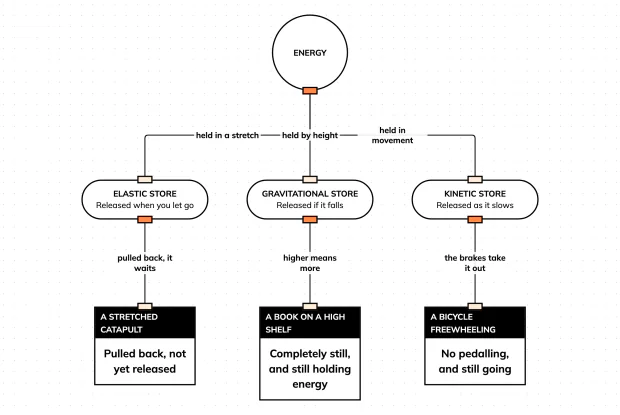
Energy branches into three stores, each with something holding it now
Is Energy a Substance, or a Number?
Energy gets talked about as though it were a kind of invisible fuel — something that flows into things, gets used up, and runs out. That picture is comfortable and it causes most of the confusion people have about physics, because energy is not a substance at all. It is a quantity, a number you can calculate about a situation, and the useful question is never what is energy but where is it being held.
The places it can be held are called stores. A moving bicycle holds energy in a kinetic store, because it is moving. A book on a high shelf holds energy in a gravitational store, because of its height. A stretched catapult holds energy in an elastic store, food and fuel and batteries hold it in chemical stores, and a hot cup of tea holds it in a thermal store. That is most of the list, and none of them require imagining a fluid.
There is one distinction that clears up an enormous amount of muddle, and it is worth getting straight immediately. Electricity, light and sound are not stores. They are how energy gets from one store to another — the moving, not the holding. Calling electricity a type of energy is a bit like calling delivery a type of parcel. In the playground below you will build energy down into three stores, and each store down to something you can see holding it right now.
Where Can Energy Be Held?
What are the main energy stores?
Five cover almost everything you meet. A kinetic store belongs to anything moving, and it grows very quickly with speed — double the speed and the kinetic energy quadruples, which is exactly why crashes get so much worse at higher speeds. A gravitational store belongs to anything raised above the ground, and it depends on both mass and height. An elastic store belongs to anything stretched or squashed, from a catapult to a compressed spring. A chemical store sits in the arrangement of atoms in food, fuel and batteries. A thermal store belongs to anything warm, and it grows with both temperature and quantity. There are others for specialist situations, including nuclear and magnetic stores, but those five will describe the overwhelming majority of everyday physics.
Why aren't electricity and light energy stores?
Because nothing is holding them — they are energy in transit. When a torch is on, energy leaves the chemical store in the battery and arrives in the thermal store of the room, and electricity and light are the two routes it takes on the way. Nothing anywhere contains a store of electricity. This matters more than it sounds, because it fixes questions that are otherwise unanswerable, like how much electrical energy a wire holds — the answer is none, in the same way a road holds no journeys. The four common ways energy moves are electrical working, heating, radiation such as light, and mechanical working, which is a force pushing something along. Stores are nouns; pathways are verbs. Keeping them in separate categories is most of the work.
How can something completely still hold energy?
The book on the shelf is doing nothing at all, and it holds a substantial gravitational store — which sounds like a contradiction if you think of energy as activity. It is not activity; it is potential for change. The book has energy in the sense that, given the chance, something could happen: knock it off and that store empties into a kinetic store as it falls, and then into thermal and sound stores when it lands. Notice the arithmetic buried in that. The higher the shelf, the more it holds, and the faster it is travelling when it hits. This is exactly why falls from height are dangerous in proportion to the height, and it is a good demonstration that a store is about what could happen rather than what is happening.
How much energy is actually involved?
Energy is measured in joules, and one joule is small — roughly the energy needed to lift an apple a metre. That makes everyday quantities large: a slice of bread holds something like a million joules in its chemical store, which is why food energy is usually quoted in kilojoules or calories instead. The scale is worth a moment because it explains something people find counter-intuitive. Chemical stores in fuel and food are extraordinarily dense compared with the stores we can easily build by other means, which is why a small tank of petrol moves a car for hours while an enormous battery moves it for less far. Nothing mysterious is happening; the numbers are simply very different, and knowing the rough scale is what makes energy claims possible to sanity-check.
Real World Example
Where Is the Energy at Each Point of a Bungee Jump?
A bungee jump moves energy between three different stores in a few seconds, which makes it an unusually clean example to follow:
On the platform
You are standing still, high up. Nothing is moving and nothing is stretched, so essentially all of the energy is in a gravitational store, set by your mass and your height. This is the fullest that store will be at any point in the jump, and everything that follows is that store emptying.
Halfway down
Now you are falling fast and the cord has not yet gone taut. The gravitational store has partly emptied, and what left it has arrived in your kinetic store — you are lower, and you are moving. Nothing has been created; the same energy is simply held somewhere else. A little has already leaked into the air as you push through it.
At the bottom, cord fully stretched
At the lowest point you are momentarily not moving at all, so the kinetic store is briefly empty. The energy is now in the elastic store of the stretched cord, which is what then throws you back up. Each bounce is smaller than the last, because some energy leaves on every cycle as heat in the cord and sound in the air — and that leak is where the next concept begins.
FAQs
Final Words
Energy is a quantity, not a substance, and the useful question is where it is being held. Kinetic for movement, gravitational for height, elastic for stretch, chemical for fuel and food, thermal for warmth — those five cover nearly everything. Electricity, light, sound and heating are not stores at all; they are how energy travels between them.
That store-and-pathway split is what makes the next idea possible to state precisely. Watching a bungee cord bounce lower each time, it plainly looks as though energy is being lost — and the next concept is about following where it actually goes, because it is never destroyed.
Continue This Track
This concept is part 1 of Energy, Forces and What They Really Do.
What Are the Different Ways Energy Is Stored?
Energy is not a substance with types — it is a quantity held in stores. Learn the main stores and build energy down into each one in an interactive playground.
Where Does Energy Go When It Runs Out?
Energy is never used up — it spreads out until it is too thin to be useful. Follow one battery worth of energy all the way to the end.
What Does a Force Actually Do?
A force does not keep things moving; it changes how they move. Learn what that difference means, and build a force down to what it changes in an interactive playground.
Why Does a Falling Object Stop Speeding Up?
A skydiver does not accelerate all the way down. Learn how growing drag brings forces into balance, and build the four stages.