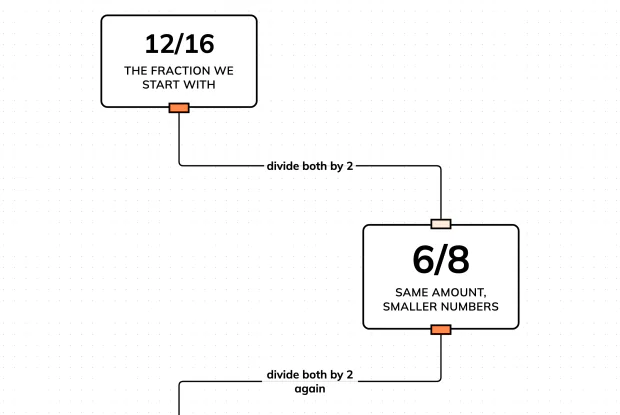
How Do You Multiply and Divide Fractions?
Root Concept
To multiply two fractions, multiply the numerators together and the denominators together, then simplify: 2/3 × 3/4 = 6/12 = 1/2. To divide by a fraction, flip the second fraction (its reciprocal) and multiply instead: 1/2 ÷ 1/4 = 1/2 × 4/1 = 2.
CodePLU Goal
Upgrading Human Mental Models
Learn how to think in Workflows

Concept Development By codeplu.com
Four fraction problems, each landed on its value — the tiles 1/8 and 5/7 are the classic wrong answers (not flipping, or adding across)
Are Fractions Actually Easier to Multiply Than to Add?
Here is a surprise: multiplying and dividing fractions is often simpler than adding them. To add fractions you have to find a common denominator first, but to multiply them you do not — you just multiply straight across. The top numbers multiply together to make the new top, and the bottom numbers multiply together to make the new bottom. So 2/3 × 3/4 = (2×3)/(3×4) = 6/12, which simplifies to 1/2.
Dividing looks harder but hides an easy trick: to divide by a fraction, you flip the second fraction upside down and multiply instead. 'Flip and multiply' turns every division into a multiplication you already know how to do. So 1/2 ÷ 1/4 becomes 1/2 × 4/1 = 4/2 = 2. The flipped fraction is called the reciprocal, and using it is the whole secret of dividing fractions.
That is really all there is to it: multiply straight across, and to divide, flip and multiply — then simplify the answer. In the playground you will work out two multiplication problems and two division problems and land each on its value, while a couple of tiles show the answers you would get by forgetting to flip or by adding across instead.
How Do You Multiply and Divide Fractions?
Multiplying: straight across
To multiply two fractions, you multiply the two top numbers (the numerators) to get the new top, and the two bottom numbers (the denominators) to get the new bottom. That is it — no common denominator needed. For 1/2 × 2/3, multiply the tops (1 × 2 = 2) and the bottoms (2 × 3 = 6) to get 2/6, which simplifies to 1/3. It often helps to simplify at the end (or cancel common factors first) so the answer is in lowest terms. A nice way to picture it: 'a half of a third' really is a smaller piece than either — multiplying fractions usually makes the result smaller, because you are taking a part of a part. Straight across, then simplify: that is the whole method for multiplying.
Dividing: flip and multiply
Dividing by a fraction is done by turning it into a multiplication. The rule is: keep the first fraction, flip the second one upside down, and multiply. The flipped fraction is called the reciprocal — flip 1/4 and you get 4/1, which is just 4. So 1/2 ÷ 1/4 = 1/2 × 4/1 = 4/2 = 2. Why does flipping work? Because dividing by 1/4 is asking 'how many quarters fit into a half?', and the answer is 2 — flipping and multiplying is the quick way to get there. The most common mistake is to forget to flip and just multiply straight across, which gives the wrong answer. Always flip the second fraction first, then multiply as usual.
The mistakes to avoid
Two errors trip people up. The first is dividing without flipping — doing 1/2 ÷ 1/4 as 1/2 × 1/4 = 1/8 instead of flipping to get 2. Remember: division only becomes multiplication after you flip the second fraction. The second is trying to 'add across' when multiplying — writing 3/4 × 2/3 as (3+2)/(4+3) or mixing tops and bottoms. Multiplying is tops-times-tops and bottoms-times-bottoms, never adding. If you keep just two rules straight — multiply straight across, and to divide, flip then multiply — you will get fraction multiplication and division right every time. In the playground, the wrong tiles (like 1/8) are exactly these classic slips, so working each one out properly is the only way to land it correctly.
Real World Example
Where Do You Multiply and Divide Fractions?
These two skills show up whenever you take a part of a part, or share something into fractional pieces. Here are three:
Halving a recipe
Half of 2/3 of a cup is a multiplication
Suppose a recipe needs 2/3 of a cup of sugar, but you want to make only half the recipe. How much sugar? You need a half of 2/3, and 'a half of' means multiply by 1/2: 1/2 × 2/3 = 2/6 = 1/3 of a cup. Multiplying fractions is exactly what scaling a recipe up or down needs — a half of this, three-quarters of that. Notice the answer, 1/3, is smaller than 2/3, which makes sense: taking half of something leaves less. Cooks do this constantly without naming it, and it is why multiplying fractions is one of the most genuinely useful bits of arithmetic in an ordinary kitchen.
How many portions fit?
Dividing tells you how many pieces you can serve
Imagine you have 1/2 of a pizza left and you want to give each person a 1/4-pizza slice. How many people can you serve? You divide: 1/2 ÷ 1/4, which by flip-and-multiply is 1/2 × 4 = 2 people. Dividing by a fraction answers 'how many of these smaller pieces fit into this amount?' — and the answer is often bigger than what you started with, which surprises people. That is the everyday meaning of dividing by a fraction: you are counting how many small portions a quantity contains. Whether it is slices of pizza, cups from a jug, or lengths cut from a ribbon, fraction division is the tool for 'how many fit?'.
Scaling a measurement
Two-thirds of three-quarters of a metre
In building, sewing and design you often take a fraction of a fraction of a length. Say a shelf is 3/4 of a metre and you want a piece that is 2/3 of it. You multiply: 2/3 × 3/4 = 6/12 = 1/2 a metre. Multiplying fractions lets you chain these 'part of a part' steps into a single tidy answer, and it stays exact rather than rounding a decimal. This is why fraction multiplication is everywhere in practical measuring: any time one fraction describes a portion of something that is itself a fraction, one multiplication gives you the final size straight away.
FAQs
Final Words
Multiplying and dividing fractions comes down to two rules. To multiply, go straight across — tops times tops, bottoms times bottoms — then simplify: 2/3 × 3/4 = 6/12 = 1/2. To divide, flip the second fraction and multiply instead: 1/2 ÷ 1/4 = 1/2 × 4 = 2. No common denominator is ever needed, which makes these often easier than adding fractions.
Steer clear of the two classic slips — dividing without flipping, and adding across when you should multiply — and these operations become quick and reliable. They power everyday tasks like halving a recipe, counting portions, and scaling a measurement. With this foundation solid, the next step is handling the signs too: what happens when the fractions you multiply and divide are negative?
Related Concepts
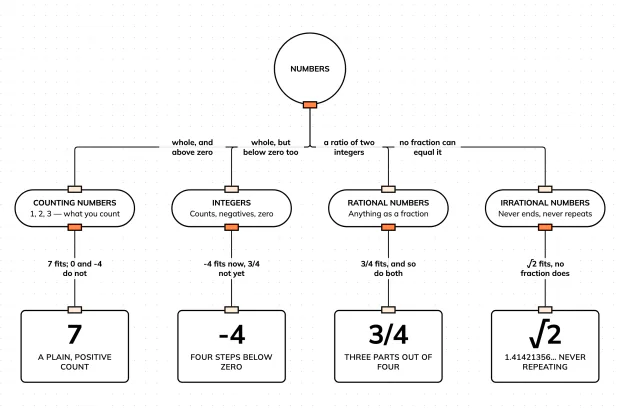
What Are the Different Types of Numbers?
Counting numbers, integers, rationals and irrationals explained in plain words — then sort each number into its family yourself in an interactive playground.
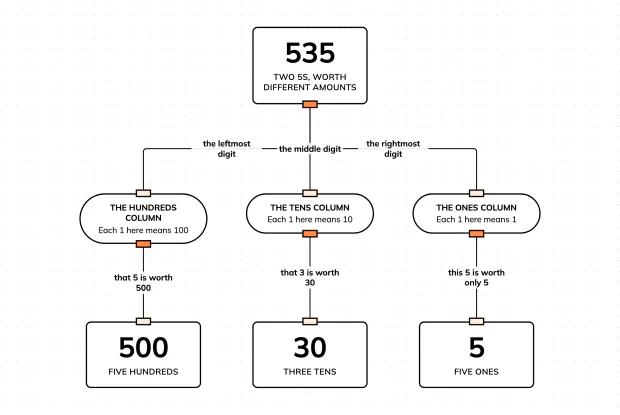
Why Does a Digit's Position Change Its Value?
The same digit can be worth 5 or 500 depending on where it sits. Learn how columns decide a digit value, then build 535 down into its columns in an interactive playground.
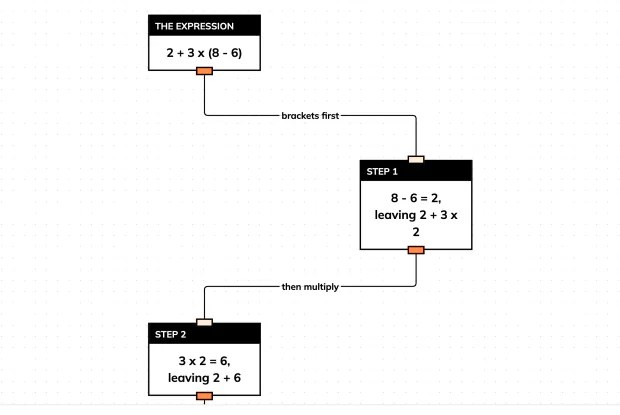
Why Does the Order of Operations Matter?
Two people can get two different answers from the same sum unless they agree on an order. Learn the rule and build the steps yourself in an interactive playground.
What's the Difference Between a Factor and a Multiple?
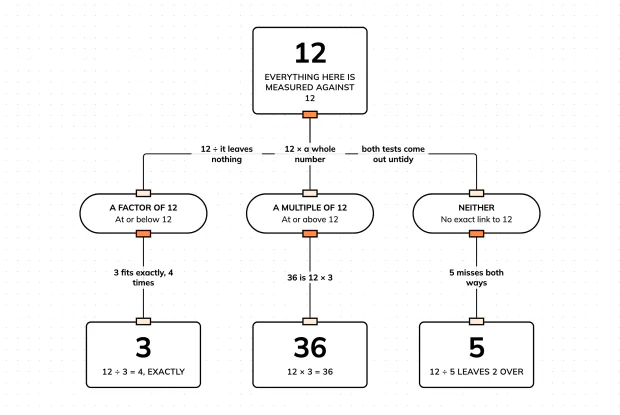
Factors go into a number; multiples come out of it. Learn which direction each word points, then sort three numbers by how they relate to 12.
What Does a Fraction Actually Mean?
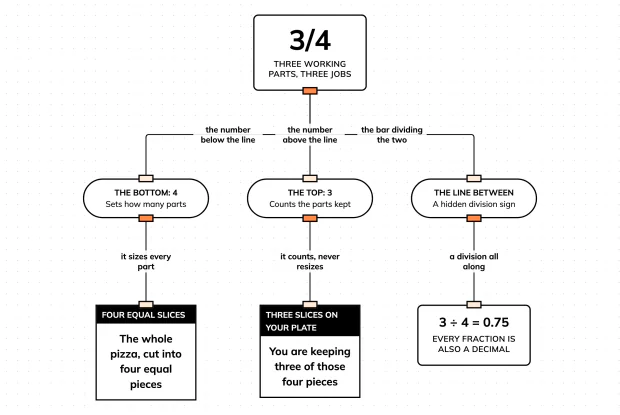
A fraction is not one number but two doing different jobs. Learn what the top and bottom each tell you, and build 3/4 down into its three working parts in an interactive playground.
How Can Two Different Fractions Be Equal?
1/2, 2/4 and 8/16 are the same amount written three ways. Learn why multiplying or dividing both parts changes nothing.