Why Does the Order of Operations Matter?
Root Concept
An expression is evaluated in an agreed order — brackets, then powers, then multiply and divide, then add and subtract — so everyone reaches the same answer.
CodePLU Goal
Upgrading Human Mental Models
Learn how to think in Workflows

Concept Development By codeplu.com
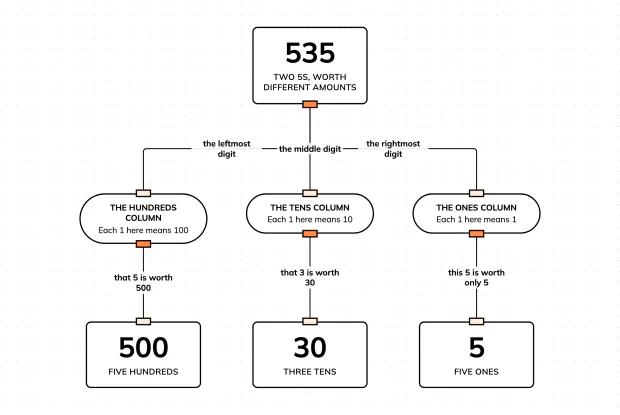
Evaluating one expression in the order the rule requires
Why Can One Sum Have Two Different Answers?
Give the expression 2 + 3 x 4 to two people and you can genuinely get two answers. One works left to right: 2 plus 3 is 5, times 4 is 20. The other multiplies first: 3 times 4 is 12, plus 2 is 14. Both did careful arithmetic. Both are confident. Only one of them matches what every calculator, spreadsheet and mathematician on the planet will tell you, which is 14.
The reason is not that one method is cleverer. It is that written maths is a language, and a language needs agreed grammar or the same sentence means different things to different readers. The order of operations is that grammar: a fixed sequence saying which parts of an expression get resolved before which. Brackets are dealt with first, then powers, then multiplication and division, and finally addition and subtraction.
You have probably met this as BODMAS, BIDMAS or PEMDAS depending on where you went to school. Those are three names for exactly the same rule, and the letters are a memory aid rather than an explanation — which is why the rule is so often half-remembered and misapplied. In the playground below you will take one expression and connect the stages of solving it in the order the rule actually requires.
How Does the Order of Operations Work?
What goes wrong without an agreed order?
Imagine a shop writing a receipt as 2 + 3 x 4 to mean two coffees at some price and three cakes at another. If the customer reads it left to right and the till reads it multiplication-first, they disagree about the bill, and neither has made an arithmetic mistake. That is the actual problem the rule solves: it removes ambiguity from notation. This matters more today than it ever did, because you are rarely the only thing reading your maths. A spreadsheet formula, a calculator, a piece of code and a colleague all have to agree on what you meant. The order of operations is what makes an expression mean one thing rather than several — it is a shared convention, in the same way that reading left to right is a convention for words.
What is the actual order?
The sequence is: brackets, then powers and roots, then multiplication and division, then addition and subtraction. Work through those four stages in order, and inside any single stage work from left to right. So in 2 + 3 x (8 - 6), the bracket goes first and gives 2 + 3 x 2; multiplication is next and gives 2 + 6; the addition finishes it at 8. Notice how much the notation was hiding — the answer is 8, whereas plodding left to right would have produced 4. That is a gap of exactly the kind that turns up in mismarked exams and broken spreadsheets, and it comes from skipping a stage rather than from bad arithmetic.
Do multiplication and division really take turns?
This is where the memory aids mislead people. BODMAS lists division before multiplication, and PEMDAS lists multiplication before division, which makes it look as though one outranks the other. Neither does — multiplication and division sit at the same rank, and you simply take them left to right as you meet them. Addition and subtraction are the same: equal rank, left to right. So 6 divided by 2 times 3 is 9, because you do the division first only because it comes first, not because division wins. Read that as an M-then-D rule and you would get 1, which is wrong. The safest way to hold the rule is as four stages rather than six letters.
What do brackets actually do?
Brackets are an override switch. They let the writer say 'ignore the usual order here and do this bit first', which is exactly why they come at the top of the sequence. In 2 + 3 x (8 - 6) the subtraction would normally happen last, and the brackets promote it to first. If there are brackets inside brackets, work from the innermost outwards, because the inner ones are the deepest override. One misconception worth clearing early: brackets do not mean multiply. It is true that 3(4) means three times four, and that is a separate shorthand where the multiplication sign has been left out. The brackets themselves are only about grouping and priority.
Real World Example
How Does One Missing Bracket Change a Bill?
Suppose you are splitting a holiday cost between friends and you write the calculation into a spreadsheet. The order of operations decides whether the answer is fair:
What you meant
The flat costs 300 and the flights cost 200, and four of you are splitting the total. So you want 300 plus 200 first, then divided by 4 — which is 500 divided by 4, or 125 each. That is a sensible answer and everybody pays the same.
What you typed
You type 300 + 200 / 4. The spreadsheet does not know your intention; it applies the rule. Division outranks addition, so it works out 200 divided by 4 first, gets 50, then adds 300. The answer comes back as 350, and it is not remotely close to what you wanted.
What fixes it
Brackets: (300 + 200) / 4. That promotes the addition to first place and gives 125. The lesson is not that spreadsheets are awkward — the spreadsheet followed the rule perfectly. The lesson is that when you want a different order, saying so with brackets is the only reliable way to be understood, whether the reader is software or a person.
FAQs
Final Words
The order of operations is grammar, not arithmetic. Brackets first, then powers, then multiplication and division taken left to right, then addition and subtraction taken left to right. Hold it as four stages rather than six letters and the trap that catches most people — assuming division outranks multiplication — disappears.
The habit the playground drilled is the one to keep: before calculating anything, look at the whole expression and decide which part is resolved first. That single pause is what separates 8 from 4, and it is the same pause that will keep your algebra honest later on.
Continue This Track
This concept is part 3 of Making Sense of Numbers.
What Are the Different Types of Numbers?
Counting numbers, integers, rationals and irrationals explained in plain words — then sort each number into its family yourself in an interactive playground.
Why Does a Digit's Position Change Its Value?
The same digit can be worth 5 or 500 depending on where it sits. Learn how columns decide a digit value, then build 535 down into its columns in an interactive playground.
Why Does the Order of Operations Matter?
Two people can get two different answers from the same sum unless they agree on an order. Learn the rule and build the steps yourself in an interactive playground.
What's the Difference Between a Factor and a Multiple?
Factors go into a number; multiples come out of it. Learn which direction each word points, then sort three numbers by how they relate to 12.