What's the Difference Between a Factor and a Multiple?
Root Concept
A factor divides into a number exactly; a multiple is what you get by multiplying that number. The two words describe one relationship from opposite ends.
CodePLU Goal
Upgrading Human Mental Models
Learn how to think in Workflows

Concept Development By codeplu.com
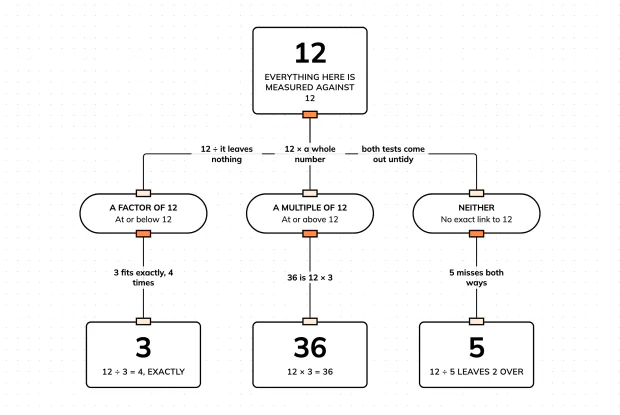
12 branches into the two relationships a number can have with it, and neither
Do Factors and Multiples Just Mean Big and Small?
Factors and multiples are two of the most commonly swapped words in early maths, and the reason is that most people learn them as a size rule: factors are the small ones, multiples are the big ones. That works often enough to feel true, and then quietly fails at exactly the moments when it matters.
The honest definitions have nothing to do with size — they are about direction. A factor of 12 is a number that divides into 12 exactly, leaving no remainder: 1, 2, 3, 4, 6 and 12. A multiple of 12 is a number you get by multiplying 12 by a whole number: 12, 24, 36, 48 and onwards forever. So factors go in and multiples come out. Same relationship, described from opposite ends — 3 is a factor of 12 and 12 is a multiple of 3 are two ways of stating one fact.
Once direction rather than size is the test, the awkward cases stop being awkward. Twelve is a factor of itself and also a multiple of itself, which the size rule cannot explain at all. In the playground below you will build 12 down into the two relationships a number can have with it — plus the case that fits neither.
How Do Factors and Multiples Differ?
What exactly is a factor?
A factor of a number divides into it with nothing left over. To find the factors of 12, try dividing by each number in turn and keep the ones that come out whole: 12 divided by 1, 2, 3, 4, 6 and 12 all work, while 5, 7, 8, 9, 10 and 11 leave remainders. So the factors of 12 are 1, 2, 3, 4, 6 and 12. A quicker way is to hunt in pairs, because factors always come in pairs that multiply to give your number: 1 and 12, 2 and 6, 3 and 4. Once the pairs start repeating you have them all. Note what the list includes: 1 is a factor of every number, and every number is a factor of itself. Both facts break the idea that factors have to be small.
What exactly is a multiple?
A multiple of a number is what you get when you multiply it by a whole number, which makes the multiples of a number simply its times table. The multiples of 12 are 12, 24, 36, 48, 60 and so on. Two things follow immediately. First, the list never ends, because you can always multiply by a bigger number — so while a number has a finite handful of factors, it has infinitely many multiples. Second, the list starts with the number itself, because 12 times 1 is 12. If you have ever recited a times table you have already listed multiples; the word is just the formal name for what was in the table.
Why do people mix the two words up?
Because the size shortcut works most of the time. Factors of 12 other than 12 itself are all smaller, and multiples of 12 other than 12 itself are all bigger, so 'small means factor' gets you the right answer often enough to become a habit. Then a question includes the number itself and the habit collapses, because 12 is both a factor and a multiple of 12. The fix is to stop asking which is bigger and start asking which direction the relationship runs: does this number go into that one, or does it come out of it? Divides into means factor. Comes out of means multiple. Direction is reliable where size is only usually right.
Real World Example
Where Do Factors and Multiples Turn Up Outside Maths Class?
These two words describe two genuinely different everyday questions, and noticing which question you are asking is the whole skill:
Factors — arranging 24 chairs
You have 24 chairs to set out in equal rows with none left over. Your options are exactly the factors of 24: 1 row of 24, 2 rows of 12, 3 rows of 8, 4 rows of 6, and the same pairs the other way round. You cannot do 5 rows, because 5 is not a factor of 24 and somebody ends up standing. Any 'split this evenly' question is a factors question.
Multiples — waiting for the bus
A bus leaves every 12 minutes starting on the hour. The departure times are the multiples of 12: 12, 24, 36, 48 and 60 minutes past. Turn up at 30 minutes past and you wait 6 minutes, because the next multiple is 36. Any 'happens repeatedly at a fixed step' question is a multiples question.
Both at once — two buses meeting
Now suppose a second bus leaves every 8 minutes. When do both leave together? You need a number that is a multiple of 12 and of 8 — the multiples of 12 are 12, 24, 36 and the multiples of 8 are 8, 16, 24, so they coincide at 24 minutes. That is the lowest common multiple, and it is the point where these two ideas start doing real work together.
FAQs
Final Words
Factors divide into a number; multiples come out of it. Drop the size shortcut and ask about direction instead, and the confusing cases stop being confusing — a number is both a factor and a multiple of itself, 1 is a factor of everything, and a number has a short list of factors but an endless supply of multiples.
These two ideas are the foundation of a surprising amount of what comes next. Simplifying a fraction is a highest-common-factor job, adding fractions with different denominators is a lowest-common-multiple job, and prime numbers are defined purely in terms of how few factors they have.
Continue This Track
This concept is part 4 of Making Sense of Numbers.
What Are the Different Types of Numbers?
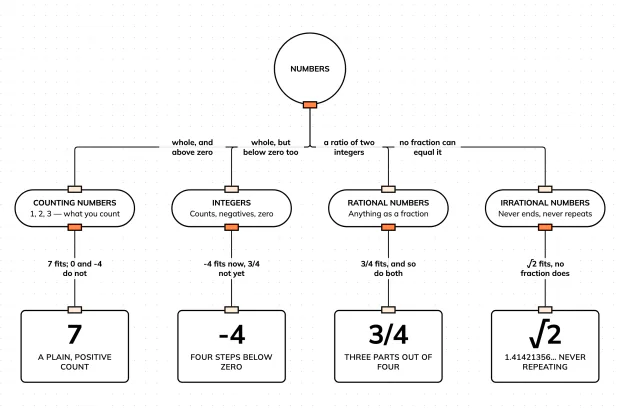
Counting numbers, integers, rationals and irrationals explained in plain words — then sort each number into its family yourself in an interactive playground.
Why Does a Digit's Position Change Its Value?
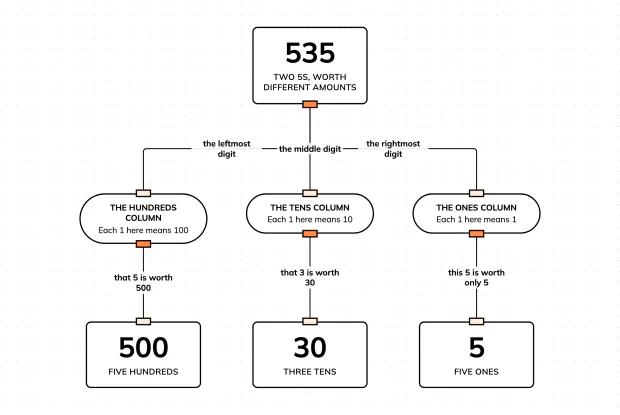
The same digit can be worth 5 or 500 depending on where it sits. Learn how columns decide a digit value, then build 535 down into its columns in an interactive playground.
Why Does the Order of Operations Matter?
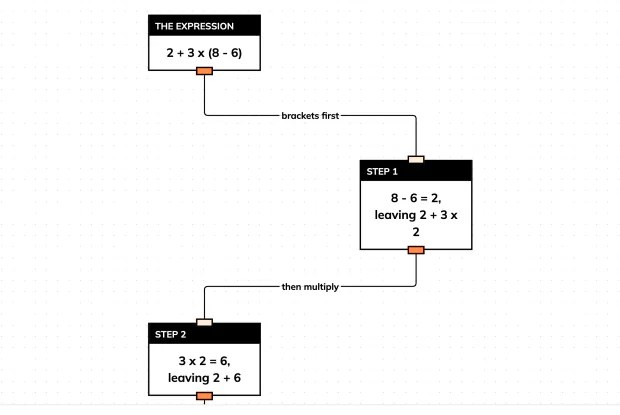
Two people can get two different answers from the same sum unless they agree on an order. Learn the rule and build the steps yourself in an interactive playground.
What's the Difference Between a Factor and a Multiple?
Factors go into a number; multiples come out of it. Learn which direction each word points, then sort three numbers by how they relate to 12.