What Are the Different Types of Numbers?
Root Concept
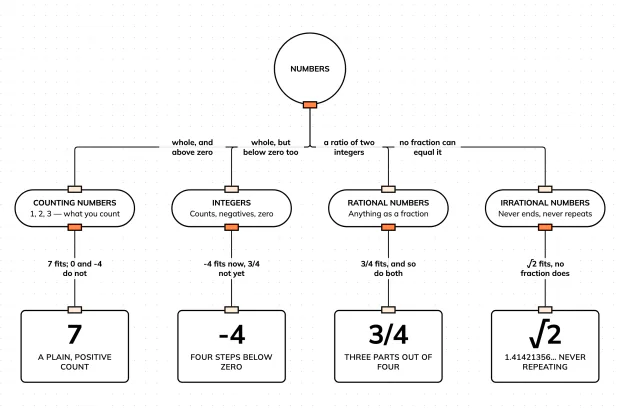
Numbers are grouped into nested families — counting numbers sit inside integers, integers sit inside rationals, and irrational numbers sit outside all of them.
CodePLU Goal
Upgrading Human Mental Models
Learn how to think in Workflows

Concept Development By codeplu.com
Sorting four everyday numbers into the number families they belong to
Why Do Numbers Come In Different Types?
You have been using several different kinds of number since you learned to count, without anyone pointing out that they were different. The 3 in 'three apples' and the 3 in '-3 degrees' and the 3 in '0.3 of a tank' all look like the same digit, but they behave in quite different ways. Mathematicians sort numbers into families so that rules can be stated once and trusted: some rules work for every number in a family, and break outside it.
There are four families worth knowing at the start. Counting numbers are what you point at things with: 1, 2, 3. Integers add the negatives and zero, so you can talk about a debt or a temperature below freezing. Rational numbers add everything you can write as a fraction, which covers halves, quarters and most decimals. Irrational numbers are the odd ones out — decimals that run on forever without ever settling into a pattern, and which no fraction can capture exactly.
Here is the part that trips people up, and it is worth knowing before anything else: these families are nested, like boxes inside boxes. The number 7 is a counting number, but it is also an integer and also a rational number, all at the same time. So the useful question is never just 'what type is this?' — it is 'what is the smallest family that still contains it?' That is exactly the question you will answer in the playground below.
What Are the Four Families of Numbers?
What are counting numbers, and where does zero fit?
Counting numbers are the ones you learned first: 1, 2, 3, 4 and onwards forever. They answer the question 'how many?', and every one of them is positive and whole. If you can point at a group of things and count them, the answer is a counting number — three chairs, twelve eggs, forty pages. Mathematicians also call these the natural numbers, which is just a fancier name for the same list. Now, the common trip-up: is zero a counting number? No. You never count a shelf of books by starting at zero, because zero is what you have when there is nothing to count. Zero is important enough to get its own name in a slightly bigger family — counting numbers plus zero are called the whole numbers. It is a small distinction, but it explains why zero keeps appearing in some definitions and not others.
Why do we need negative numbers at all?
Counting numbers run out the moment you need to describe something below a starting point. A bank balance of -50 means you owe fifty; a temperature of -4 means four degrees colder than freezing; floor -1 in a car park is one level below the ground. Put the counting numbers, their negatives, and zero together and you have the integers. Every integer is still a whole amount — no halves, no decimal tails — it just has a direction as well as a size. The misconception to drop here is that negative numbers are somehow 'less than nothing', which sounds like nonsense and puts people off. They are not a smaller amount of stuff; they are the same kind of amount pointing the other way. Owing five pounds and having five pounds are both real, definite quantities. The minus sign is a direction, not a flaw.
What makes a number rational?
A rational number is any number you can write as one whole number divided by another — a ratio, which is where the word comes from. Three quarters is 3/4. Half is 1/2. That immediately covers every fraction you have ever met, and it quietly covers a lot more besides. Every integer is rational too, because 7 can be written as 7/1. And most decimals are rational: 0.75 is just 3/4 wearing different clothes, and even 0.333... repeating forever is exactly 1/3. This is where people often go wrong, assuming that 'fractions' and 'decimals' are two separate families. They are not families at all — they are two ways of writing the same thing. The family is rational numbers, and fractions and decimals are both notations for members of it.
What is an irrational number, and why can't it be a fraction?
An irrational number is one whose decimal form goes on forever and never falls into a repeating pattern — and because of that, no fraction of two whole numbers can equal it exactly. The square root of 2 is the classic example: 1.41421356... and onwards, with no repeat ever appearing. Pi is the other famous one: 3.14159265... forever. The key word is exactly. You can get as close as you like with a fraction — 22/7 is close to pi, and people often write it as though the two were equal — but zoom in far enough and they always differ. That is the misconception worth clearing: 22/7 is an approximation, a useful one, not the real thing. Irrational numbers are the only family here that sits outside the others rather than inside them, which is why they are the interesting edge of the map.
Real World Example
How Many Families Show Up When You Measure a Room?
Imagine you are working out how much it costs to redecorate a square room. Nothing here is advanced maths, but every family of number turns up in the space of an hour:
Counting numbers — how many of each thing
You walk in and start counting: 4 walls, 2 windows, 1 door, 6 tins of paint on the shelf. Every one of these answers 'how many?' and every one is a plain positive whole number. This is the family that needs no explanation, because it is the one everybody starts with.
Integers — when direction matters
You check the forecast, because the paint will not dry properly in the cold: it says -3 degrees overnight. You also note that the floor is 1 level below the street, so the delivery will be a floor of -1. The minus sign is doing real work here — it is telling you which side of a starting point you are on, not describing a broken number.
Rational numbers — parts of things
Almost nothing in a real room is a whole number. The wall is 3.5 metres wide. You have 3/4 of a tin of paint left over from last time. The shelf needs to sit 2.25 metres up. Every one of these can be written as a fraction of two whole numbers, so they are all rational — whether you happen to write them as a fraction or a decimal.
Irrational numbers — the diagonal nobody expects
Then you decide to run a cable corner to corner across the square floor. For a square, the diagonal is always the side length multiplied by the square root of 2 — an irrational number. So a perfectly ordinary 3-metre square room has a diagonal of about 4.243 metres, and no fraction will ever give you that length exactly. You will cut the cable to a rounded measurement, which is precisely what everyone does with an irrational number in real life: approximate it, deliberately, and know that you have.
FAQs
Final Words
You now have the map that most number rules quietly assume you already own. Counting numbers answer 'how many?'. Integers add direction, so debts and cold mornings can be described. Rational numbers add parts of things, and cover every fraction and every decimal that stops or repeats. Irrational numbers are the outsiders — endless, non-repeating, and impossible to write as a fraction no matter how hard you try.
The habit worth taking away is the one the playground drilled: when you meet a number, ask what the smallest family containing it is. That single question tells you what you are allowed to do with it — which is why the next concept, place value, makes far more sense once you know what kind of number you are looking at in the first place.
Continue This Track
This concept is part 1 of Making Sense of Numbers.
What Are the Different Types of Numbers?
Counting numbers, integers, rationals and irrationals explained in plain words — then sort each number into its family yourself in an interactive playground.
Why Does a Digit's Position Change Its Value?
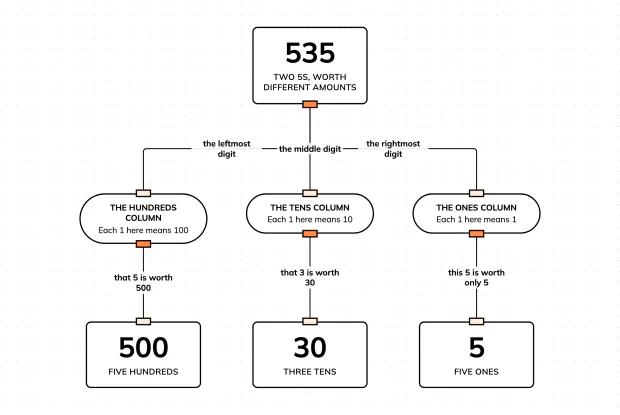
The same digit can be worth 5 or 500 depending on where it sits. Learn how columns decide a digit value, then build 535 down into its columns in an interactive playground.
Why Does the Order of Operations Matter?
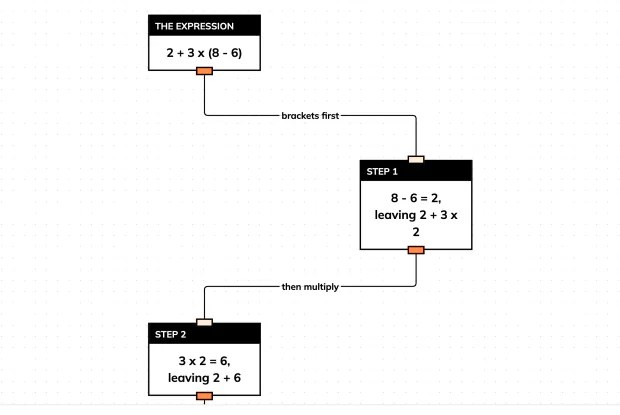
Two people can get two different answers from the same sum unless they agree on an order. Learn the rule and build the steps yourself in an interactive playground.
What's the Difference Between a Factor and a Multiple?
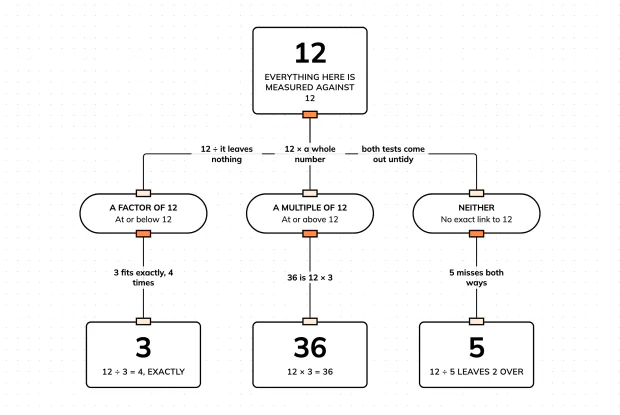
Factors go into a number; multiples come out of it. Learn which direction each word points, then sort three numbers by how they relate to 12.